
In This Guide
- Identify what supply readiness means on this machine
- Record the state before it changes again
- Link the event to bottles and product supply
- Use a readiness-event record
- Separate acknowledgement from correction
- Verify recovery and improve the event record
- Customer Questions
- Product References
- Discuss Your Requirement
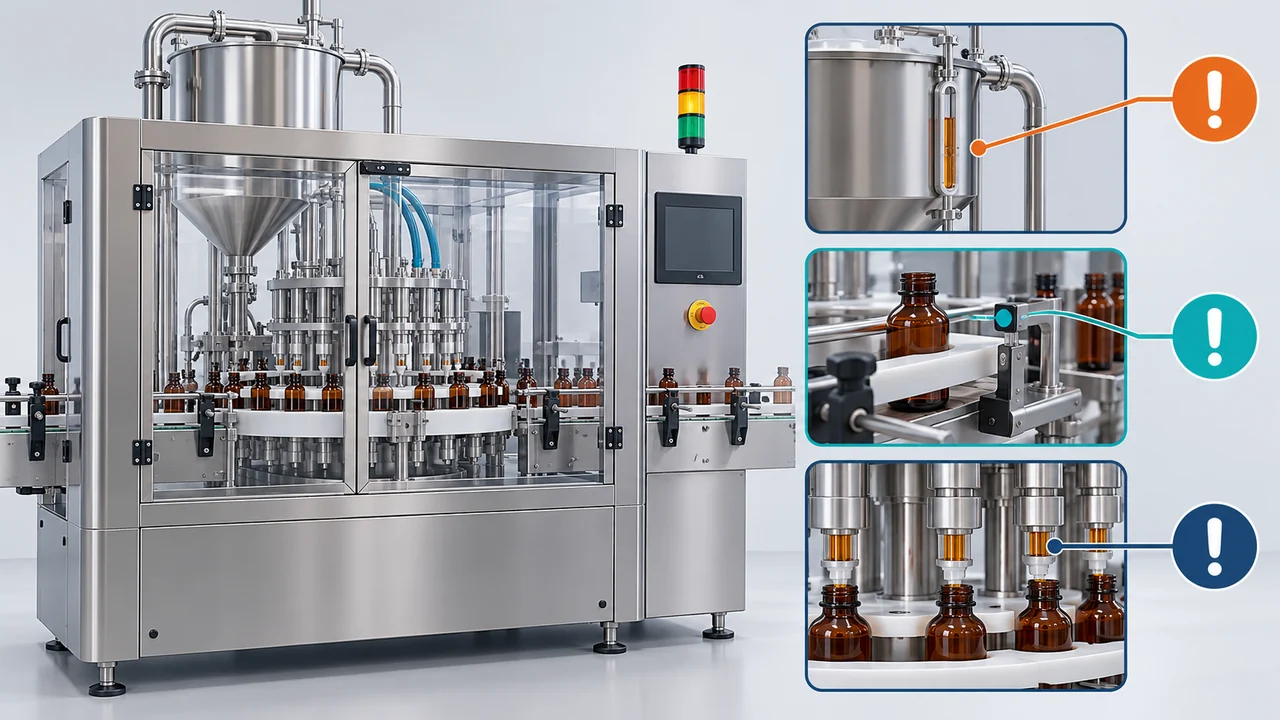
A syrup filler can stop or inhibit a cycle when a selected readiness condition changes. Resetting the displayed message without recording the surrounding state can remove useful evidence from an investigation. The operator’s event note should connect the message to the product supply and bottle sequence, while preserving the approved response procedure.
Follow the required safe response first, then record the displayed message, supply indication, machine phase and affected bottles before an authorized reset where practical. Identify the actual ordered signal and its meaning. Do not invent alarm codes, assume automatic logging or infer the cause from a message title alone.
Identify what supply readiness means on this machine
Ask the supplier which product-supply conditions the installed controller actually monitors and how they affect operation. A readiness input may come from another piece of equipment or a selected instrument. The signal list should define its source and meaning rather than relying on an informal label.
The H M syrup page contains separate volumetric and servo gear pump references. Confirm the supplied arrangement before discussing its controls. A message seen on one reference or another installation is not evidence that the same alarm or response exists here.
Record the state before it changes again
Capture the exact displayed wording or permitted screenshot, the event time and whether the machine was waiting, filling, transferring or already stopped. Record the product-supply indication visible at the same point. Use the ordinary safe operator view with guards active.
Do not delay an emergency action or required protective response to complete a note. Once the situation is controlled, document what is known and identify missing evidence honestly. An incomplete observation is preferable to an invented reconstruction of the controller state.
Link the event to bottles and product supply
Identify the syrup batch, active format and recent supply activity, such as replenishment or a planned stop. Record which bottles were at the filling station and how affected product was segregated under the site procedure. Include individual head identity when relevant.
Separate observed supply information from assumptions. A low-level indication, a connection to an upstream unit and an operator statement that product was available are different evidence items. Preserve their sources so the controls and process owners can interpret them together.
Use a readiness-event record
| Field | Useful entry |
|---|---|
| Message | Exact displayed wording and permitted event reference |
| Signal source | Ordered input or instrument identified by documentation |
| Cycle state | Waiting, dosing, transfer or stopped as actually observed |
| Supply event | Refill, pause or other known change with timing |
| Product status | Affected bottles and approved disposition |
| Response | Authorized action, reset and subsequent result |
Keep unknown fields marked unknown. An event sheet should clarify the investigation rather than turning a likely explanation into a recorded fact.
Separate acknowledgement from correction
Ask what acknowledgement or reset does in the supplied control sequence. Clearing a display does not necessarily restore the physical readiness condition, and a restored condition does not automatically release affected product. Follow the approved recovery procedure.
Do not bypass an input, bridge a sensor or repeatedly reset a recurring event to maintain production. Escalate unexplained or repeated messages with the event record. Physical supply inspection and controls work require the appropriate authorized procedures.
Verify recovery and improve the event record
After the approved response, record whether readiness returns and which sequence the machine follows. Keep the first-off checks and product release separate from the act of resetting. Preserve any repeat event with its own time and state instead of overwriting the original note.
Confirm whether the supplied controller stores an alarm history and how it is retrieved, if that capability exists. Manual records remain useful where automatic logging is absent or incomplete. Send the supplier the exact message, signal identity and cycle timeline for a focused review.
Customer Questions
Does a supply alarm title prove the root cause?
No. It identifies a reported condition in the selected controls. Review the signal definition and surrounding evidence before diagnosing the physical cause.
Does reset mean the affected bottles are acceptable?
No. Follow the approved product segregation, first-off verification and release procedure separately.
Should every syrup filler be assumed to store alarm history?
No. Confirm the actual controller capability and retrieval method. Use an approved manual record when appropriate.
Product References and Further Details
These pages describe published equipment arrangements. Review the supplied machine, actual materials and agreed operating requirements when applying the guide.
Discuss Your Machine Requirement
Share your product, container or closure samples, required output, process conditions and line layout with H M Pharma Machines for a technical review.
Request a Technical Review