
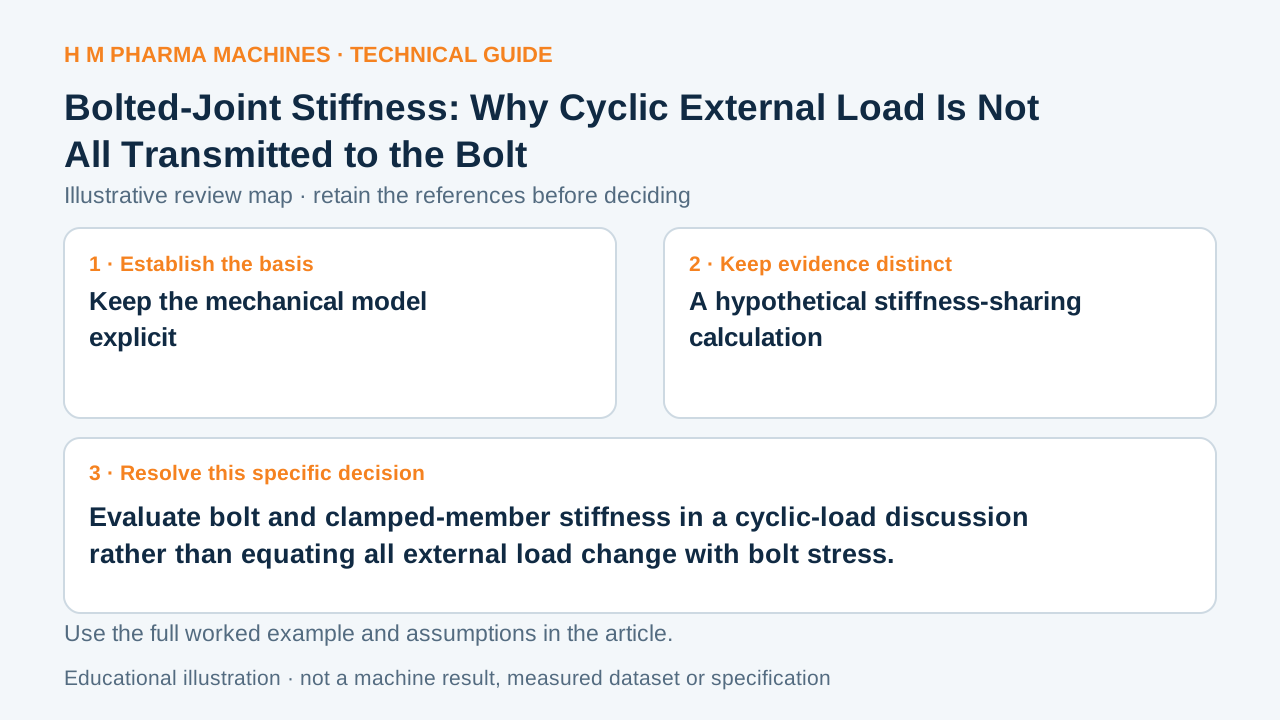
A changing external load and a changing bolt load need not have equal amplitudes. State the assumed joint model before calculating fatigue inputs.
Keep the mechanical model explicit
NASA's Fastener Design Manual addresses preloaded joints and fatigue considerations. Its general mechanical discussion is not a product qualification for a particular machine. Primary reference: NASA Fastener Design Manual.
In a simplified elastic, nonseparating joint model, the fraction of an external tensile-load increment entering the bolt can be represented by bolt stiffness divided by bolt-plus-member stiffness. State those assumptions and the actual load-introduction basis; the expression should not be applied indiscriminately to every joint geometry.
A hypothetical stiffness-sharing calculation
Assume a fictional model with bolt stiffness 20 in a consistent stiffness unit and member stiffness 80 in the same unit. The modeled fraction is 20/(20 + 80) = 0.2. A stated 500 N external-load increment then gives a modeled 100 N bolt-load increment under the assumptions. It is not automatically a 500 N bolt-load change.
Record stiffness sources, model assumptions, external cycle and derived bolt cycle separately. These invented values identify no HM joint and establish no fatigue life, preload or safety factor. Separation or other omitted effects can invalidate the simplified model.
Use the result as an input, not a verdict
A cyclic-stress assessment still needs the actual bolt geometry, initial state, material and relevant application evidence. Keep the modeled load change distinguishable from an observed strain or force record.
When the clamped members or load path change, revisit the stiffness and model rather than preserving an earlier load fraction by default. The worksheet helps a buyer understand why a fatigue review needs the assembled joint, not only the maximum external force. It provides a conditional calculation example without claiming a universal fatigue improvement or complete joint qualification.
Customer Questions
Does every external load increment enter the bolt unchanged?
Not in the stated simplified sharing model; the actual arrangement requires its appropriate assessment.
Does the 0.2 example apply to every joint?
No. It follows only from the invented stiffnesses and stated assumptions.
Does a smaller modeled increment establish fatigue life?
No. The complete stress, material, geometry and duty assessment remains necessary.
Primary References
These references support the technical principles discussed in this guide. The worked examples and review questions are educational.
Discuss Your Machine Requirement
Share your product, container, required output and the evidence needed for your technical review.
Request a Technical Review