
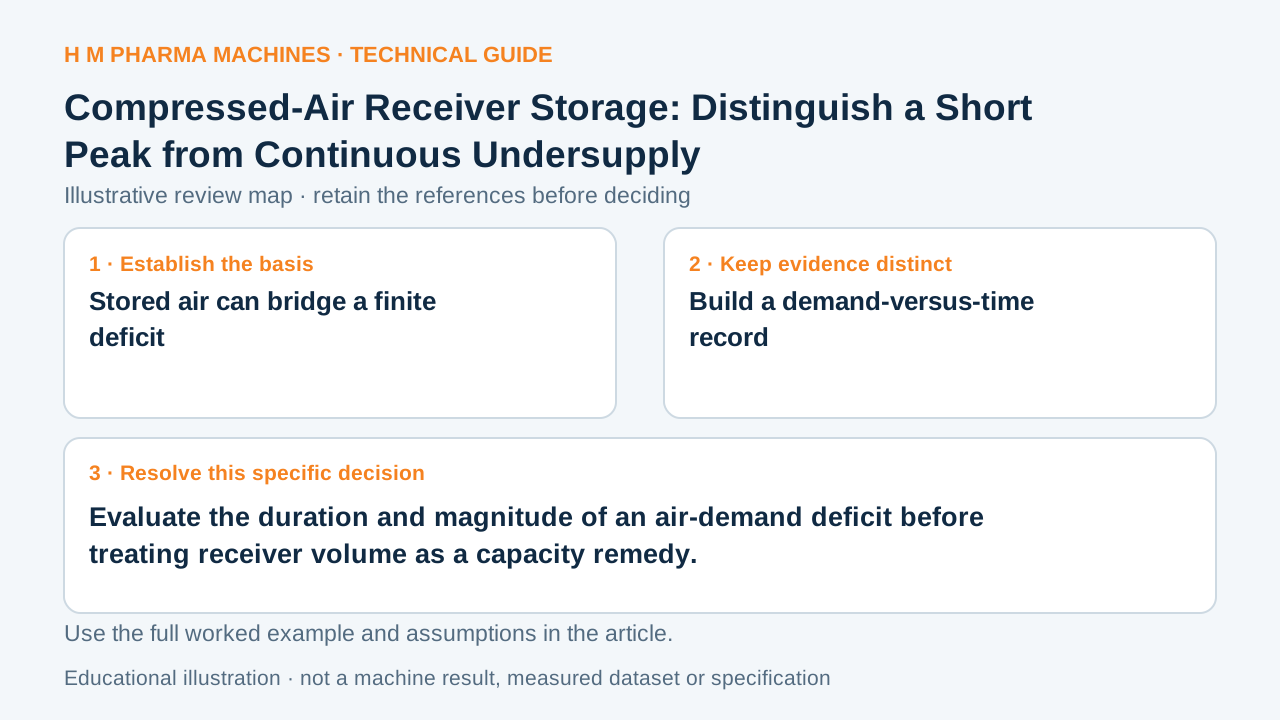
Evaluate the duration and magnitude of an air-demand deficit before treating receiver volume as a capacity remedy.
Stored air can bridge a finite deficit
A receiver can support temporary demand above the air supplied to a system. The US Department of Energy's storage guidance treats storage as part of pressure and demand management. Storage does not create a continuing source of air: if demand remains above supply, a finite reserve is eventually depleted. A useful review therefore asks how large the deficit is, how long it lasts and how the reserve can recover between peaks.
US DOE: compressed air storage strategies supports the technical principle above.
Build a demand-versus-time record
Record the demand interval, air-flow basis, supply available during that interval, permitted pressure band and recovery time. Put different operating modes in separate rows instead of averaging away a short high-demand event. Check that demand and supply values share the same reference conditions. Identify the location of storage and the components between it and the point of use, because pressure losses and flow restrictions may affect the intended result.
The worksheet is an input to an engineered storage design, not a vessel drawing. Receiver selection and installation also need their applicable pressure-vessel requirements and the responsible designer's assessment. Do not assign a volume from a generic litres-per-compressor rule while leaving pressure range or demand duration undefined.
Hypothetical deficit calculation
Imagine a fictional operation requiring 600 reference L/min for 10 seconds while only 300 reference L/min is available for that operation during the peak. The reference-air deficit is (600 − 300) × 10/60 = 50 reference litres. If the same deficit lasts 60 seconds, it becomes 300 reference litres. These are quantities of missing reference air, not receiver volumes: converting to vessel volume requires an appropriate pressure and temperature model. Add a separate recovery row and ask whether sufficient surplus supply exists before the next event. These invented numbers describe no HM cycle and do not certify a storage solution.
Check whether the proposed remedy matches the pattern
If the demand record shows brief peaks and adequate recovery, storage may be part of a solution. If it shows sustained undersupply, investigate capacity, distribution and demand together. Compare the promised outcome against the original demand trace rather than against a larger receiver nameplate alone. When discussing pneumatic machinery, provide peak durations and simultaneous plant demand where available. The guide's distinct output is a pressure-and-time question for the utility designer; it makes no guaranteed pressure improvement, installation instruction or universal sizing recommendation.
Customer Questions
Can a bigger receiver fix indefinite undersupply?
No. A finite reserve cannot support a permanent demand excess without replenishment.
Is the calculated reference-air deficit the receiver volume?
No. It is an air quantity; vessel sizing also depends on pressure, temperature and design conditions.
Why record recovery time?
Storage must be replenished sufficiently before the next demand peak to provide the intended support.
Related Equipment References
Review the actual offered equipment and application separately from this educational example.
Primary References
These references support the technical principles discussed in this guide. The worked examples and review questions are educational.
Discuss Your Machine Requirement
Share your product, container, required output and the evidence needed for your technical review.
Request a Technical Review