
In This Guide
Part of Utilities, Installation & Line Planning.
A utility connection requirement tells the site what supply the machine needs. A consumption record tells the buyer what was used over a stated period and equipment boundary. Keep both records, then connect operating-mode data to the actual production schedule.
1. Separate supply capacity, power and energy
Retain the approved electrical and other utility connection requirements for installation. Do not replace them with an average consumption estimate. Conversely, multiplying a quoted connected load by shift hours does not establish actual energy use.
kW describes power; kWh describes energy over time. With a representative average power in kW and duration in hours, energy for that interval is average kW × hours. An accumulated meter reading difference can provide the interval energy directly; do not multiply an already accumulated kWh value by hours again. See the US Energy Information Administration's explanation of these units.
Identify whether each input is a connection requirement, supplier estimate, measured interval or buyer planning assumption. A label such as “measured” should include the record, method and conditions that support it.
2. Build a mode schedule without overlapping time
Use the modes relevant to the actual equipment: startup, productive running, replenishment, idle or the approved cleaning sequence. Include the associated product, format and configuration. Choose one consistent boundary, and identify any intervals still missing from the schedule.
| Mode | Duration (h) | Assumed average power (kW) | Calculated energy (kWh) |
|---|---|---|---|
| Startup | 0.5 | 6.0 | 3.0 |
| Production | 5.0 | 4.0 | 20.0 |
| Idle / waiting | 1.5 | 1.0 | 1.5 |
| Cleaning | 1.0 | 3.0 | 3.0 |
| Total | 8.0 | Do not add the mode powers | 27.5 |
The example totals 27.5 kWh across eight hours. It says nothing about the required supply capacity or an actual machine's demand. Replace the assumed averages and durations with applicable evidence. If power varies within a mode, use its representative interval result rather than one convenient instantaneous reading.
3. Draw the measurement boundary before adding totals
List the machine, pumps, heaters, conveyors and external services included at each measurement point. Record whether an auxiliary is already inside a machine or line total. Shared plant equipment needs a documented allocation method before part of its use is attributed to one machine.
| Record | Invented result | Boundary |
|---|---|---|
| Whole selected line | 40 kWh | Includes the selected filler and its shared transfer pump. |
| Filler submeter | 12 kWh | Already inside the 40 kWh line total. |
| Transfer-pump submeter | 3 kWh | Already inside the 40 kWh line total. |
Adding 40 + 12 + 3 produces a double-counted 55 kWh. For this invented boundary, the total remains 40 kWh; the submeters describe portions of it. These figures belong to a separate example and must not be added to the 27.5 kWh mode example above.
For water or compressed air, preserve the supplier's units, reference conditions, rate or accumulated-volume basis, time interval and included streams. Do not transfer the electrical example to a differently defined quantity or combine water grades into an unexplained total.
4. Keep a record that another reviewer can reproduce
| Field | Required context |
|---|---|
| Identity | Machine/configuration, utility, product/format and operating mode. |
| Status | Requirement, estimate, measured result or schedule assumption; source and revision. |
| Quantity | Value, unit, rate versus accumulated amount, and applicable reference conditions. |
| Interval | Start/end or duration, production counts if relevant, and stops included. |
| Boundary | Meter/measurement point, included auxiliaries, exclusions and overlapping records. |
| Decision | Calculation or use proposed, open evidence, responsible reviewer and review date. |
Keep original readings or supplier documents with the calculation. Record exclusions explicitly, including off-shift use if it lies outside the assessed period. Review installation requirements using the separate utility connection checklist.
5. Revisit assumptions when the schedule changes
A change in product mix, cleaning frequency, batch count or waiting time changes the planning basis. Update the affected modes instead of scaling every utility by the production count. Compare candidates over equivalent time, duty and boundaries, and identify the installed evidence still needed.
An energy estimate alone does not establish a bill, payback or environmental saving. Keep any tariff, demand charge, shared-service allocation and lifecycle assumptions separate. For line timing, use the bottleneck and output record; for offer scope, use the quotation comparison guide.
Buyer questions
Can connection capacity be reused as daily consumption?
No. Supply capacity and actual use answer different questions. Consumption needs an applicable operating pattern, quantity basis and equipment boundary.
Can machine and line energy totals be added?
Only after checking boundaries. If a machine's energy is already included in the line total for the same interval, adding it again double counts that use.
Do these example numbers describe HM machines?
No. Both numerical examples are invented to explain the calculation and boundary checks. Actual project values need identified supplier or measurement evidence.
Continue the utility review
Browse the utilities, installation and line-planning hub. Keep connection approval, consumption evidence and commercial assumptions as distinct review records.
Related machine reference
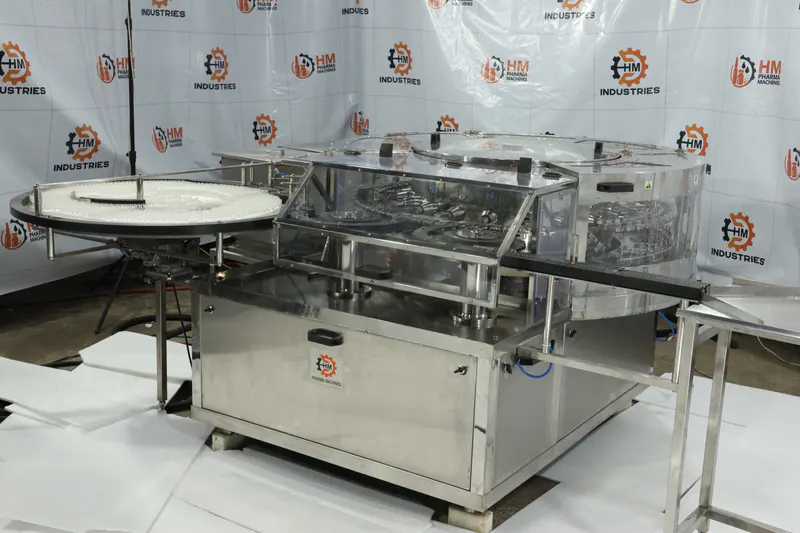
The rotary gripper bottle washer is an equipment reference for discussing utility interfaces. Its published arrangement does not supply the hypothetical consumption values used above.
Discuss Your Machine Requirement
Share the machine duty, actual samples, required result and relevant site information with H M Pharma Machines for a technical review.
Request a Technical Review