
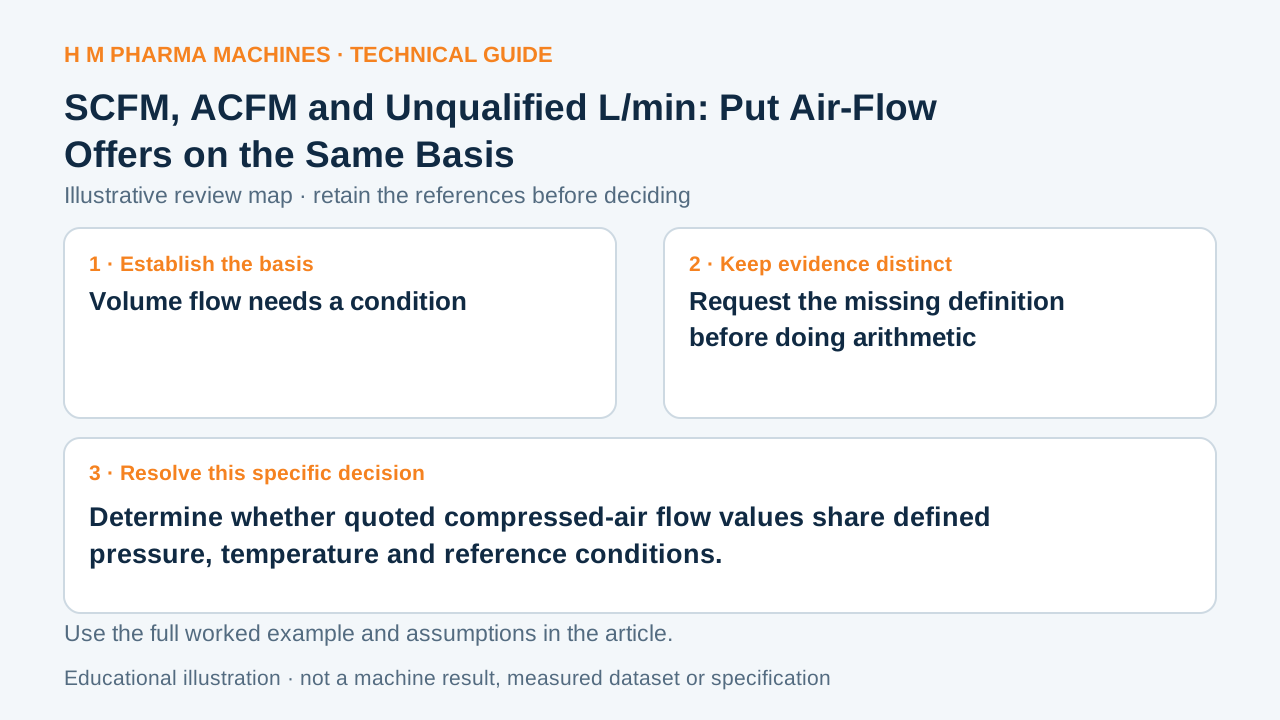
Determine whether quoted compressed-air flow values share defined pressure, temperature and reference conditions.
Volume flow needs a condition
A gas volume depends on pressure and temperature. Compressed-air references distinguish actual flow from flow expressed at stated reference conditions. Natural Resources Canada's compressed-air guide provides this terminology in a system-performance context. A bare figure such as 200 L/min is therefore incomplete for a comparison. Before using it to judge a compressor, dryer or machine utility requirement, establish what volume basis the figure represents and where the pressure and temperature apply.
Natural Resources Canada: compressed-air energy-efficiency reference guide supports the technical principle above.
Request the missing definition before doing arithmetic
Create RFQ columns for value, units, actual or reference basis, reference pressure, reference temperature, humidity convention and location. Record whether pressure is gauge or absolute. Preserve the supplier's definition of standard or normal rather than assuming the word has one universal numerical meaning. If the location is the machine inlet, state whether the figure concerns average demand, peak demand or a rated operating condition.
Use a conversion only after both bases are known and the assumptions are suitable. Ideal-gas reasoning can illustrate pressure and temperature effects, but real equipment ratings may also specify moisture and measurement conventions. Do not manufacture an equivalence from two incomplete labels merely to finish a purchasing table.
Hypothetical volume comparison
In a deliberately simplified teaching exercise, compare 100 L/min of dry air at 2 bar absolute with the equivalent volume at 1 bar absolute, at the same temperature. Under an ideal-gas approximation, conserved mass gives approximately 200 L/min at the lower pressure. This is not a compressor performance calculation. Now consider two fictional RFQs: A states 200 reference L/min with complete conditions; B states 100 L/min but omits the pressure basis. B cannot be declared smaller or more efficient. Add an unresolved-condition flag and ask for its definition. No example value here is an HM air-consumption specification.
Use a coherent utility schedule
Once definitions are supplied, retain the original ratings and the normalized comparison together, including conversion assumptions. A utility schedule should distinguish machine demand from plant distribution capacity and the pressure needed at the point of use. That helps prevent a later installer from interpreting a normalized flow as an actual line volume. When discussing air-jet cleaning or a pneumatic function in a new project, supply the complete plant-air basis and ask for the machine's defined requirement. This guide clarifies the language of the comparison; it selects no compressor or pipe size.
Customer Questions
Is L/min alone enough to compare compressed-air demand?
No. The actual or reference volume basis and conditions must be known.
Can gauge pressure be used as absolute pressure?
No. They have different reference points; the conversion must use the required pressure definition.
Does reference flow specify the pipe's actual volume flow?
Not by itself. Actual flow depends on the conditions at the relevant location.
Related Equipment References
Review the actual offered equipment and application separately from this educational example.
Primary References
These references support the technical principles discussed in this guide. The worked examples and review questions are educational.
Discuss Your Machine Requirement
Share your product, container, required output and the evidence needed for your technical review.
Request a Technical Review