
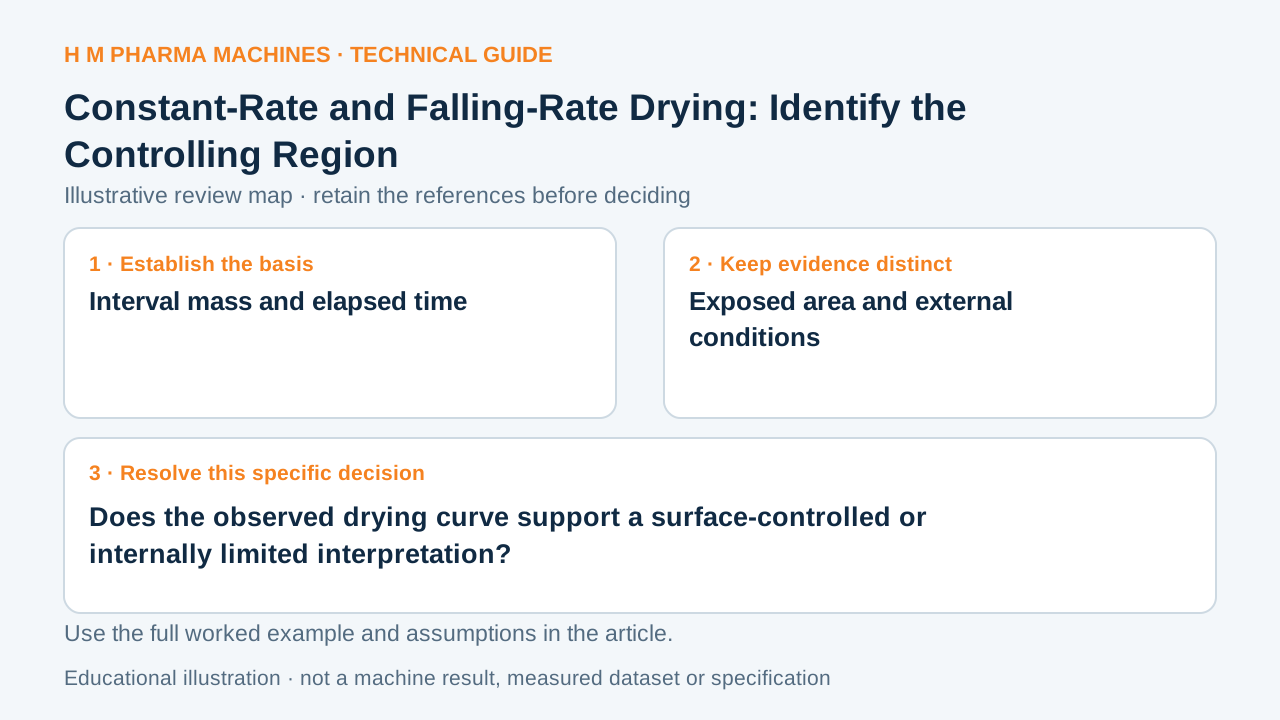
Compare water-removal rate by interval under controlled conditions before extending a constant-rate model into a later drying period.
Identify the Material Response
NPTEL distinguishes a constant-rate drying period from a falling-rate period after the critical moisture condition. The rate history belongs to the identified drying conditions and material state. Primary reference: drying-rate periods.
Review a Hypothetical Comparison
An invented area-held-constant drying record loses 10 g during one 5-minute interval, then 5 g during a later 5-minute interval. The corresponding average mass-removal rates are 2 and 1 g/min. Applying the first rate to every remaining minute would erase the observed change; these two intervals alone do not locate the full transition.
Keep the Evidence with the Decision
Keep airflow, temperature, exposed area and sample preparation beside interval mass changes. Distinguish mass removal from a percentage whose denominator may change. Retain the complete curve and the method used to identify a region, including intervals during which an external condition changed. A falling rate should not automatically be attributed to a different dryer setting.
No universal critical moisture or completion time follows from the fictional data. The remaining process may involve changing transport resistance, shrinkage or other effects that need the actual material evidence. Use the measured rate history to decide whether a proposed extrapolation is defensible. This guide does not prescribe a drying cycle, formulation limit or HM production throughput.
Does the observed drying curve support a surface-controlled or internally limited interpretation?
This blank worksheet is for your own project. It contains no H M machine trial result.
| Review field | Reference or result | Responsible person |
|---|---|---|
| Interval mass and elapsed time | To complete | To complete |
| Exposed area and external conditions | To complete | To complete |
| Region/transition identification basis | To complete | To complete |
| Extrapolation boundary and endpoint | To complete | To complete |
Customer Questions
What rates do 10 g and 5 g over 5 minutes give?
2 and 1 g/min respectively.
Do two intervals locate a complete critical-moisture point?
No. Retain the full region evidence.
Can the first rate be extended indefinitely?
Not when the observed rate changes.
Primary References
These references support the technical principles discussed in this guide. The worked examples and review questions are educational.
Discuss Your Machine Requirement
Share your product, container, required output and the evidence needed for your technical review.
Request a Technical Review