
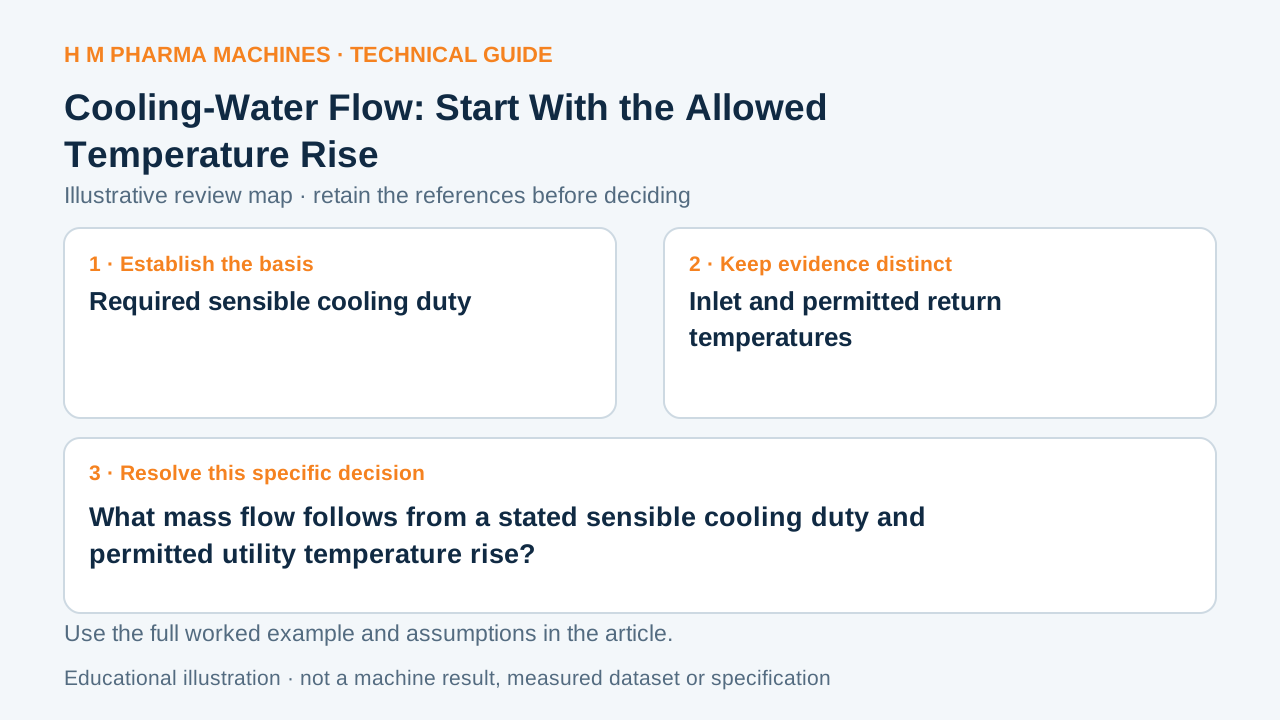
A permitted cooling-water temperature rise is a mass-flow input. Pair it with duty before choosing a nominal water rate.
Define the Thermal Model
For single-phase sensible cooling with nearly constant properties, P = ṁ cₚ(T_out − T_in). Alfa Laval’s calculation method relates heat load to mass flow and temperature change. The resulting utility flow does not by itself show whether the exchanger can reach the process outlet temperature.
Compare a Hypothetical Case
For an invented 40 kW duty and cₚ = 4 kJ/(kg·K), allowing the utility to warm by 5 K requires 2 kg/s. Allowing 10 K gives 1 kg/s in the same energy model. Converting either result to litres per minute also needs the utility density; a mass-flow result should not silently become a volume-flow specification.
Complete the Engineering Review
Record the warmest expected inlet and permitted return temperature. Keep utility temperature rise distinct from the hot-to-cold terminal approach. Ask the supplier to check area, flow distribution and pressure drop at the calculated rate. If a site return-temperature limit changes, revise the flow basis rather than leaving a rounded legacy litres-per-minute value.
For a manufacturing-vessel cooling discussion, provide actual utility data and the required product duty. The example is not an HM cooling-water specification. A balanced sensible-energy calculation cannot establish a phase-changing utility or an achievable process endpoint without a suitable transfer model.
What mass flow follows from a stated sensible cooling duty and permitted utility temperature rise?
This blank worksheet is for your own project. It contains no H M machine trial result.
| Review field | Reference or result | Responsible person |
|---|---|---|
| Required sensible cooling duty | To complete | To complete |
| Inlet and permitted return temperatures | To complete | To complete |
| Mass flow and density for volume conversion | To complete | To complete |
| Separate approach and hydraulic checks | To complete | To complete |
Customer Questions
Is utility rise the exchanger approach?
They compare different temperature pairs.
Can kg/s be read directly as L/s?
Use the actual density.
Does balanced duty prove the target outlet?
Transfer capability must also be checked.
Related Equipment References
Review the actual offered equipment and application separately from this educational example.
Primary References
These references support the technical principles discussed in this guide. The worked examples and review questions are educational.
Discuss Your Machine Requirement
Share your product, container, required output and the evidence needed for your technical review.
Request a Technical Review