
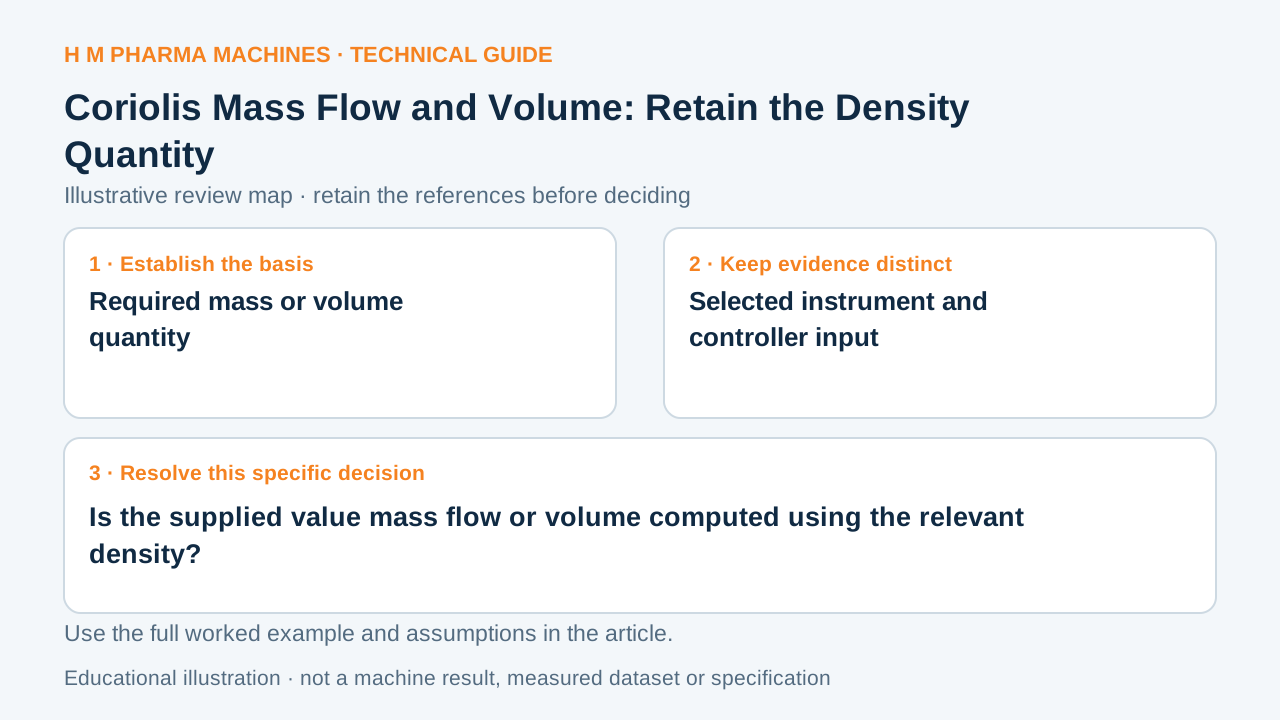
A Coriolis instrument can measure mass flow and density, then calculate volume. Identify which quantity the dosing decision actually uses.
Identify the Physical Basis
The Coriolis measuring principle obtains mass flow from the behaviour of vibrating tubes; density is another measured quantity used to derive volume. Endress+Hauser’s principle explanation distinguishes primary measured variables from secondary calculated outputs. For a defined homogeneous liquid, Q_V = Q_m/ρ. A litre output therefore has a density basis even when mass flow is directly measured.
Work Through an Example
Take a hypothetical mass rate of 1.2 kg/min. At a representative density of 0.8 kg/L, the corresponding volume rate is 1.5 L/min. At 1.0 kg/L it is 1.2 L/min. The identical mass rate does not imply identical liquid volume. These values are an arithmetic illustration; they do not report the performance, fitted measuring principle or product density of an HM filler.
Use the Result in the Review
Record whether the requirement is mass, process-condition volume or a reference-condition volume. Ask which output the selected controller reads and whether its density value is measured, entered or modeled. Align the density with the flowing product and temperature, particularly when comparing a sample measurement with a time-varying stream. Keep mass and volume totals separately labelled in a review record instead of calling both simply quantity.
For the flowmeter filler, request the selected instrument identity and dosing basis before applying this principle. Gas inclusion or multiphase conditions require an instrument-specific assessment. A mass-to-volume calculation alone does not demonstrate delivered fill accuracy or establish an installed Coriolis option.
Is the supplied value mass flow or volume computed using the relevant density?
This blank worksheet is for your own project. It contains no H M machine trial result.
| Review field | Reference or result | Responsible person |
|---|---|---|
| Required mass or volume quantity | To complete | To complete |
| Selected instrument and controller input | To complete | To complete |
| Density origin and fluid condition | To complete | To complete |
| Separately labelled rate and total units | To complete | To complete |
Customer Questions
Does calculated volume use density?
Yes, even when mass flow is measured directly.
Are kg/min and L/min interchangeable?
No. Define and justify the conversion.
Does the HM page identify Coriolis?
No. Confirm the selected instrument.
Related Equipment References
Review the actual offered equipment and application separately from this educational example.
Primary References
These references support the technical principles discussed in this guide. The worked examples and review questions are educational.
Discuss Your Machine Requirement
Share your product, container, required output and the evidence needed for your technical review.
Request a Technical Review