
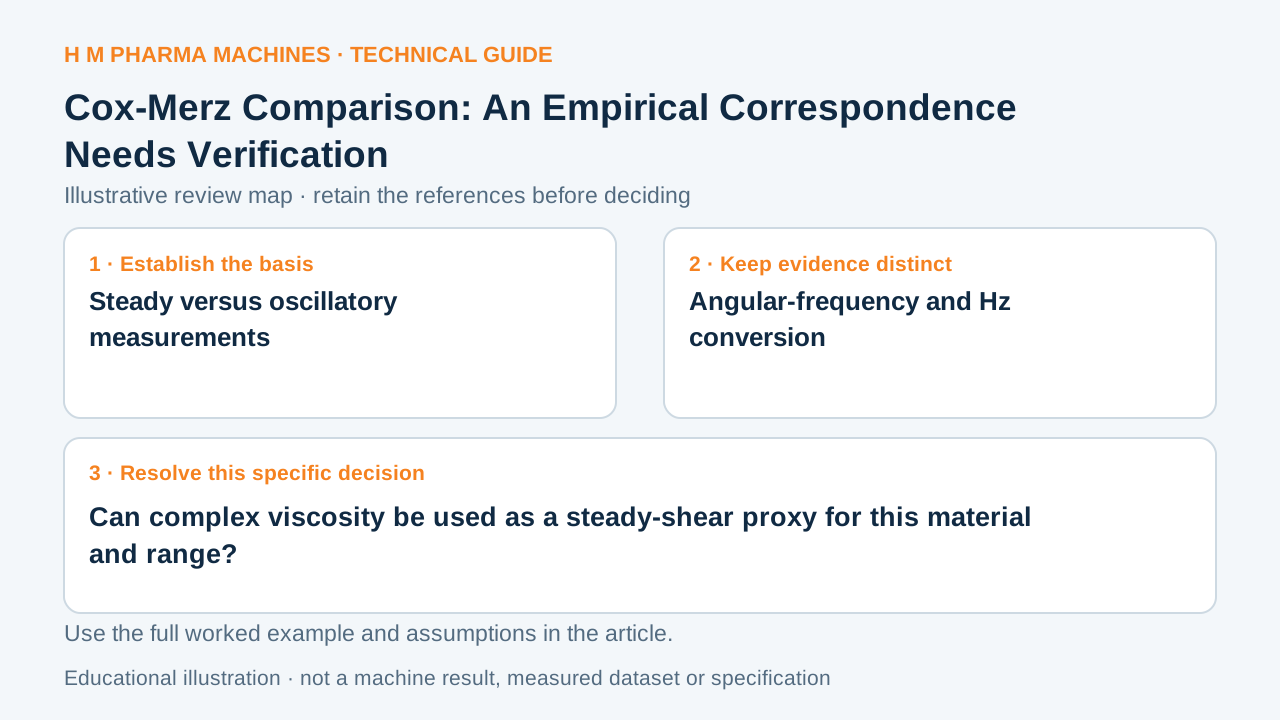
Verify an empirical correspondence before replacing a measured steady-shear curve with complex viscosity from an oscillatory test.
Identify the Deformation and Model
NETZSCH describes the Cox-Merz comparison as an empirical relationship between steady-shear viscosity and complex-viscosity magnitude at numerically corresponding shear rate and angular frequency. It must be assessed for the material and range. Primary reference: Cox-Merz comparison.
Review a Hypothetical Comparison
In a fictional oscillatory result, modulus magnitude 200 Pa at angular frequency 10 rad/s gives complex-viscosity magnitude 20 Pa·s. The corresponding steady comparison is at shear rate 10 per second. Separately, a frequency reported as 1 Hz is about 6.283 rad/s, so it must not silently be compared with shear rate 1 per second.
Keep the Evidence with the Decision
Plot independently measured steady and oscillatory values on the compatible rate basis. Keep oscillatory linear-range evidence, material history and temperature with the comparison. Mark the overlap region and departures rather than using one close point to certify the entire curve. State whether interpolation or extrapolation supplies any part of the proposed proxy.
Agreement is an observed material-specific relationship, not an identity that every structured fluid must follow. A change in formulation or history needs its own supporting comparison. The fictional modulus and frequency supply no actual viscosity certificate or HM flow prediction. The worksheet should preserve measured evidence and unit conversions so a convenient proxy does not conceal a missing steady-shear result.
Can complex viscosity be used as a steady-shear proxy for this material and range?
This blank worksheet is for your own project. It contains no H M machine trial result.
| Review field | Reference or result | Responsible person |
|---|---|---|
| Steady versus oscillatory measurements | To complete | To complete |
| Angular-frequency and Hz conversion | To complete | To complete |
| Linear range/state/temperature | To complete | To complete |
| Overlap, departures and proxy boundary | To complete | To complete |
Customer Questions
What complex viscosity follows from 200 Pa at 10 rad/s?
20 Pa·s on the magnitude basis.
Is 1 Hz numerically 1 rad/s?
No. It is 2π rad/s.
Must Cox-Merz agreement hold for every material?
No. It is an empirical comparison.
Primary References
These references support the technical principles discussed in this guide. The worked examples and review questions are educational.
Discuss Your Machine Requirement
Share your product, container, required output and the evidence needed for your technical review.
Request a Technical Review