
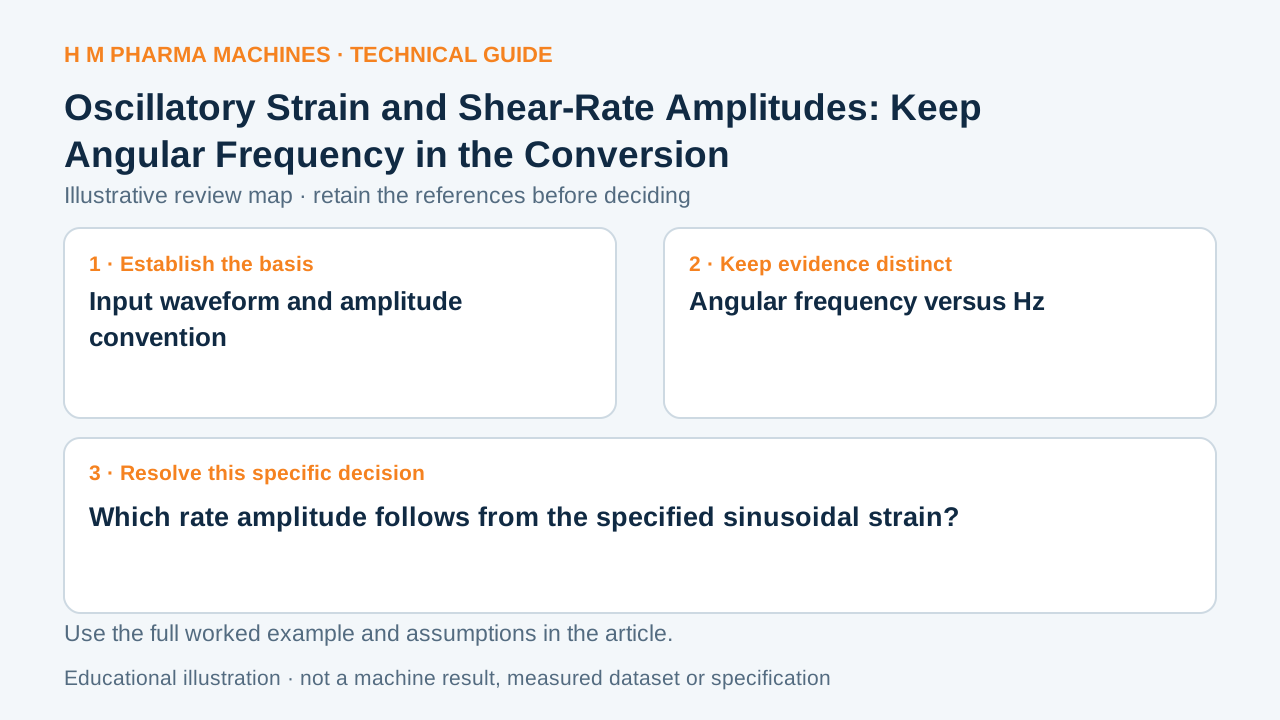
Differentiate the imposed sinusoidal strain before calling its amplitude a shear-rate amplitude.
Identify the Deformation and Model
The primary oscillatory-shear paper writes rate as a sinusoidal function. For an explicitly chosen strain γ(t) = γ₀ sin(ωt), differentiation gives rate amplitude γ₀ω, with angular frequency ω. Primary reference: oscillatory imposed flow.
Review a Hypothetical Comparison
A hypothetical strain amplitude γ₀ = 0.01 at angular frequency 10 rad/s gives rate amplitude 0.10 per second. At 20 rad/s with the same strain amplitude, the rate amplitude is 0.20 per second. The strain amplitude stays one percent while the maximum rate doubles; these describe different input quantities.
Keep the Evidence with the Decision
Retain the complete input waveform, strain amplitude, angular frequency and the convention for amplitude versus peak-to-peak values. Convert a frequency supplied in Hz using ω = 2πf before differentiating. Keep the signed instantaneous rate distinct from its positive amplitude and from any time average. Ask which of these quantities the material-response comparison actually needs.
Matching a maximum rate does not make oscillatory flow equivalent to steady shear, because direction and history differ. No particular frequency or deformation is prescribed for an actual material. The invented waveform specifies no HM test instrument or process rate. The useful output is a compatible input-quantity sheet that prevents percent strain, radians per second and inverse seconds from becoming interchangeable report labels.
Which rate amplitude follows from the specified sinusoidal strain?
This blank worksheet is for your own project. It contains no H M machine trial result.
| Review field | Reference or result | Responsible person |
|---|---|---|
| Input waveform and amplitude convention | To complete | To complete |
| Angular frequency versus Hz | To complete | To complete |
| Differentiated rate and signed history | To complete | To complete |
| Steady versus oscillatory comparison boundary | To complete | To complete |
Customer Questions
What rate amplitude follows from 0.01 and 10 rad/s?
0.10 per second.
Does fixed strain amplitude fix rate amplitude?
No. Angular frequency also matters.
Does equal peak rate make flow histories identical?
No. Oscillation and steady flow differ.
Primary References
These references support the technical principles discussed in this guide. The worked examples and review questions are educational.
Discuss Your Machine Requirement
Share your product, container, required output and the evidence needed for your technical review.
Request a Technical Review