
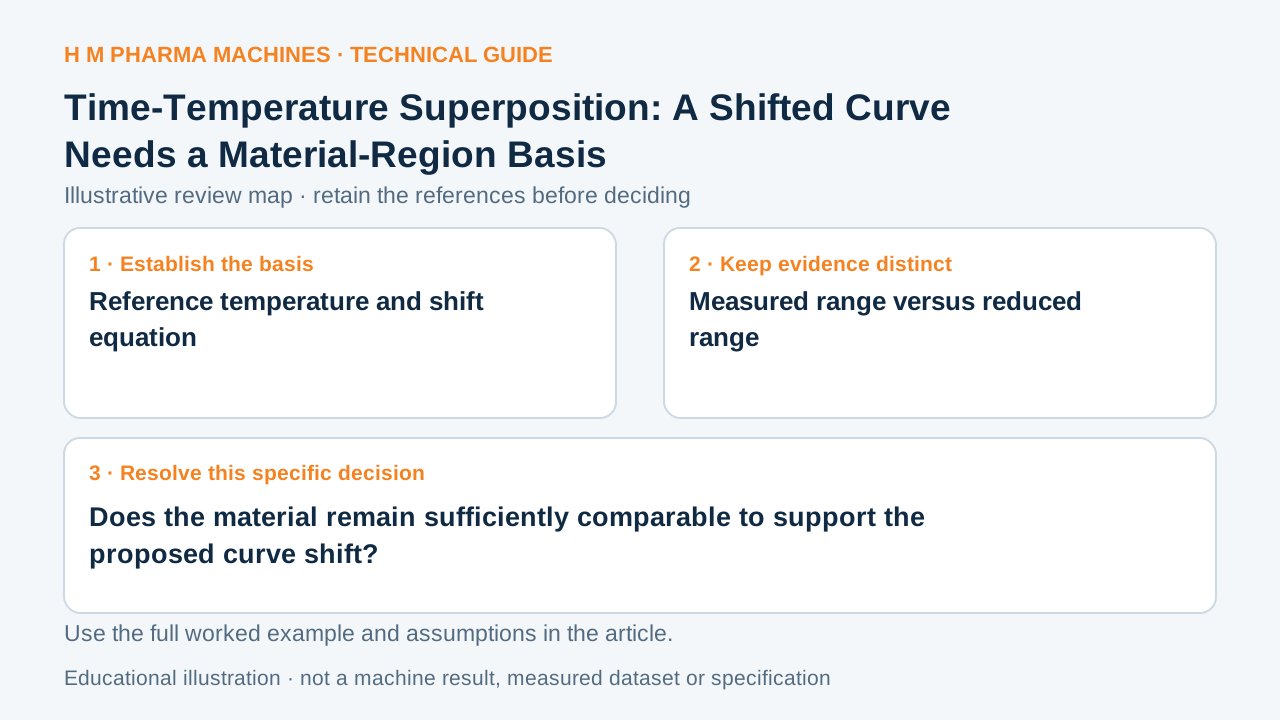
Check curve shape and material comparability before using temperature shifts to extend a measured viscoelastic time or frequency range.
Identify the Deformation and Model
TA Instruments describes time-temperature superposition as shifting compatible viscoelastic responses measured at different temperatures, with measurements inside the linear region. A master curve depends on the validity of that material/time relationship. Primary reference: time-temperature superposition.
Review a Hypothetical Comparison
Suppose a fictional analysis defines reduced angular frequency as a_T times measured angular frequency. With a_T = 10, a measured 2 rad/s maps to 20 rad/s at the reference basis. Reversing the convention would give a different number, so the shift equation is essential. The assigned factor is not an actual measured temperature law.
Keep the Evidence with the Decision
Retain the reference temperature, horizontal-shift convention and any stated vertical shift. Inspect whether overlapping regions actually align in shape, including both relevant response components. Identify transitions, aging or composition changes that could disrupt comparability. A smooth software-generated joined line cannot replace those checks or conceal a poorly overlapping region.
The method does not directly verify years of product operation or every nonlinear deformation. Ask which material region and amplitude support the extension, and mark the originally measured range separately from the shifted result. The fictional factor supplies no gasket life, process temperature or HM material prediction. Its practical output is a master-curve assumption register with the extrapolation boundary visible.
Does the material remain sufficiently comparable to support the proposed curve shift?
This blank worksheet is for your own project. It contains no H M machine trial result.
| Review field | Reference or result | Responsible person |
|---|---|---|
| Reference temperature and shift equation | To complete | To complete |
| Measured range versus reduced range | To complete | To complete |
| Overlap/shape and vertical shifts | To complete | To complete |
| Material-region and linear-range evidence | To complete | To complete |
Customer Questions
What reduced value follows from the stated factor?
20 rad/s under that convention.
Does a joined curve prove compatible material states?
No. Review overlap and underlying assumptions.
Does this verify long-term product life?
No. The model’s scope and validation remain necessary.
Primary References
These references support the technical principles discussed in this guide. The worked examples and review questions are educational.
Discuss Your Machine Requirement
Share your product, container, required output and the evidence needed for your technical review.
Request a Technical Review