
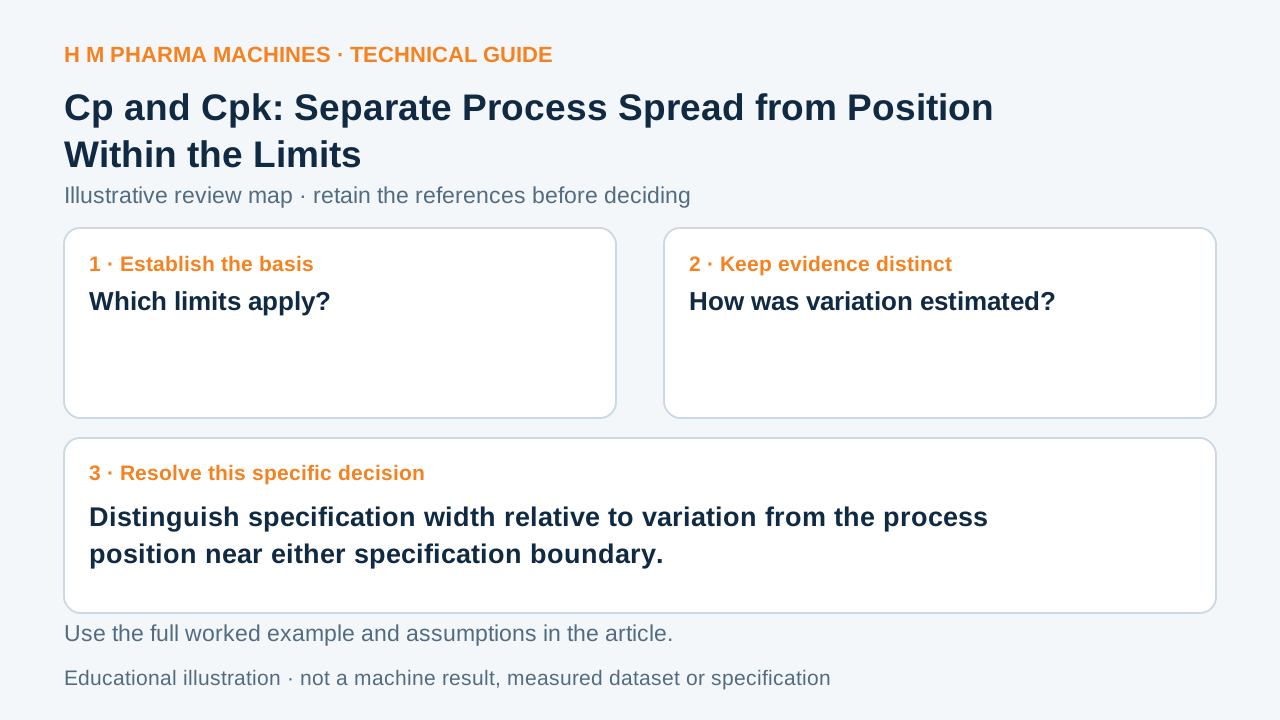
Two processes can have similar spread and different risk near a specification boundary. Interpret capability indices with their basis.
What differs between the indices?
In the usual two-sided capability formulation, Cp compares specification width with six process standard deviations. Cpk also accounts for the distance of the process mean from each limit, using the nearer standardized distance. The comparison presupposes an appropriate process and variation estimate; it does not turn any short sample into a qualified production claim.
A hypothetical centering comparison
Assume a purely illustrative stable normal-process model, limits 98 and 102 g, and sigma 0.5 g. With mean 100 g, Cp and Cpk are both about 1.33. Shift the mean to 101 g with the same sigma: Cp remains about 1.33, while Cpk falls to about 0.67. The specification and spread stayed fixed; position changed.
These numbers teach the distinction and are not suggested filling limits, required capability thresholds or HM performance claims. Do not infer a defect percentage unless the distributional and stability assumptions needed for that inference are justified.
Ask for the calculation basis
Retain the specification reference, units, process condition, observation count and method used to estimate variation. Identify whether the reported estimate describes within-group variation or a longer combined period; different bases can answer different questions.
For supplier comparison, obtain the definitions rather than comparing unlabelled index values. Review measurement suitability and time behavior separately. If only one specification boundary exists, use an appropriate one-sided formulation and make that scope explicit. A buyer should not add a second artificial limit simply to obtain a familiar two-sided number.
Trial discussion worksheet
This blank worksheet is for your own project. It contains no H M machine trial result.
| Review question | Reference or observation to retain |
|---|---|
| Which limits apply? | Actual one-sided or two-sided requirement |
| How was variation estimated? | Method and grouping |
| What was the process position? | Mean relative to each boundary |
Customer Questions
Can Cp remain unchanged when the mean moves?
Yes. Its usual formula compares width and variation.
Is 1.33 a universal HM acceptance requirement?
No. This example does not prescribe a capability threshold.
Do all variation estimates produce the same index?
No. Preserve the stated estimation method and process scope.
Primary References
These references support the technical principles discussed in this guide. The worked examples and review questions are educational.
Discuss Your Machine Requirement
Share your product, container, required output and the evidence needed for your technical review.
Request a Technical Review