
A change in crystal habit can reflect different face-growth rates even when the chemical identity is unchanged.
Define the Phase or Process Boundary
Ma and colleagues' primary IUCr study distinguishes growth along individual crystal-face directions from one size number. Facet-specific growth can change external shape. A size-equivalent sphere or one projected dimension does not retain all those directional changes.
Review a Hypothetical Comparison
In an invented geometry, two pairs of opposite faces initially span 40 µm in perpendicular directions. Assign symmetric face-normal growth of 0.5 µm/min in the first direction and 0.1 µm/min in the second for 30 min. Their full dimensions become 40+2×0.5×30=70 µm and 40+2×0.1×30=46 µm. The dimension ratio changes from 1 to about 1.522. Calling both directions a single growth rate would erase the mechanism behind the changing habit.
Keep the Evidence with the Decision
Keep face identity, direction and whether the measured distance spans one face or an opposite pair in the record. Establish which dimensions are actually observed and which are assumed. Compare changes over a stated time interval and solution state. Shape change alone does not identify a new polymorph; structural-form evidence belongs in a separate review.
The symmetric rates and geometry are assigned and are not the IUCr paper's measurements. This illustration proposes no imaging procedure, real growth law or shape target.
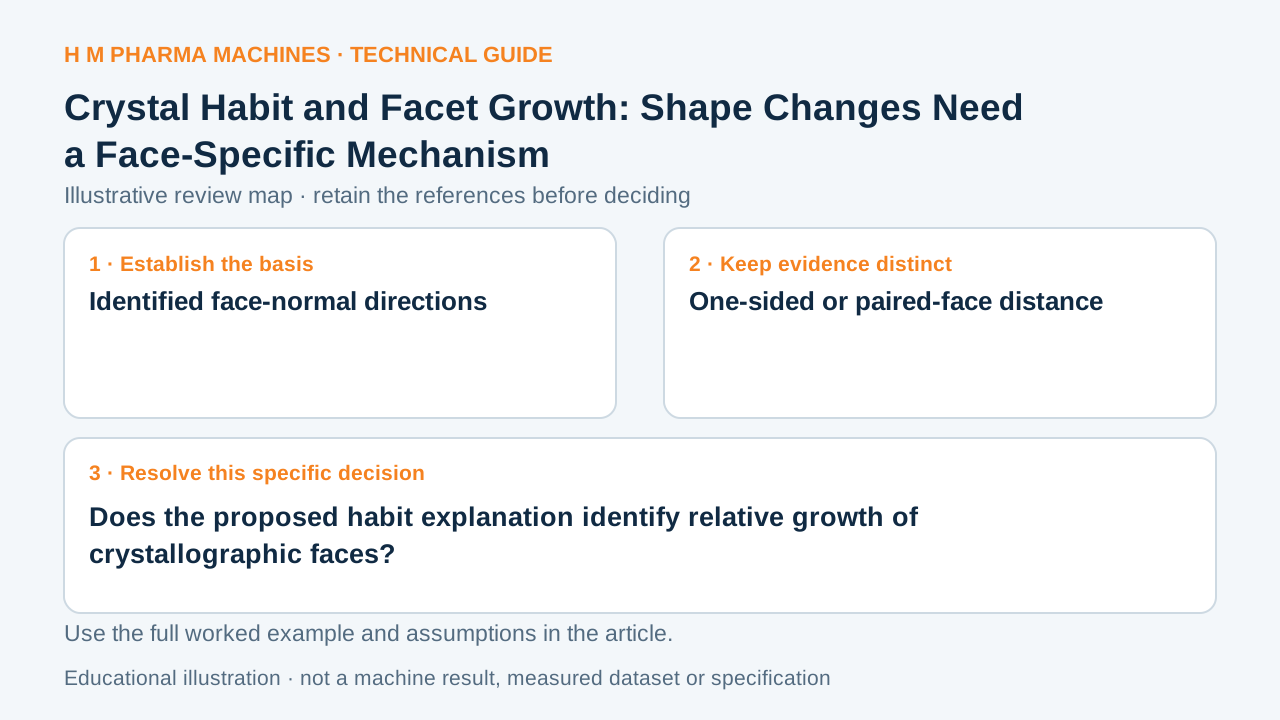
Does the proposed habit explanation identify relative growth of crystallographic faces?
This blank worksheet is for your own project. It contains no H M machine trial result.
| Review field | Reference or result | Responsible person |
|---|---|---|
| Identified face-normal directions | To complete | To complete |
| One-sided or paired-face distance | To complete | To complete |
| Interval and solution state | To complete | To complete |
| Observed versus assumed dimensions | To complete | To complete |
Customer Questions
Is one diameter enough to describe habit growth?
It does not retain all face-specific directional changes.
Why multiply each assigned rate by two?
Both opposite faces advance symmetrically in this fictional model.
Does a shape change prove a polymorph change?
No. Crystal structure requires separate evidence.
Primary References
These references support the technical principles discussed in this guide. The worked examples and review questions are educational.
Discuss Your Machine Requirement
Share your product, container, required output and the evidence needed for your technical review.
Request a Technical Review