
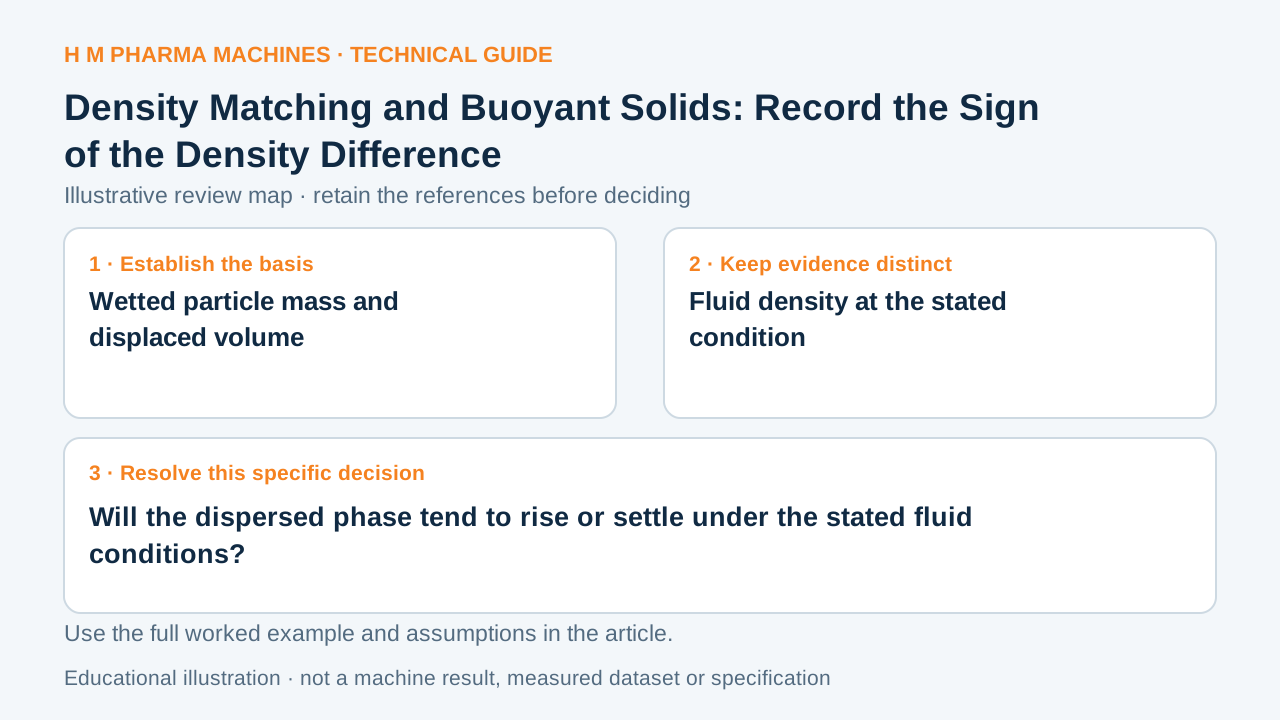
Before estimating a particle’s migration rate, establish whether its buoyancy-corrected weight points downward or upward.
Define the Process Model
OpenStax’s buoyancy treatment relates buoyant force to displaced-fluid weight. For a fully immersed body, the downward net weight contribution is (ρp − ρf)Vpg. A density match removes that contribution in the simplified static balance. It does not remove every transport mechanism or prove that a formulation remains uniform.
Compare a Hypothetical Case
Imagine a fully wetted particle occupying 1 mm³, or 10⁻⁹ m³. In a liquid of density 1,000 kg/m³, particle densities of 1,200 and 800 kg/m³ give equal-magnitude net weight terms of about 1.96 µN in opposite directions. At 1,000 kg/m³ the term is zero. No drag model or terminal velocity has been calculated in this comparison.
Complete the Engineering Review
Record whether particle density means the actual wetted object, a porous aggregate or a dry skeletal measurement. Account for trapped gas and fluid uptake when those change the relevant displaced volume or mass. Preserve temperature and composition because both affect the density comparison. Treat a near match as a condition to characterize, rather than a guaranteed permanent suspension state.
For a processing-tank discussion, describe whether solids settle, float or change behaviour after wetting. The hypothetical force calculation does not establish HM agitation performance. It identifies the direction of one physical driving term before a rate or mixing response is selected.
Will the dispersed phase tend to rise or settle under the stated fluid conditions?
This blank worksheet is for your own project. It contains no H M machine trial result.
| Review field | Reference or result | Responsible person |
|---|---|---|
| Wetted particle mass and displaced volume | To complete | To complete |
| Fluid density at the stated condition | To complete | To complete |
| Sign of the density difference | To complete | To complete |
| Gas uptake, wetting and other transport effects | To complete | To complete |
Customer Questions
Does a zero density difference prove complete stability?
Other transport and material changes can still matter.
Can dry skeletal density describe a floating aggregate?
Check the actual wetted object and trapped gas.
Does this calculation give terminal speed?
A suitable drag model is still needed.
Related Equipment References
Review the actual offered equipment and application separately from this educational example.
Primary References
These references support the technical principles discussed in this guide. The worked examples and review questions are educational.
Discuss Your Machine Requirement
Share your product, container, required output and the evidence needed for your technical review.
Request a Technical Review