
A solids percentage needs its denominator. Mass fraction and volume fraction can differ substantially when phase densities differ.
Define the Process Model
IUPAC’s mass-fraction definition uses constituent mass divided by total mixture mass. A volume-based particle model requires the corresponding phase volumes instead. Conversion therefore needs a stated density and volume model; replacing mass percent with volume percent changes the physical input, even when the numbers share the same percent sign.
Compare a Hypothetical Case
Consider an invented mixture with 10 kg solid of density 2 kg/L and 90 kg liquid of density 1 kg/L. The mass fraction is 10/100 = 0.10. Under an explicitly additive-volume approximation, the phase volumes are 5 and 90 L, giving solids volume fraction 5/95 ≈ 0.0526. Ten percent by mass has become about 5.26% by volume in that model.
Complete the Engineering Review
Record dry or wet solids basis, the relevant phase densities and temperature. State whether additive volumes are justified, particularly if dissolution, swelling or porosity changes the applicable volume. Keep the composition definition attached to settling, rheology or capacity models that use it. An accurate mass record does not automatically supply the volume fraction a model needs.
For a manufacturing-vessel discussion, provide actual material composition and property evidence. The example gives no formulation recipe or HM handling capability. It shows the information needed to reconcile two different concentration statements before they enter the same engineering comparison.
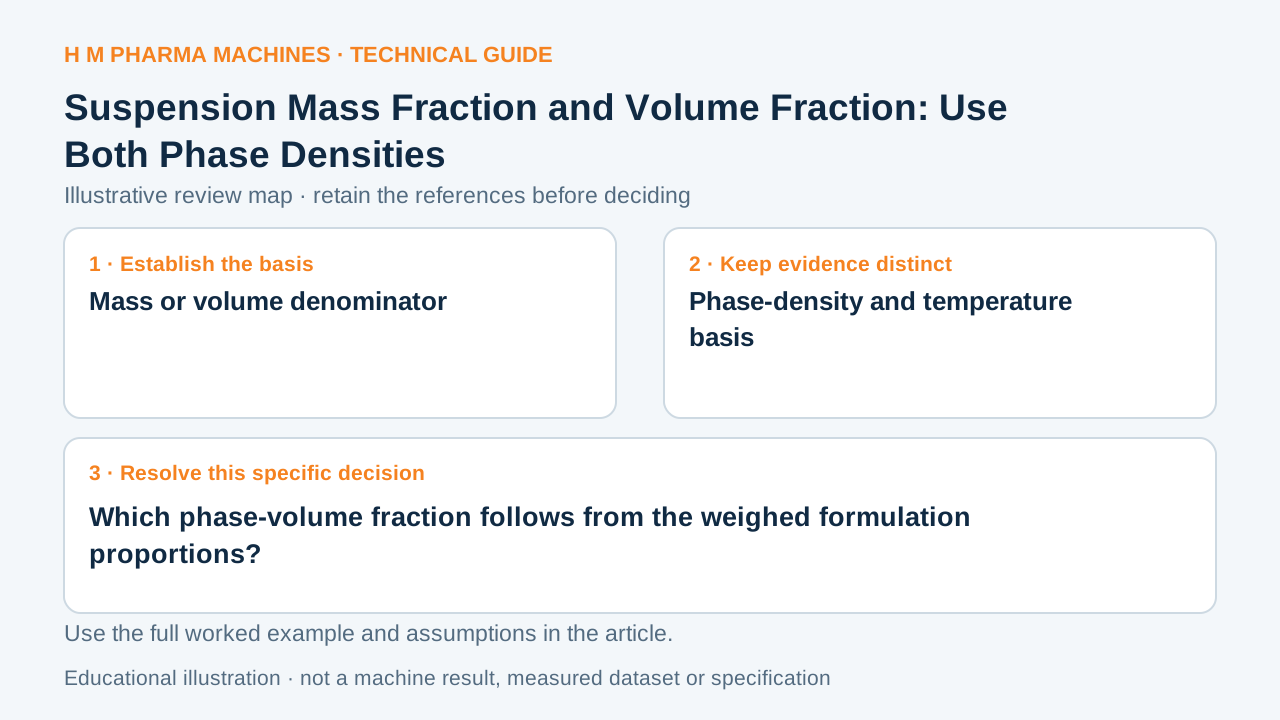
Which phase-volume fraction follows from the weighed formulation proportions?
This blank worksheet is for your own project. It contains no H M machine trial result.
| Review field | Reference or result | Responsible person |
|---|---|---|
| Mass or volume denominator | To complete | To complete |
| Phase-density and temperature basis | To complete | To complete |
| Additive-volume assumption | To complete | To complete |
| Wet/dry solids and material-state boundary | To complete | To complete |
Customer Questions
Are 10% mass and 10% volume always equal?
They depend on different denominators and densities.
Can skeletal density always supply suspension phase volume?
Justify the relevant wetted-particle volume model.
Does this example assume additive phase volumes?
Yes; actual mixtures need an applicable volume model.
Related Equipment References
Review the actual offered equipment and application separately from this educational example.
Primary References
These references support the technical principles discussed in this guide. The worked examples and review questions are educational.
Discuss Your Machine Requirement
Share your product, container, required output and the evidence needed for your technical review.
Request a Technical Review