
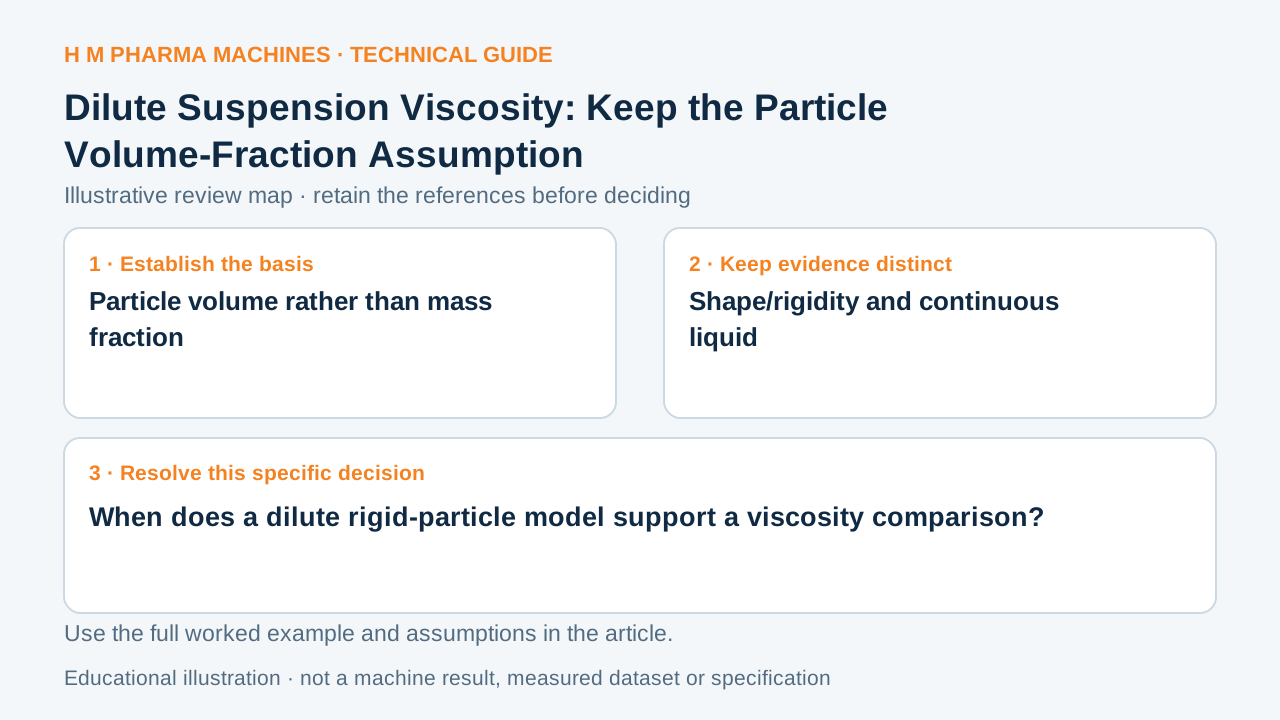
Check the dilute rigid-sphere assumptions before using a first-order suspension-viscosity expression as a concentration comparison.
Identify the Deformation and Model
The primary mathematical paper presents the Einstein first-order result for dilute rigid spheres: relative viscosity is approximately 1 + 2.5φ, with φ the small particle volume fraction. Interactions and higher-order effects bound the approximation. Primary reference: dilute suspension result.
Review a Hypothetical Comparison
For an invented compatible dilute suspension at φ = 0.01, the first-order relative viscosity is 1.025. A base liquid viscosity 1 Pa·s would therefore give 1.025 Pa·s under that approximation. Substituting φ = 0.20 would produce an arithmetic number, but this calculation alone does not justify applying the dilute model at that concentration.
Keep the Evidence with the Decision
Keep volume fraction distinct from mass fraction and retain the particle-shape, rigidity and continuous-liquid assumptions. Mark the order of approximation beside the answer. Compare the prediction with appropriate material evidence, especially where interactions, associations or non-spherical particles can change the response. Do not label an equation-derived number as a measured viscosity.
The expression does not supply a universal maximum acceptable particle concentration or capture all structured-fluid behavior. Its coefficient is tied to the stated idealized particle setting. The fictional calculation establishes no HM product viscosity or filling capability. Its useful decision is whether the supporting approximation belongs to the actual suspension, rather than extending a convenient linear relation without its physical boundary.
When does a dilute rigid-particle model support a viscosity comparison?
This blank worksheet is for your own project. It contains no H M machine trial result.
| Review field | Reference or result | Responsible person |
|---|---|---|
| Particle volume rather than mass fraction | To complete | To complete |
| Shape/rigidity and continuous liquid | To complete | To complete |
| Approximation order and dilute boundary | To complete | To complete |
| Prediction versus measured evidence | To complete | To complete |
Customer Questions
What relative viscosity follows at φ = 0.01?
1.025 in the first-order model.
Does arithmetic at φ = 0.20 validate the model there?
No. Applicability needs separate evidence.
Is the calculated value a measurement?
No. It is a conditional prediction.
Primary References
These references support the technical principles discussed in this guide. The worked examples and review questions are educational.
Discuss Your Machine Requirement
Share your product, container, required output and the evidence needed for your technical review.
Request a Technical Review