
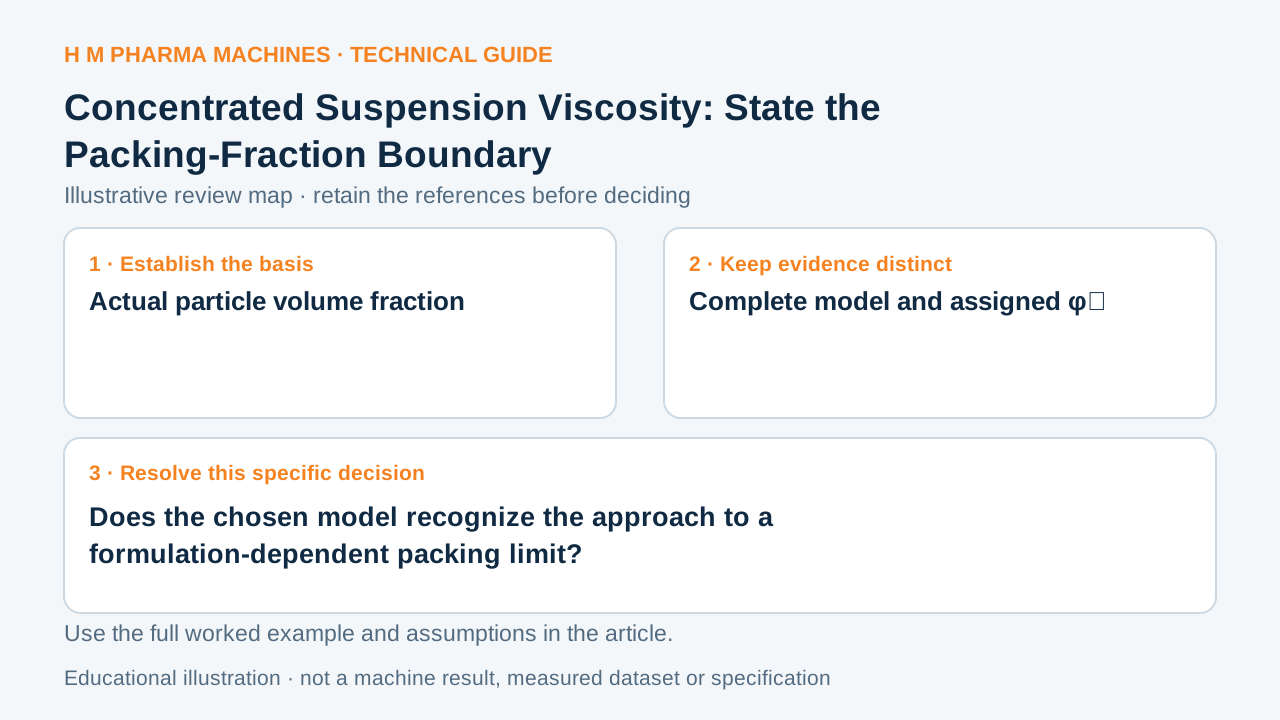
Keep the formulation-dependent packing limit visible when a concentrated-suspension model uses distance from crowding as its main variable.
Identify the Deformation and Model
Malvern Panalytical describes concentration-based suspension models containing maximum packing fraction φₘ and particle-dependent parameters. Approaching this model boundary differs from a dilute linear correction. Primary reference: packing and suspension rheology.
Review a Hypothetical Comparison
At invented actual particle volume fraction φ = 0.30, choosing φₘ = 0.60 gives reduced fraction φ/φₘ = 0.50. Choosing φₘ = 0.75 gives 0.40 at the same actual loading. Thus the model proximity to packing changes even though no solid inventory was added. These assigned limits are not measured properties or universal values.
Keep the Evidence with the Decision
Retain the complete constitutive expression and the evidence used to choose φₘ. Identify particle shape, interactions, size mixture and imposed-flow conditions relevant to that value. Distinguish a fitted packing parameter from a separately measured maximum packing state. Plot the proposed range against the model boundary and check how uncertain parameters affect a prediction near it.
An apparent mathematical divergence does not identify a universal operational jam point for every real suspension. Other mechanisms can change the response before the fitted boundary is approached. No viscosity, pump pressure or HM formulation limit follows from the two reduced fractions alone. The worksheet should document the packing assumption so an actual loading change is not confused with a model-parameter change.
Does the chosen model recognize the approach to a formulation-dependent packing limit?
This blank worksheet is for your own project. It contains no H M machine trial result.
| Review field | Reference or result | Responsible person |
|---|---|---|
| Actual particle volume fraction | To complete | To complete |
| Complete model and assigned φₘ | To complete | To complete |
| Shape/interactions and fitting evidence | To complete | To complete |
| Distance to boundary and sensitivity | To complete | To complete |
Customer Questions
Why do the reduced fractions differ?
The assumed packing limits differ.
Does fitted φₘ have to be a measured maximum?
No. Keep its derivation explicit.
Does the ratio alone calculate viscosity?
No. The remaining model parameters matter.
Primary References
These references support the technical principles discussed in this guide. The worked examples and review questions are educational.
Discuss Your Machine Requirement
Share your product, container, required output and the evidence needed for your technical review.
Request a Technical Review