
In This Guide
- 1. Build one requirement sheet before comparing machines
- 2. Separate dosing principle, actuator and machine family
- 3. Specify operator tasks and line interfaces
- 4. Include cleaning and handover in the selection
- 5. Download and complete the filling shortlist
- Frequently asked questions
- Continue the selection review
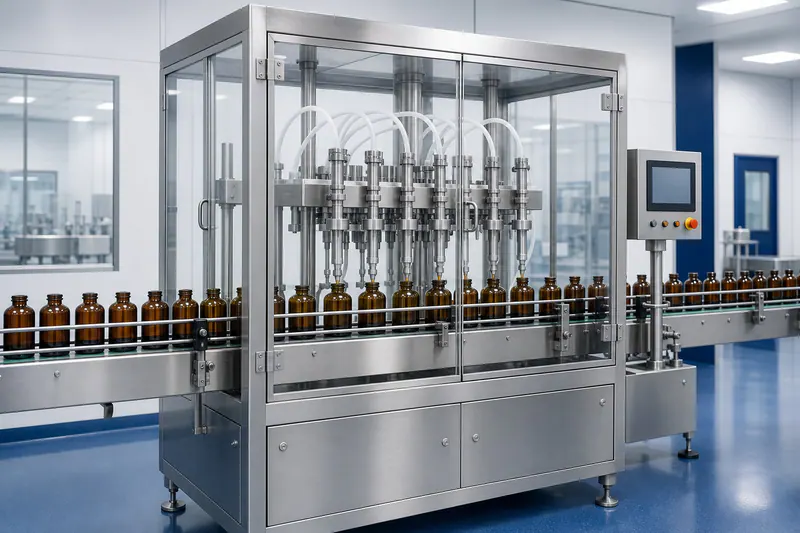
Part of Filling Machines & Product Trials.
Choose the filling method from the quantity you need to deliver, the actual product and the container. Then specify the drive, controls and handling arrangement. These are separate decisions: a servo-driven piston can also be a volumetric filler.
1. Build one requirement sheet before comparing machines
Product and product path
Provide a representative sample and identify temperature, viscosity or flow behavior, density where relevant, foam, suspended particles and the cleaning procedure. Record the conditions behind a viscosity number. List every wetted component to review, including the tank, pump, tubing, valves, seals and nozzle; a stainless-steel frame does not describe the complete product path.
Dose and measurement basis
State the required dose points and units. A target of 100 mL and a target of 100 g are different requirements. For a gravimetric check, distinguish gross mass, the applicable container tare and net product mass. If mass is used to infer volume, document the product density and its applicable conditions. Agree the measuring instrument, sampling plan and acceptance criteria before the trial.
Container and closure
Send dimensioned drawings and samples for every planned format, including the neck opening, body dimensions and closure. Keep nominal bottle capacity separate from the required dose. Review nozzle clearance, container support and the transfer to capping or stoppering. For a narrow neck, use the nozzle and bottle-clearance guide.
Production requirement
Express demand as the required good packs per batch or shift. Record the time available after setup, cleaning, format changes, checks and planned stops. Ask each proposal to identify the product, dose, container, number of heads and operating conditions behind its output figure. Compare the same production requirement across offers.
2. Separate dosing principle, actuator and machine family
Volumetric describes a volume-based dose. Piston identifies a metering mechanism. Servo identifies a controlled drive. These labels can describe the same arrangement, so counting “volumetric” and “servo piston” as mutually exclusive technologies can distort a shortlist.
| Candidate arrangement | What to distinguish | Evidence needed before selection |
|---|---|---|
| Piston or dosing-chamber volume metering | A volumetric family may use a piston/chamber arrangement. A servo piston adds a particular drive and motion-control arrangement. | Selected chamber/tooling range, product passage, valve and nozzle behavior, cleanability and results at each required dose. |
| Flow-meter feedback | The selected meter and controller determine how delivered quantity is measured and used. Ask whether the reported quantity is mass or volume. | Meter compatibility with the actual liquid, operating flow, aeration, calibration and shut-off strategy. |
| Load-cell feedback | A weighing arrangement uses a mass result; container tare and the weighing sequence need explicit definitions. | Container stability, settling time, tare method and the net-fill result under the agreed operating conditions. |
| Gear-pump metering | The pump configuration, movement and calibration relate to the delivered dose. “Servo” alone does not identify the quantity check. | Product compatibility, pump and seal materials, shear or particle concerns, dose results and cleaning access. |
| Peristaltic pumping | The pump compresses tubing; the pumping mechanism does not contact the liquid. The complete supplied fluid path still needs review. | For the proposed pump and tubing, confirm material, bore, replacement basis, calibration and dose results. |
Primary manufacturer literature identifies rotary-valve piston dosing as volumetric and distinguishes it from other pumping arrangements. It also describes peristaltic tubing contact. These terminology references support the comparison; they do not establish HM machine ratings or compatibility for your formulation. See Syntegon’s filling-system descriptions.
Use this short decision path
- Define the result: required mass or volume, dose points and the agreed measurement method.
- Screen the product path: remove options that cannot meet the documented compatibility, cleaning, particle or product-handling requirement.
- Compare the remaining mechanisms: test dose delivery and nozzle behavior with the actual product and pack.
- Add automation: confirm the drive, recipes, container handling, controls and line interfaces needed for the duty.
Keep the decision record beside the shortlist
For each candidate, record the requirement revision, quantity basis, product-contact arrangement, selected tooling, trial reference and unresolved question. Use statuses such as “trial required,” “demonstrated for this combination” and “excluded for this stated constraint.” A rejected configuration does not prove that every machine using the same technology is unsuitable.
Two illustrative shortlists
Fictional examples, not HM trials or recommended settings. The quantities below describe invented buying requirements. They do not specify accuracy, output or a tested machine range.
| Invented requirement | Candidates to discuss | What the trial must resolve |
|---|---|---|
| 100 mL of a water-like liquid in a narrow-neck bottle | A suitable piston/chamber arrangement and a compatible flow-meter arrangement. | Nozzle clearance, air escape, splash/foam, shut-off and dose results. Confirm the meter’s suitability; “water-like” is not a complete product specification. |
| 250 mL of a viscous cosmetic product, with two product changes per shift | A suitable servo-piston arrangement and a compatible gear-pump arrangement. | Behavior at the actual filling temperature, product passage and nozzle withdrawal, retained product and cleaning/changeover work. Do not choose solely from one viscosity value. |
The shortlist remains open until the evidence closes the stated questions. If an isolated tubing path or another requirement is decisive, review that requirement explicitly rather than excluding an option by habit.
3. Specify operator tasks and line interfaces
A semi-automatic or automatic label does not prove dose accuracy, batch labor or usable output. Map loading, replenishment, checks, unloading, cleaning and changeover, then compare the supplied functions. The automation task comparison shows how to compare a complete batch.
Standalone or connected line
For a connected line, confirm transfer height, direction, container support, downstream readiness, backup handling and responsibility for control signals. Compare the sustained line requirement with washing, capping and labeling capacity. No-bottle/no-fill, diving nozzles, recipes and alarm functions belong in the agreed configuration; do not assume them from the machine name.
4. Include cleaning and handover in the selection
Compare drained and retained product, removable parts, access, tools, seals, reassembly checks and the proposed cleaning method. Review each product-contact material against the formulation and cleaning exposure. Define which cleaning and changeover tasks the supplier demonstrates and which procedures and release decisions remain with the buyer.
Controls, safety and documentation
Identify required guarding and interlocks, operator access, recipe and record functions, manuals, drawings, certificates, FAT/SAT and qualification support in the written scope. PLC/HMI or SCADA alone does not establish the suitability of an electronic-record system. Agree the intended records and responsibilities with the buyer’s quality and engineering teams.
Resolve these gaps before comparing prices
- Different offers tested at different dose, speed or product conditions.
- A format range without the included change-parts list.
- A headline production rate without cleaning, checks or line constraints.
- A generic accuracy claim without its measurement and acceptance basis.
5. Download and complete the filling shortlist
Download the buyer review workbook (XLSX) and use the Filling shortlist tab. Record product and temperature, container/drawing revision, dose and unit, quantity basis, proposed mechanism, tooling, cleaning requirements, trial evidence and the decision owner.
Send that sheet with representative product and container information, required good output, available utilities, layout and the installation location. Ask for one approved configuration statement that links the offered machine, product path, format parts, controls and acceptance conditions.
Frequently asked questions
Are volumetric and servo-piston fillers different alternatives?
Not necessarily. A piston can meter a volume, while servo describes its drive. Compare the actual dosing principle, actuator, product path and control arrangement rather than treating the labels as mutually exclusive categories.
Which filling method should I choose for a viscous product?
Prepare a shortlist using the actual flow behavior, filling temperature, dose, product path and cleaning needs. Suitable piston or pump arrangements may be candidates, but a representative trial must resolve the application-specific questions.
Does a higher visible fill level mean more product was delivered?
Not by itself. Use the agreed quantity measurement and keep container geometry, foam, tare and any mass-to-volume conversion basis separate from the visible-level observation.
Can one filler handle every bottle in our range?
Only the reviewed formats and included adjustments or change parts should be treated as approved. Send the complete drawing and sample list and confirm each required dose-format combination.
Continue the selection review
- Review the complete wetted path.
- Prepare tare, settling and net-weight checks.
- Browse filling-machine and product-trial guides.
For the distinction between gross, tare and net weighing, see the NIST weighing terminology. It is a measurement reference, not an HM performance specification.
Need Help Selecting a Liquid Filling Machine?
Share your product details, fill volume, bottle and cap samples, required output and automation level. Our team can review your application and recommend a suitable standalone filling machine or complete pharmaceutical packaging line.
Request a Free Quote Email Your Requirements