
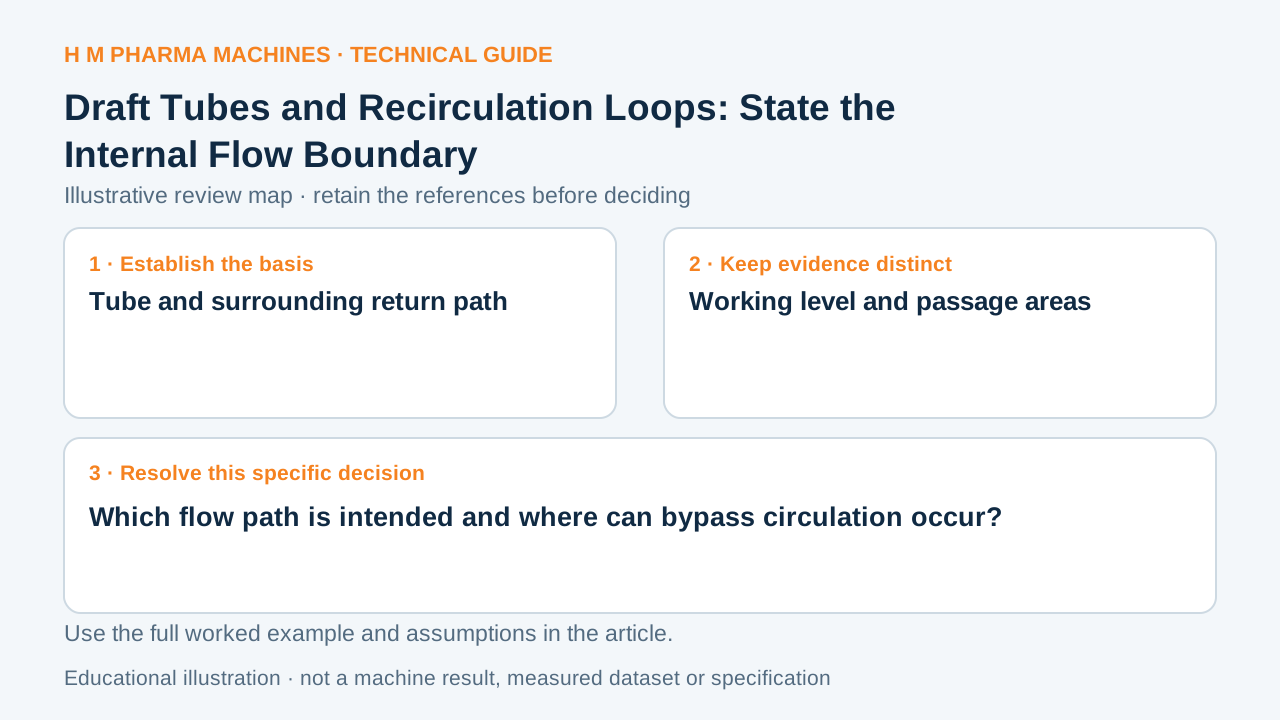
When a proposal includes a draft tube, review the defined circulation passage rather than treating the tube as extra storage volume.
Define the Process Model
A draft tube is an internal geometry choice for a selected mixing task. ProQuip’s tank-design discussion identifies it in a solids-suspension context. A useful review traces the passage through the tube and the return path outside it. An internal part’s presence alone does not establish a particular circulation rate or uniformity result.
Compare a Hypothetical Case
Imagine a proposed arrangement routes 6 L/s through an internal passage with 0.03 m² flow area. The corresponding area-average velocity is 0.20 m/s. A second drawing halves that passage area while retaining the same hypothetical rate, giving 0.40 m/s. Neither calculation establishes that the selected impeller can actually deliver that rate through the altered resistance.
Complete the Engineering Review
Mark the tube inlet, outlet, surrounding return area and any opening that can short-circuit the intended path. Identify which areas and working levels belong to the flow claim. Ask the supplier to provide the actual circulation basis, mechanical clearances and access arrangement. Separate a proposed path drawing from measured evidence that particles follow it.
For a manufacturing-vessel project, obtain the offered internals drawing first. This example does not say HM supplies a draft tube or adopt a manufacturer’s generic vessel-height limits. It helps review an option when it is explicitly included in a supplier proposal.
Which flow path is intended and where can bypass circulation occur?
This blank worksheet is for your own project. It contains no H M machine trial result.
| Review field | Reference or result | Responsible person |
|---|---|---|
| Tube and surrounding return path | To complete | To complete |
| Working level and passage areas | To complete | To complete |
| Claimed circulation-rate basis | To complete | To complete |
| Mechanical and access interfaces | To complete | To complete |
Customer Questions
Does tube area prove its flow rate?
The driving system and resistance must also be assessed.
Is a draft tube extra active volume?
Identify the participating flow path and inventory.
Is one manufacturer’s height limit universal?
Review the complete selected design instead.
Related Equipment References
Review the actual offered equipment and application separately from this educational example.
Primary References
These references support the technical principles discussed in this guide. The worked examples and review questions are educational.
Discuss Your Machine Requirement
Share your product, container, required output and the evidence needed for your technical review.
Request a Technical Review