
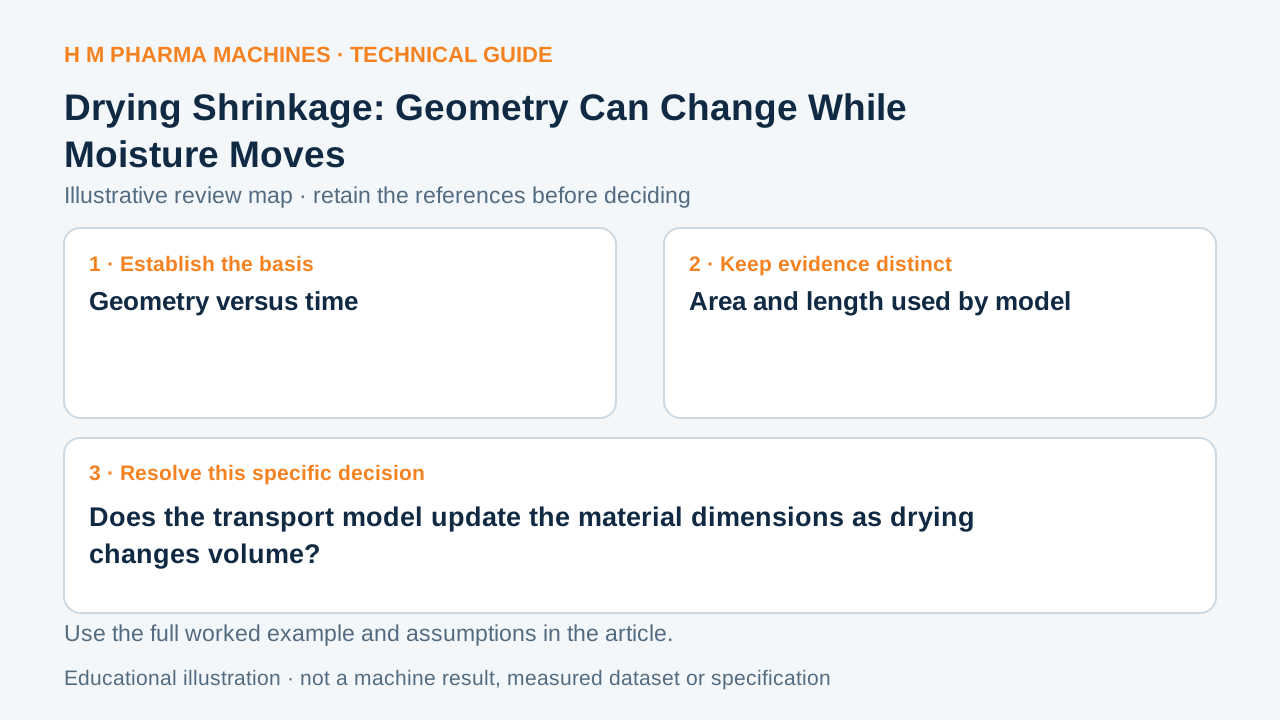
Record changing dimensions during drying before keeping area and diffusion length fixed in a model.
Define the Material or Thermodynamic Model
A primary dehydration-mechanics model couples moisture removal with deformation. Geometry can therefore change with material state. A fixed initial dimension is a modelling assumption, not an automatic consequence of a measured mass loss.
Review a Hypothetical Comparison
Imagine a uniformly shrinking cube whose edge changes from 10 to 8 mm. Its volume becomes 0.8³ = 0.512 of the original, while its exposed area becomes 0.8² = 0.64. A model that retains the original area would overstate the current area by 56.25%. No water percentage follows from those dimensions unless density and solid inventory are also defined.
Keep the Evidence with the Decision
Track dimension, exposed area and material mass separately. Decide which geometry is being updated in the transport calculation and how the measurements support it. Keep uniform shrinkage distinct from cracks, pores or nonuniform deformation.
The cube is an invented geometric calculation, not the cited study’s experiment. Shrinkage does not alone predict a faster drying process: path length, resistance, area and material properties can change together.
Does the transport model update the material dimensions as drying changes volume?
This blank worksheet is for your own project. It contains no H M machine trial result.
| Review field | Reference or result | Responsible person |
|---|---|---|
| Geometry versus time | To complete | To complete |
| Area and length used by model | To complete | To complete |
| Mass/density evidence | To complete | To complete |
| Nonuniformity and pore assumptions | To complete | To complete |
Customer Questions
What volume ratio is calculated?
0.512.
What area ratio follows?
0.64.
Does this predict drying time?
No transport coefficients or time model are supplied.
Primary References
These references support the technical principles discussed in this guide. The worked examples and review questions are educational.
Discuss Your Machine Requirement
Share your product, container, required output and the evidence needed for your technical review.
Request a Technical Review