
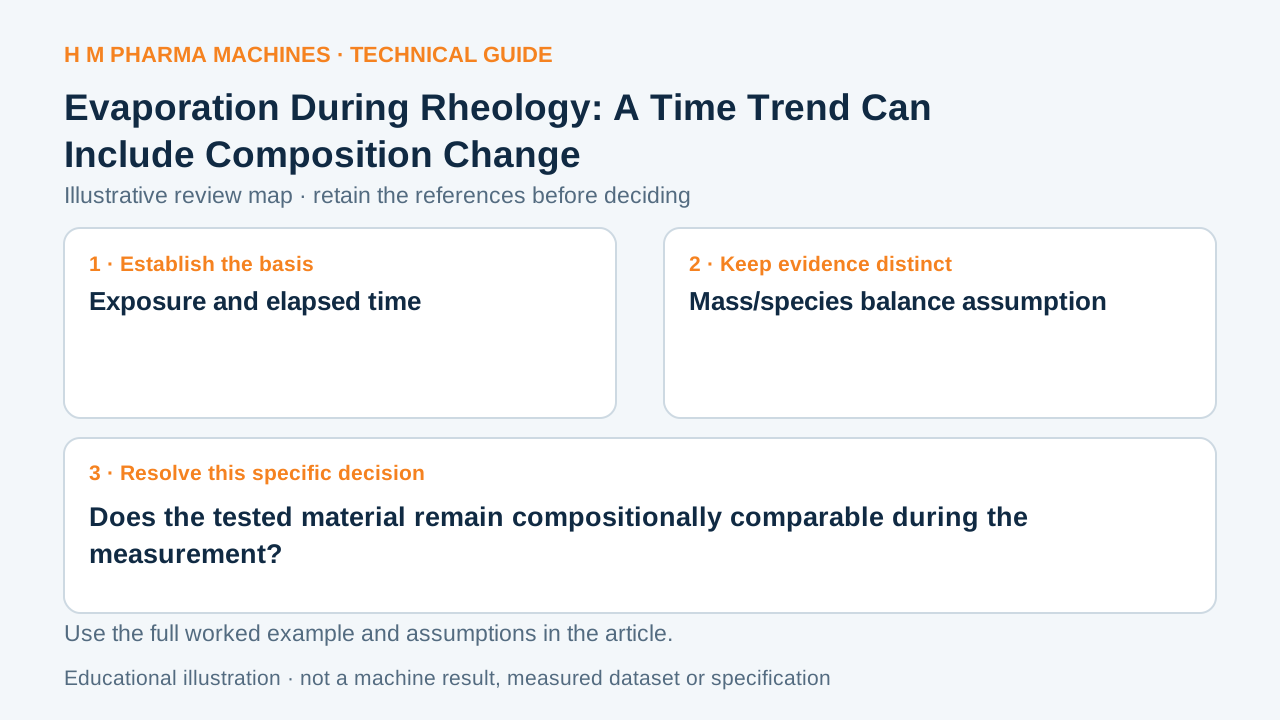
Check whether solvent loss changes the sample during a time-dependent rheology measurement before interpreting the trend as a response of unchanged material.
Identify the Deformation and Model
TA Instruments identifies evaporation and condensation as potential rheology artifacts because composition at the exposed interface can change. The material being measured may therefore differ during a long run. Primary reference: composition change during measurement.
Review a Hypothetical Comparison
Imagine a fictional 10 g mixture containing 1 g nonvolatile solid and 9 g water. Under the explicitly assumed loss of 0.5 g water only, the remaining mixture is 9.5 g and its solid mass fraction becomes 1/9.5, about 10.53 percent, rather than 10 percent. The mass balance alone does not calculate the new viscosity.
Keep the Evidence with the Decision
Retain exposure area, elapsed time, temperature and any actual mass or composition checks. Distinguish solvent-loss controls from surface-slip controls because they address different mechanisms. State whether the recorded response represents the original formulation, an evolving concentration or an unverified sample state. Keep repeat runs comparable in exposure as well as imposed motion.
A mass change does not automatically identify which species left, and condensation can change the balance in the opposite direction. The invented water-only assumption is not evidence for an actual formulation or an instruction to apply a particular edge treatment. Its practical output is a sample-state record that prevents a composition change from silently becoming a thixotropy or stability claim.
Does the tested material remain compositionally comparable during the measurement?
This blank worksheet is for your own project. It contains no H M machine trial result.
| Review field | Reference or result | Responsible person |
|---|---|---|
| Exposure and elapsed time | To complete | To complete |
| Mass/species balance assumption | To complete | To complete |
| Temperature and concentration evidence | To complete | To complete |
| Response interpretation and controls | To complete | To complete |
Customer Questions
What solid fraction follows in the water-only example?
About 10.53 percent by remaining mixture mass.
Does mass loss calculate viscosity?
No. A material response relation is also required.
Does all mass loss prove water evaporation?
No. The lost species must be established.
Primary References
These references support the technical principles discussed in this guide. The worked examples and review questions are educational.
Discuss Your Machine Requirement
Share your product, container, required output and the evidence needed for your technical review.
Request a Technical Review