
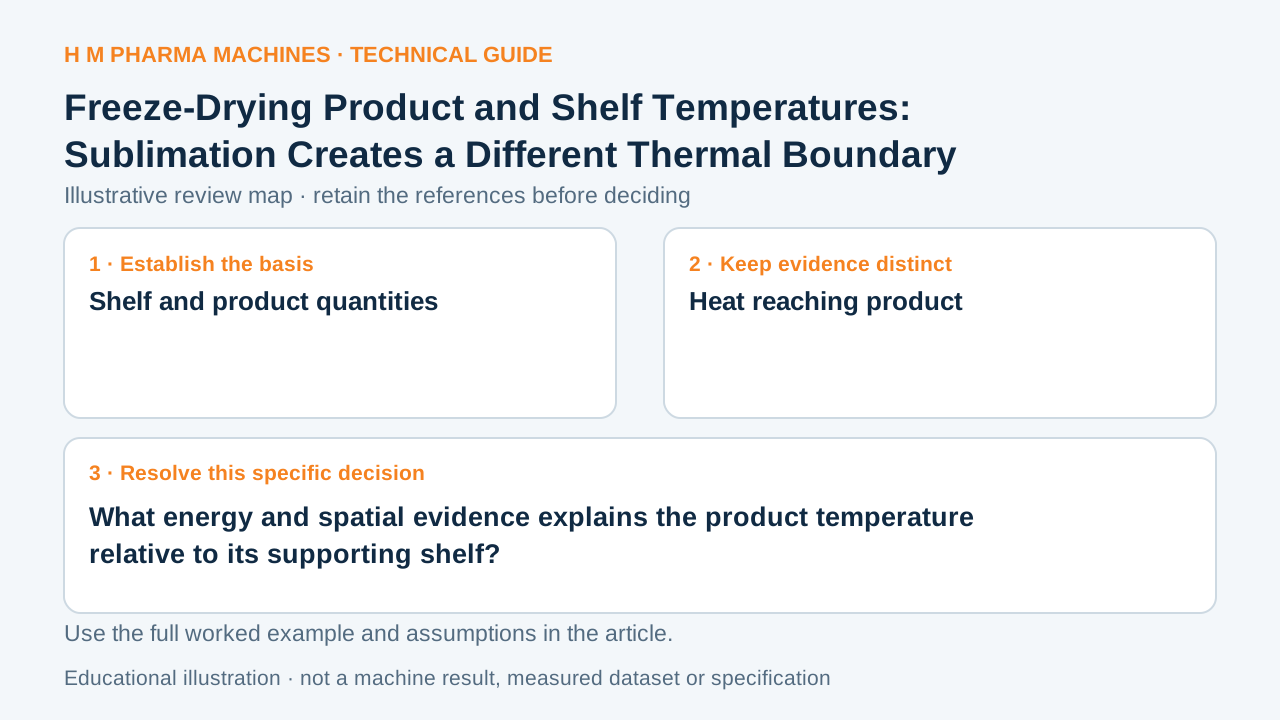
Treat shelf temperature as an external thermal condition and product temperature as a material response during sublimation.
Define the Material or Thermodynamic Model
Martin Christ’s process explanation shows separate shelf and product temperature traces during primary drying. Heat arriving at the product can supply sublimation as well as change temperature; the shelf setting therefore does not uniquely specify product temperature.
Review a Hypothetical Comparison
In a hypothetical instantaneous energy account, 5 W reaches a product, 4 W supplies an assigned sublimation sink and 1 W changes sensible energy. If its effective heat capacity is assigned as 100 J/K, the temperature rate is 0.01 K/s at that instant. Setting the product-temperature rate to 0.05 K/s would incorrectly allocate all 5 W to sensible heating.
Keep the Evidence with the Decision
Keep the shelf boundary, actual product observation, heat-input model and latent-energy sink in separate fields. A product trace approaching a shelf trace can be evidence to interpret alongside other observations; it is not an automatic endpoint test by itself.
The quantities are invented and local in time. No physical cycle, formulation limit or shelf programme is supplied. Geometry, thermal gradients and changing sublimation rate can make a lumped heat-capacity account inadequate.
What energy and spatial evidence explains the product temperature relative to its supporting shelf?
This blank worksheet is for your own project. It contains no H M machine trial result.
| Review field | Reference or result | Responsible person |
|---|---|---|
| Shelf and product quantities | To complete | To complete |
| Heat reaching product | To complete | To complete |
| Sublimation versus sensible terms | To complete | To complete |
| Endpoint evidence and model adequacy | To complete | To complete |
Customer Questions
What sensible power is assigned?
1 W.
What local temperature rate follows?
0.01 K/s for the assigned 100 J/K.
Is shelf temperature a product measurement?
No; the illustration keeps their roles separate.
Primary References
These references support the technical principles discussed in this guide. The worked examples and review questions are educational.
Discuss Your Machine Requirement
Share your product, container, required output and the evidence needed for your technical review.
Request a Technical Review