
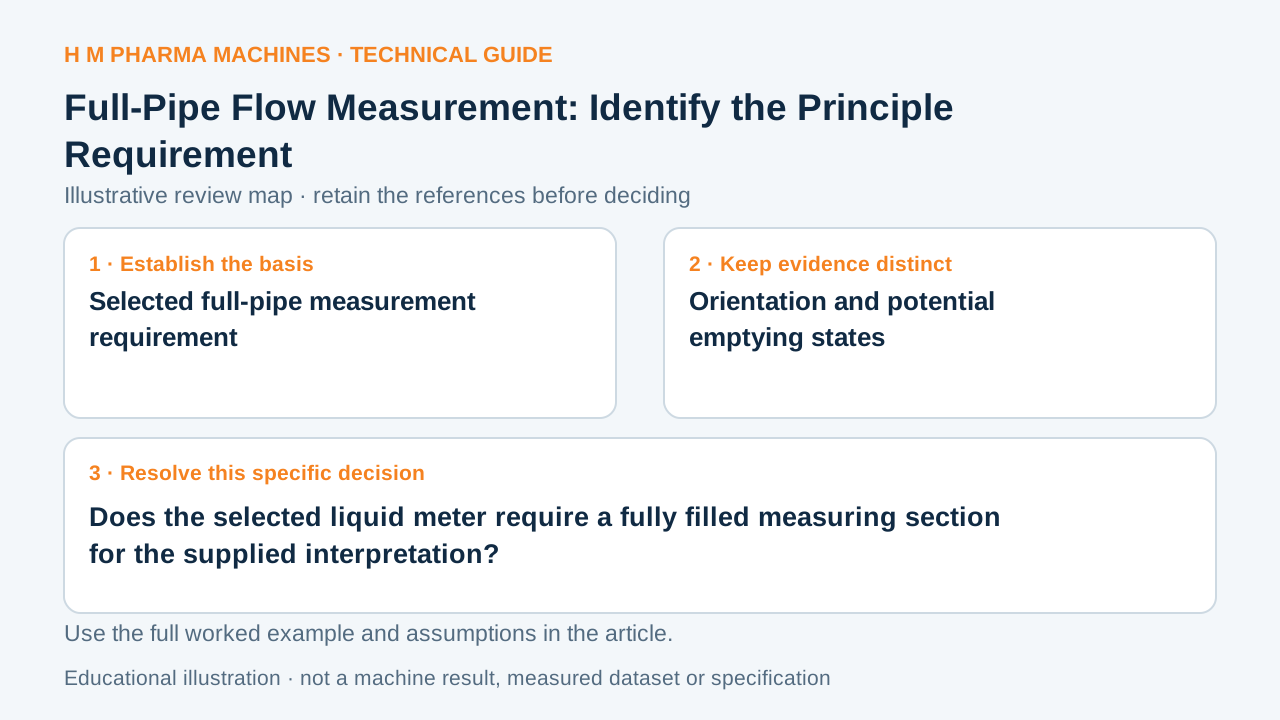
A pipe that carries some liquid is not necessarily full at the measuring section. Establish the fill condition required by the selected instrument.
Identify the Physical Basis
For conventional full-bore electromagnetic measurement, the wetted condition of the electrodes and measuring tube matters. Endress+Hauser’s principle explanation distinguishes empty and partially filled states and describes an optional detection function. Such detection is a separate capability to confirm; a powered display or absence of an alarm does not establish that the required full-pipe condition exists.
Work Through an Example
Consider a hypothetical drain-down record showing liquid in the lower half of a horizontal measuring tube. An external photograph of a wet outlet does not show the tube’s complete internal state. A later reading labelled zero may mean no flow, invalid measurement or a configured output response. Without instrument status and the selected measuring conditions, the number alone does not distinguish those possibilities.
Use the Result in the Review
Describe the measuring-section orientation and possible emptying, gas accumulation or interrupted supply. Ask what condition the selected instrument requires and how it reports loss of that condition. If an empty-pipe function is provided, preserve its actual configuration and test evidence. Compare state indications with observations through the whole start, run and finish sequence, not only a steady period when the line is known to be full.
For a flowmeter filling trial, confirm the fitted measuring principle and product-wetted arrangement. This guide concerns the pipe’s occupied state, distinct from the chemical conductivity requirement. It does not prescribe a siphon, pressurisation or piping change for an unspecified machine.
Does the selected liquid meter require a fully filled measuring section for the supplied interpretation?
This blank worksheet is for your own project. It contains no H M machine trial result.
| Review field | Reference or result | Responsible person |
|---|---|---|
| Selected full-pipe measurement requirement | To complete | To complete |
| Orientation and potential emptying states | To complete | To complete |
| Detection capability and configuration | To complete | To complete |
| Flow value with status through sequence | To complete | To complete |
Customer Questions
Does a wet outlet prove a full measuring tube?
No. It does not show the complete measuring-section state.
Is empty-pipe detection always installed and enabled?
Confirm the selected device and configuration.
Does zero prove no physical liquid movement?
Not alone. Read the measurement status and output response too.
Related Equipment References
Review the actual offered equipment and application separately from this educational example.
Primary References
These references support the technical principles discussed in this guide. The worked examples and review questions are educational.
Discuss Your Machine Requirement
Share your product, container, required output and the evidence needed for your technical review.
Request a Technical Review