
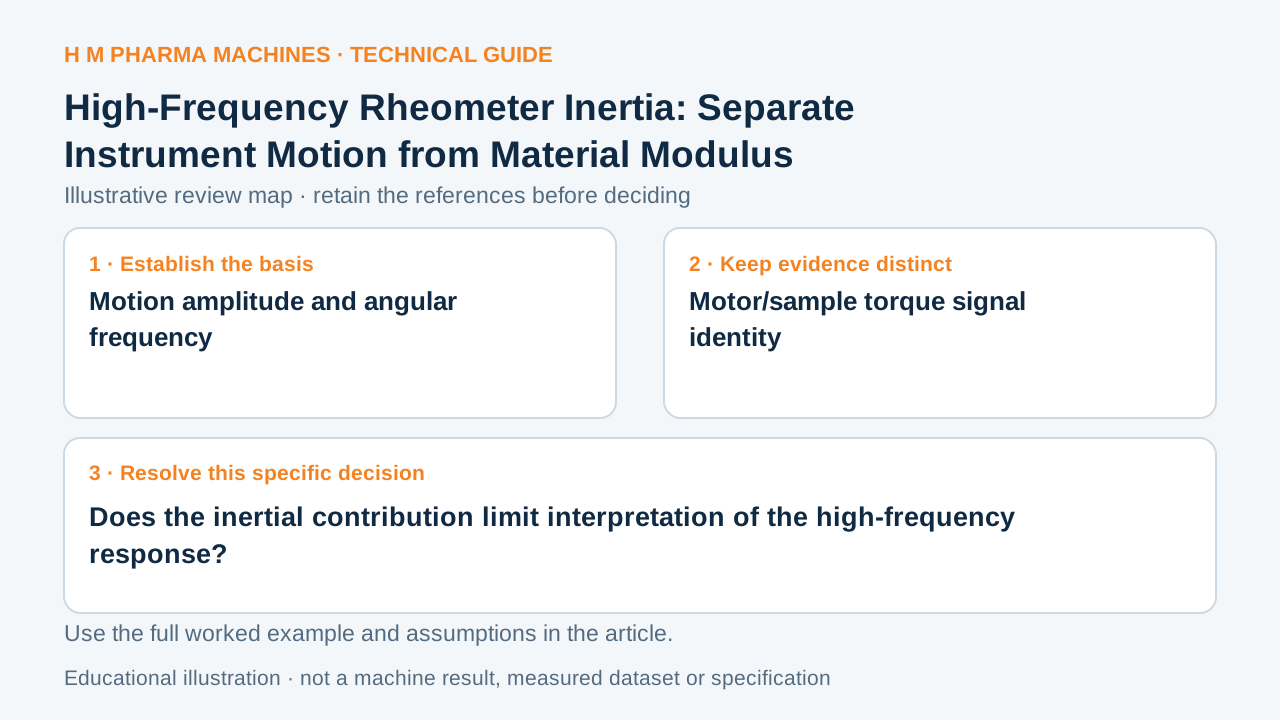
Ask which part of an oscillatory torque record belongs to accelerated instrument motion before interpreting the entire high-frequency response as material behavior.
Identify the Deformation and Model
TA Instruments explains that instrument inertia contributes torque during rotational acceleration and that its oscillatory contribution grows with angular frequency squared. The measured and corrected signal definitions therefore matter. Primary reference: instrument inertia.
Review a Hypothetical Comparison
For an invented rotating inertia I, angular displacement amplitude θ₀ and sinusoidal angular frequency ω, the inertial torque amplitude is Iω²θ₀. Doubling ω at the same I and θ₀ multiplies that term by four. This comparison describes the acceleration contribution, not a fourfold change in the sample modulus.
Keep the Evidence with the Decision
Request the actual motion trace, geometry identity, inertia characterization and correction basis with the high-frequency result. Distinguish motor torque from independently measured sample torque where the instrument design does so. Keep the residual signal and any documented interpretation limit visible rather than presenting a corrected curve as automatically unaffected by instrument dynamics.
Instrument architecture, coupling and correction validity need their own evidence. A frequency-dependent rise alone does not prove either intrinsic elasticity or an inertia artifact. The hypothetical scaling supplies no correction coefficient, supported frequency limit or HM rheometer specification. Its output is a signal-contribution review that states what must be separated before the material conclusion is used.
Does the inertial contribution limit interpretation of the high-frequency response?
This blank worksheet is for your own project. It contains no H M machine trial result.
| Review field | Reference or result | Responsible person |
|---|---|---|
| Motion amplitude and angular frequency | To complete | To complete |
| Motor/sample torque signal identity | To complete | To complete |
| Geometry inertia and correction basis | To complete | To complete |
| Residual signal and interpretation boundary | To complete | To complete |
Customer Questions
What happens to the modeled inertial term when frequency doubles?
It increases fourfold at unchanged inertia and angle amplitude.
Does that prove the material modulus quadruples?
No. Instrument motion is a separate contribution.
Can every instrument use the same correction?
No. Retain its own design and validated basis.
Primary References
These references support the technical principles discussed in this guide. The worked examples and review questions are educational.
Discuss Your Machine Requirement
Share your product, container, required output and the evidence needed for your technical review.
Request a Technical Review