
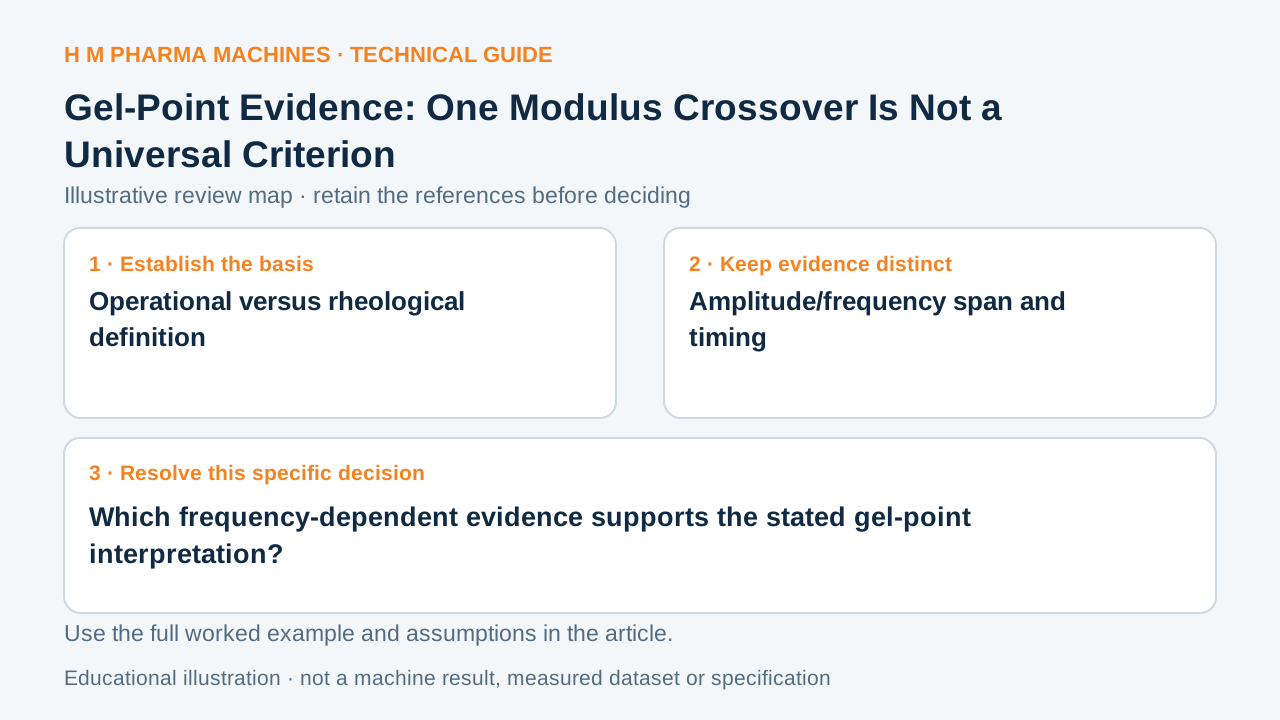
Request frequency-dependent evidence before treating one storage/loss modulus crossover as a universal gel-point criterion.
Identify the Deformation and Model
TA Instruments explains that the Winter-Chambon interpretation uses frequency-independent phase angle or tan δ with compatible power-law frequency dependence of the moduli. A single-frequency G′ = G″ observation can differ from this evidence. Primary reference: gel-point criteria.
Review a Hypothetical Comparison
Suppose an invented evolving material has G″/G′ = 0.5 at two distinct angular frequencies at one stated time. That shared ratio motivates a broader frequency-response check; it is not a complete gel-point determination from two points alone. A different observation with G′ = G″ at one frequency only establishes equality there.
Keep the Evidence with the Decision
Retain the measurement timing because the material can evolve while frequencies are acquired. Check amplitude range, frequency span, phase-angle comparability and the relevant modulus dependence together. Distinguish an operational set-time definition from a stated rheological criterion. Identify how the chosen method provides comparable material states across frequencies rather than silently combining observations from different cure stages.
A criterion requires its complete supporting evidence and material assumptions. No source resin, cure time or component ratio is reproduced in the fictional comparison, and no HM formulation or production setting is asserted. The useful output is a criterion-to-evidence map showing whether a convenient crossover label or a fuller frequency-based interpretation is actually supported.
Which frequency-dependent evidence supports the stated gel-point interpretation?
This blank worksheet is for your own project. It contains no H M machine trial result.
| Review field | Reference or result | Responsible person |
|---|---|---|
| Operational versus rheological definition | To complete | To complete |
| Amplitude/frequency span and timing | To complete | To complete |
| Phase ratio and modulus frequency law | To complete | To complete |
| Criterion evidence and missing checks | To complete | To complete |
Customer Questions
Is one G′ = G″ point universally the gel point?
No. The applicable criterion needs its evidence.
Do two equal tan δ values complete the criterion?
No. Review range, modulus dependence and material state.
Can evolving samples be combined without timing?
No. Their states must be comparable.
Primary References
These references support the technical principles discussed in this guide. The worked examples and review questions are educational.
Discuss Your Machine Requirement
Share your product, container, required output and the evidence needed for your technical review.
Request a Technical Review