
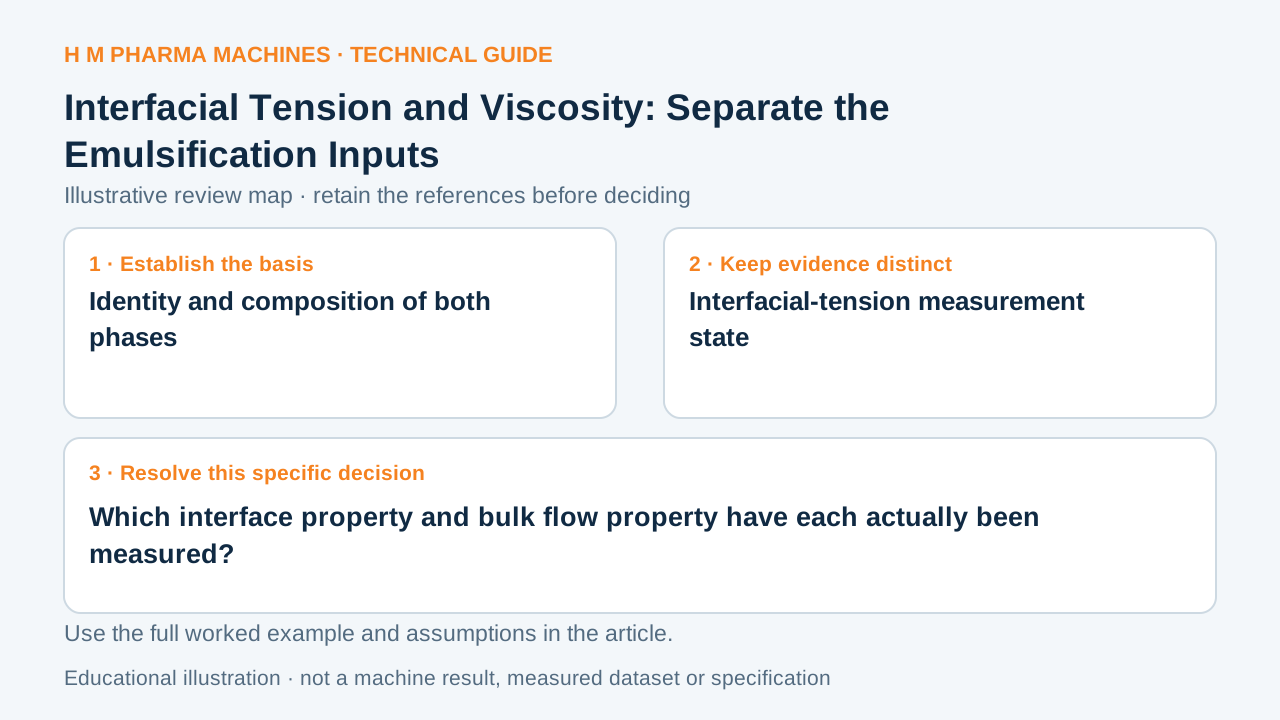
Viscosity and interfacial tension describe different resistance mechanisms. One cannot be inferred from the other.
Define the Process Model
KRÜSS’s liquid–liquid application report treats viscosity and interfacial tension as separate properties and discusses measurements under specified phase conditions. Viscosity characterizes fluid resistance in motion; interfacial tension characterizes the boundary between the adjoining phases. The identity and composition of both liquids belong to the latter result.
Compare a Hypothetical Case
Imagine two hypothetical phase pairs with the same measured continuous-phase viscosity of 0.010 Pa·s. Their interfacial tensions are 0.030 and 0.010 N/m. At the same selected velocity, the second gives three times the capillary number. Matching viscosity alone would have hidden that difference; neither number establishes which actual formulation will make a stable product.
Complete the Engineering Review
Record the phase pair, temperature, pressure, composition and measurement condition for interfacial tension. Keep the viscosity method and phase identity beside it. When additives change the formulation, ask whether both properties were characterized rather than substituting a single-liquid surface-tension value for the liquid–liquid boundary result.
For an ointment-manufacturing enquiry, supply the formulation’s actual property evidence. No values from the application report are assigned to HM or a customer product. The comparison explains why two apparently similar liquid-property sheets can still describe different interface behaviour.
Which interface property and bulk flow property have each actually been measured?
This blank worksheet is for your own project. It contains no H M machine trial result.
| Review field | Reference or result | Responsible person |
|---|---|---|
| Identity and composition of both phases | To complete | To complete |
| Interfacial-tension measurement state | To complete | To complete |
| Viscosity phase and method condition | To complete | To complete |
| Property changes after formulation changes | To complete | To complete |
Customer Questions
Does viscosity determine interfacial tension?
They require separate characterization.
Is liquid–air surface tension the same result?
A liquid–liquid pair defines another interface.
Can the example choose a mixer?
Actual process evidence is also required.
Related Equipment References
Review the actual offered equipment and application separately from this educational example.
Primary References
These references support the technical principles discussed in this guide. The worked examples and review questions are educational.
Discuss Your Machine Requirement
Share your product, container, required output and the evidence needed for your technical review.
Request a Technical Review