
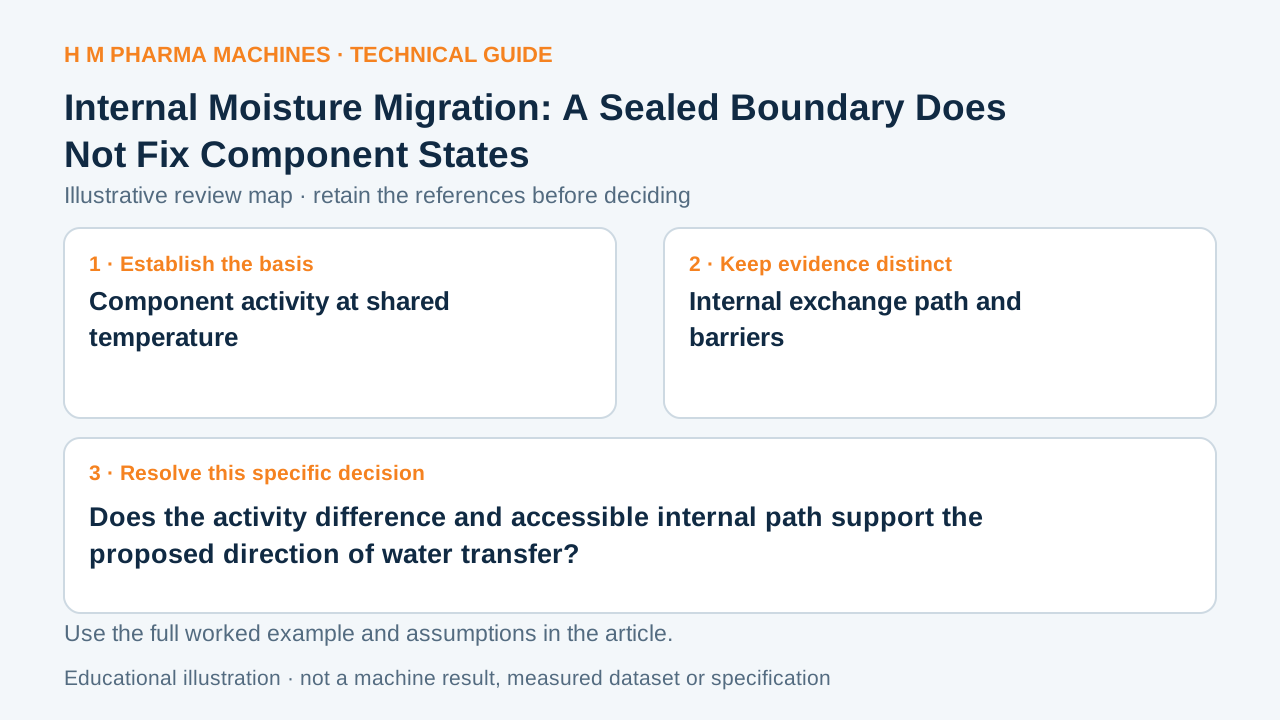
Review the direction of water exchange between connected components instead of assuming that a sealed outer package stops internal redistribution.
Define the Material or Thermodynamic Model
METER’s moisture-migration discussion identifies activity differences as a driving force for water exchange between components. At the same temperature, an accessible vapour pathway can carry water from the higher-activity component toward the lower-activity one; total water inventory alone does not specify direction.
Review a Hypothetical Comparison
Suppose fictional component A contains 6 g of water at activity 0.75, while B contains 14 g at 0.35. They share a vapour path at the same temperature. The stated activities favour transfer from A to B even though A contains less water. If a later invented observation finds A at 5 g and B at 15 g, the sealed system still contains 20 g; its constant total does not imply unchanged component states.
Keep the Evidence with the Decision
Draw the internal path as well as the outer boundary. Keep each component’s activity condition, initial inventory and later water account separately. A barrier around the whole assembly can reduce exchange with the environment while leaving internal exchange possible.
The 1 g transfer is an assigned observation, not a prediction of rate or endpoint. Material-specific sorption, accessible pathways and their resistance determine how much moves and how fast. No packaging lifetime or product-stability limit is established.
Does the activity difference and accessible internal path support the proposed direction of water transfer?
This blank worksheet is for your own project. It contains no H M machine trial result.
| Review field | Reference or result | Responsible person |
|---|---|---|
| Component activity at shared temperature | To complete | To complete |
| Internal exchange path and barriers | To complete | To complete |
| Separate component water accounts | To complete | To complete |
| Rate/endpoint evidence beyond direction | To complete | To complete |
Customer Questions
Which direction is favoured initially?
From the assigned activity 0.75 component toward 0.35.
What total water follows the later record?
20 g.
Does the example predict a 1 g transfer?
No; that later record is explicitly invented.
Primary References
These references support the technical principles discussed in this guide. The worked examples and review questions are educational.
Discuss Your Machine Requirement
Share your product, container, required output and the evidence needed for your technical review.
Request a Technical Review