
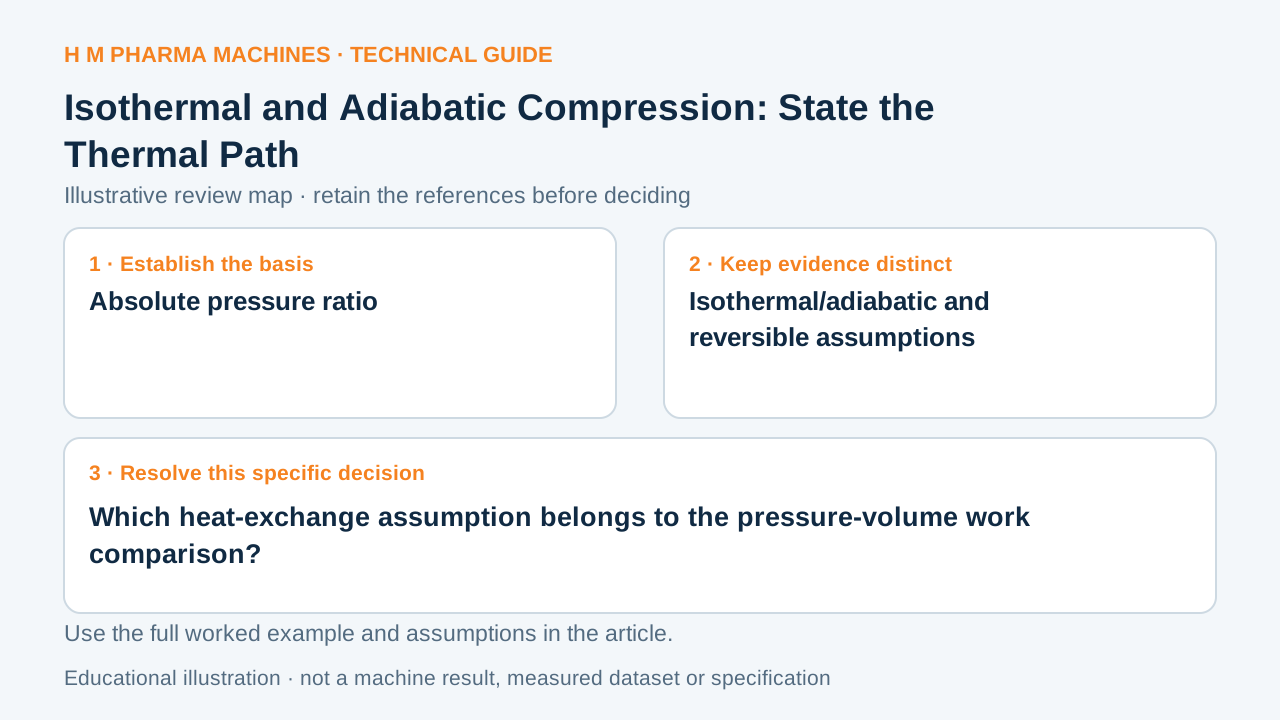
Label the heat-exchange and reversibility assumptions before comparing compression temperatures.
Define the Material or Thermodynamic Model
NASA’s isentropic derivation gives T2/T1 = (P2/P1)^((γ − 1)/γ) for the stated ideal-gas, no-loss path. Isothermal compression instead holds temperature fixed. Adiabatic describes heat exchange; reversibility is an additional assumption needed for the isentropic formula.
Review a Hypothetical Comparison
Start a fictional ideal gas at 300 K and compress through absolute pressure ratio 3 with constant γ = 1.4. The reversible adiabatic formula gives 410.62 K. An isothermal model gives 300 K. Neither result alone describes an actual compressor with losses and finite heat exchange, and this comparison does not reuse a vendor compressor dataset.
Keep the Evidence with the Decision
Name the model path alongside every predicted temperature. If an actual discharge temperature is being interpreted, distinguish heat exchange, irreversible losses and property variation rather than declaring the process reversible because it has insulation.
The assigned constant γ and ideal equation of state are explicit simplifications. No machinery rating, work requirement or cooling-system capacity is calculated.
Which heat-exchange assumption belongs to the pressure-volume work comparison?
This blank worksheet is for your own project. It contains no H M machine trial result.
| Review field | Reference or result | Responsible person |
|---|---|---|
| Absolute pressure ratio | To complete | To complete |
| Isothermal/adiabatic and reversible assumptions | To complete | To complete |
| Gas property range | To complete | To complete |
| Actual heat/loss evidence | To complete | To complete |
Customer Questions
What is the modelled adiabatic temperature?
410.62 K.
What is the isothermal temperature?
300 K by the imposed path.
Does insulation establish reversibility?
No; losses require a separate assumption or account.
Primary References
These references support the technical principles discussed in this guide. The worked examples and review questions are educational.
Discuss Your Machine Requirement
Share your product, container, required output and the evidence needed for your technical review.
Request a Technical Review