
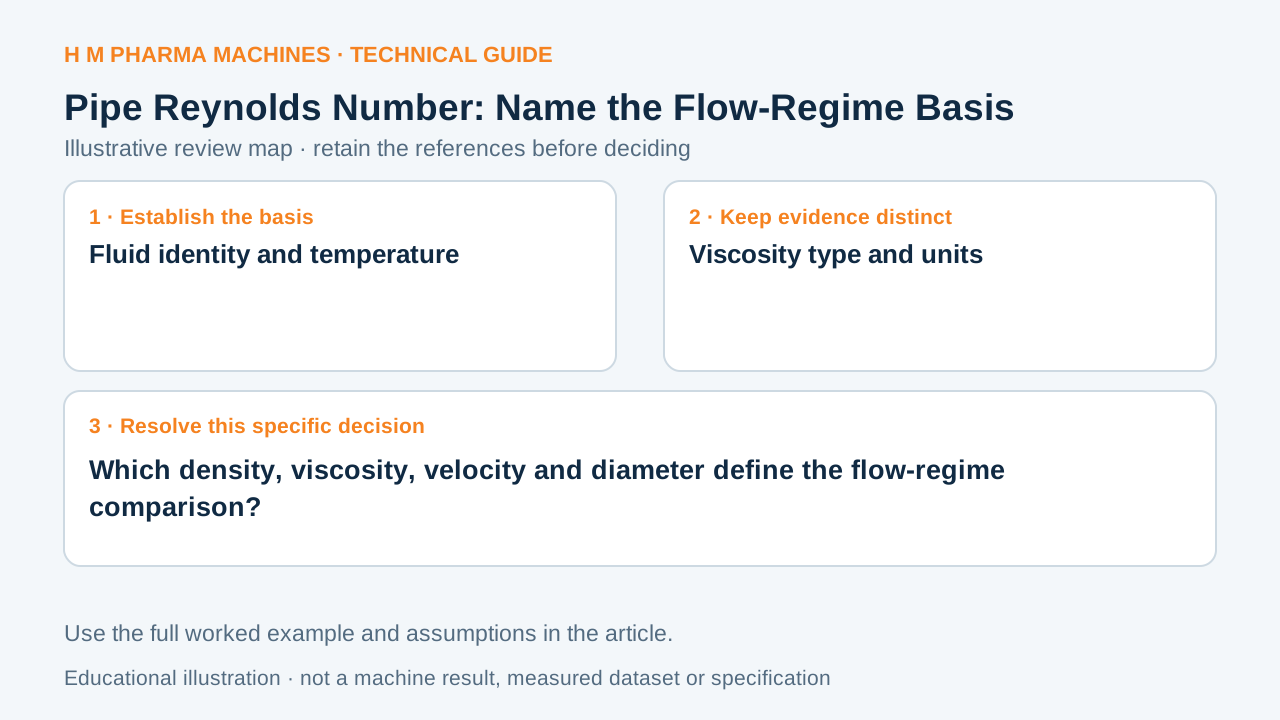
Before choosing a pipe-loss correlation, identify the fluid properties and actual passage used to calculate Reynolds number.
Identify the Physical Basis
For a Newtonian liquid in a circular pipe, Re = vD/ν = ρvD/μ. The dimensions must cancel. COMSOL’s pipe-flow equations place Reynolds number within the friction-correlation basis. This is a model-selection input; a convenient pump label does not establish the flow regime. Write down which physical properties and passage the number represents.
Work Through an Example
In a hypothetical comparison, v = 0.20 m/s, D = 0.020 m and ν = 10 × 10⁻⁶ m²/s give Re = 400. A second liquid at the same velocity and bore with ν = 1 × 10⁻⁶ m²/s gives Re = 4,000. Identical litres per minute therefore do not make these two cases hydraulically equivalent. These numbers describe an illustration, not a recommended transfer rate.
Use the Result in the Review
Write the temperature beside each viscosity value and distinguish dynamic from kinematic units. Then name the regime assumptions of the selected calculation and check whether the proposed operating range crosses them. If a bore changes along the route, calculate its local velocity and Reynolds number separately. A single number taken from a wider upstream section can conceal a different local condition.
Use the processing-tank page to identify the equipment context, then supply the actual transfer-line drawing for review. Non-Newtonian products need a justified rheological model; inserting one convenient apparent viscosity into the Newtonian expression does not establish that the chosen loss correlation applies.
Which density, viscosity, velocity and diameter define the flow-regime comparison?
This blank worksheet is for your own project. It contains no H M machine trial result.
| Review field | Reference or result | Responsible person |
|---|---|---|
| Fluid identity and temperature | To complete | To complete |
| Viscosity type and units | To complete | To complete |
| Inside diameter and local velocity | To complete | To complete |
| Correlation and regime assumptions | To complete | To complete |
Customer Questions
Is Reynolds number a flow rate?
No. It is a dimensionless comparison involving the fluid and passage as well as velocity.
Can I use nominal pipe size for D?
Use the actual inside diameter relevant to the calculation.
Does a high value prove good mixing?
No. A pipe-flow regime does not by itself establish a vessel mixing result.
Related Equipment References
Review the actual offered equipment and application separately from this educational example.
Primary References
These references support the technical principles discussed in this guide. The worked examples and review questions are educational.
Discuss Your Machine Requirement
Share your product, container, required output and the evidence needed for your technical review.
Request a Technical Review