
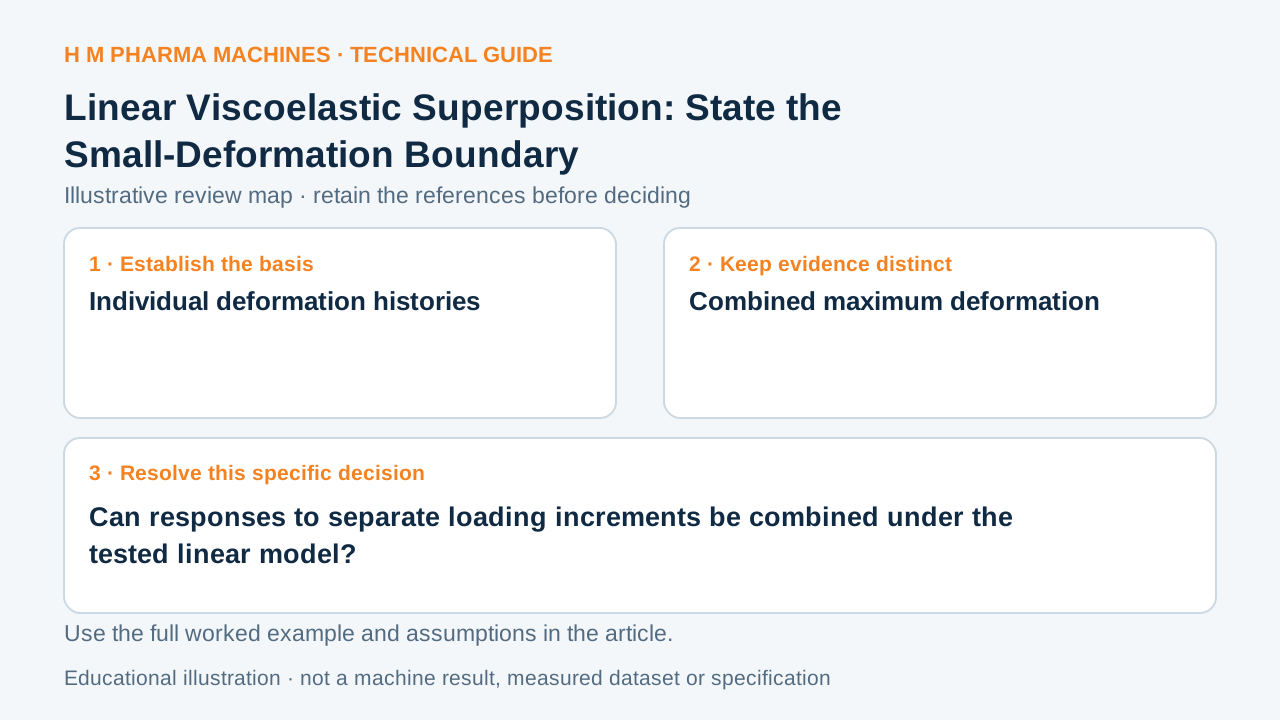
State the tested linearity boundary before combining responses to separate deformation increments into one viscoelastic prediction.
Identify the Deformation and Model
TA Instruments describes the Boltzmann superposition principle for independent deformation contributions within the linear viscoelastic region. The linear boundary belongs to the proposed addition of responses. Primary reference: linear viscoelastic superposition.
Review a Hypothetical Comparison
Suppose a hypothetical linear model predicts 2 Pa from one identified small strain history and 3 Pa from another at the same observation time. Their combined prediction is 5 Pa. That sum assumes the same unchanged linear material model; it is not a rule that measured responses at arbitrary amplitudes or preparation states must add.
Keep the Evidence with the Decision
Keep each complete input history and its time origin with the predicted contribution. Check that their combined deformation, rather than only each component in isolation, remains within the established range. Retain temperature and initial material condition so contributions from different states are not silently superposed. Compare the calculated combined response with available validation evidence.
An amplitude sweep can help characterize a range but does not by itself supply every response kernel or justify every transient sequence. Nor does “linear” mean that stress is independent of time. Use superposition only with its stated model and tested boundary. The fictional stress contributions are not HM material measurements or a machinery load approval; the useful output is an input-history and range check for the prediction.
Can responses to separate loading increments be combined under the tested linear model?
This blank worksheet is for your own project. It contains no H M machine trial result.
| Review field | Reference or result | Responsible person |
|---|---|---|
| Individual deformation histories | To complete | To complete |
| Combined maximum deformation | To complete | To complete |
| Common state/linear-range evidence | To complete | To complete |
| Calculated response and validation basis | To complete | To complete |
Customer Questions
What gives 5 Pa in the hypothetical model?
Adding the two compatible linear contributions.
Is checking each amplitude separately always enough?
No. Check their combined deformation too.
Does linear viscoelasticity mean time-independent stress?
No. Its response can still depend on history.
Primary References
These references support the technical principles discussed in this guide. The worked examples and review questions are educational.
Discuss Your Machine Requirement
Share your product, container, required output and the evidence needed for your technical review.
Request a Technical Review