
Use correctly paired terminal temperatures before replacing an exchanger’s changing temperature difference with one mean value.
Define the Thermal Model
For positive terminal differences ΔT₁ and ΔT₂, LMTD = (ΔT₁ − ΔT₂)/ln(ΔT₁/ΔT₂). Alfa Laval’s calculation method pairs the hot inlet with cold outlet and hot outlet with cold inlet for counter-current flow. The equal-difference limit is that common difference, rather than an undefined zero-over-zero result.
Compare a Hypothetical Case
Consider invented counter-current endpoints giving ΔT₁ = 60 K and ΔT₂ = 20 K. LMTD is 40/ln(3), approximately 36.41 K. The arithmetic mean is 40 K. For the same assumed duty and U, using 40 K would calculate only about 91% of the area obtained with LMTD. This comparison tests averaging, not a selected exchanger.
Complete the Engineering Review
Place both streams on one flow sketch and pair temperatures at the physical ends. Check that the assumed heat flow remains in the intended direction. Document any configuration correction required for multiple passes or other arrangements; a counterflow expression should not silently become a universal exchanger formula.
When discussing a manufacturing-vessel utility interface, provide the external exchanger’s actual arrangement and temperature program. The calculation does not establish the U value, pressure loss or control performance. Each input should remain traceable to its own design case.
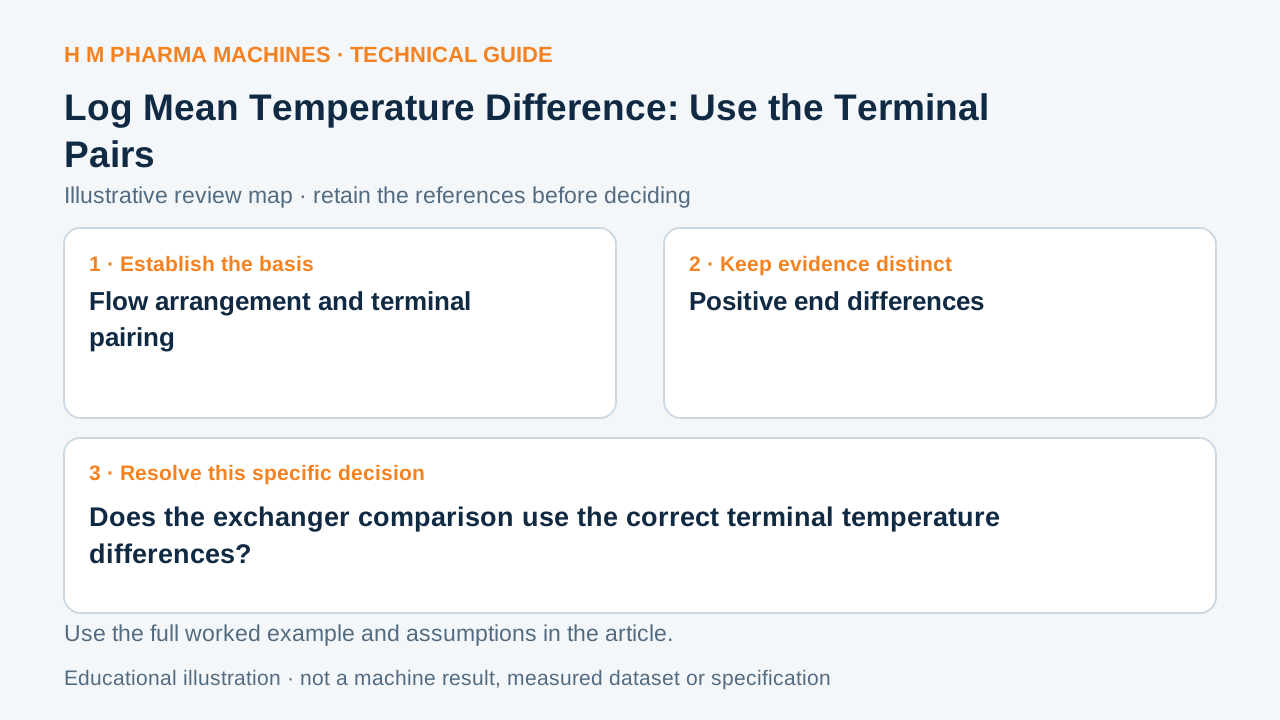
Does the exchanger comparison use the correct terminal temperature differences?
This blank worksheet is for your own project. It contains no H M machine trial result.
| Review field | Reference or result | Responsible person |
|---|---|---|
| Flow arrangement and terminal pairing | To complete | To complete |
| Positive end differences | To complete | To complete |
| LMTD and equal-difference limit | To complete | To complete |
| Configuration correction basis | To complete | To complete |
Customer Questions
Can I always use the arithmetic mean?
Check the error for the stated endpoints.
What if both differences are equal?
LMTD equals that common difference.
Can negative differences be ignored?
No. Revisit the physical temperature program.
Related Equipment References
Review the actual offered equipment and application separately from this educational example.
Primary References
These references support the technical principles discussed in this guide. The worked examples and review questions are educational.
Discuss Your Machine Requirement
Share your product, container, required output and the evidence needed for your technical review.
Request a Technical Review