
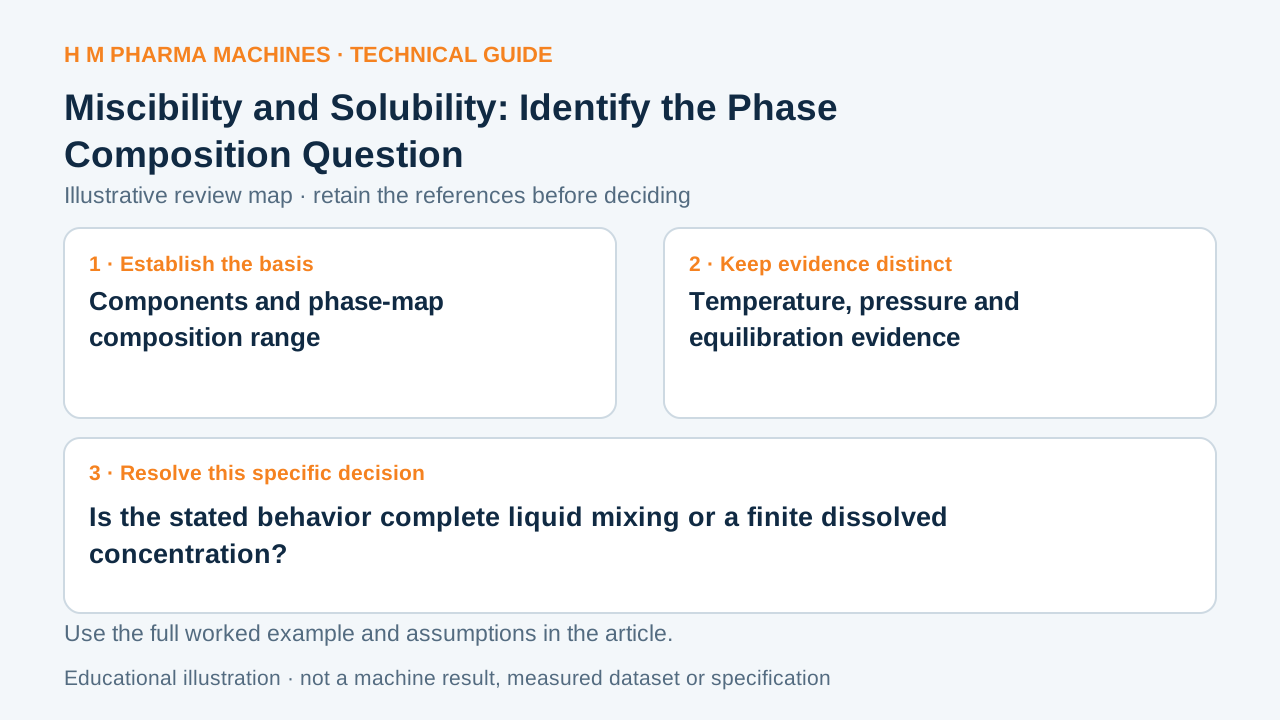
Decide whether the question concerns liquid-phase formation or the finite amount of a substance that dissolves.
Define the Interface or Transport Basis
IUPAC defines miscibility through forming one phase over specified temperature, pressure and composition ranges. Its mutual-solubility entry describes limited miscibility between components. A dissolved-concentration limit and a liquid phase map are therefore related but different descriptions.
Review a Hypothetical Comparison
Imagine a fictional liquid pair tested at fixed temperature and pressure. Mixtures containing 10%, 50% and 90% of component B each form one equilibrated liquid phase. Those observations support one-phase behavior at the tested compositions; they do not establish every composition between them or other temperatures. Separately, a solid solute can have a hypothetical saturation concentration of 12 g/L in the resulting solvent. That number does not state whether the two solvent liquids mix into one phase.
Keep the Evidence with the Decision
Use one sheet for the phase map and another for the dissolved-solute concentration. On the phase sheet list compositions, temperature, equilibration time and observed phase count. On the concentration sheet identify the solute, concentration basis and equilibrium evidence. A clear sample before equilibration is an observation to investigate, not a complete phase diagram.
Do not transfer a water-based solubility value to a mixed solvent without evidence. The worksheet identifies which experiment answers the question; it supplies no formulation limit for an HM installation.
Is the stated behavior complete liquid mixing or a finite dissolved concentration?
This blank worksheet is for your own project. It contains no H M machine trial result.
| Review field | Reference or result | Responsible person |
|---|---|---|
| Components and phase-map composition range | To complete | To complete |
| Temperature, pressure and equilibration evidence | To complete | To complete |
| Observed phase count at each point | To complete | To complete |
| Solute identity and saturation concentration basis | To complete | To complete |
Customer Questions
Does one clear mixture prove complete miscibility?
It supports that observed state, not the entire composition and temperature range.
Is solubility always a solid-in-liquid question?
No. Identify the phases and components; limited mutual solubility can concern two liquids.
Can a solubility number replace a phase map?
No. A concentration limit does not describe all possible mixture states.
Primary References
These references support the technical principles discussed in this guide. The worked examples and review questions are educational.
Discuss Your Machine Requirement
Share your product, container, required output and the evidence needed for your technical review.
Request a Technical Review