
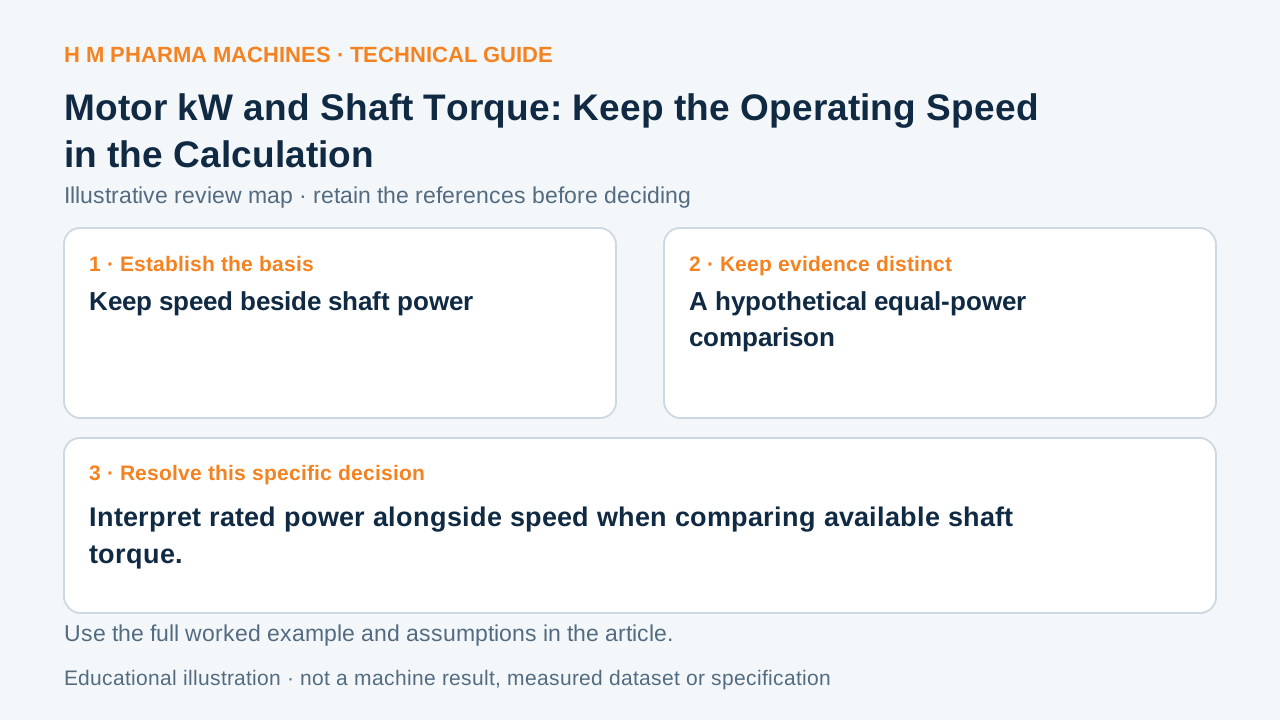
The kW figure alone does not describe torque available at every speed.
Keep speed beside shaft power
ABB's drive-dimensioning guidance relates mechanical power, torque and rotational speed. A torque calculation needs a stated speed and the relevant power basis. Primary reference: ABB drive-system dimensioning.
For a simple steady rotational point, shaft power equals torque multiplied by angular speed. That relationship converts quantities at a defined point; it does not establish a motor's full operating envelope. Keep electrical input power distinguishable from mechanical shaft output when reading the offer.
A hypothetical equal-power comparison
Assume fictional shaft output of 1 kW at 1,000 revolutions per minute. Angular speed is 2π×1,000/60, about 104.72 rad/s, and the corresponding torque is about 9.55 N·m. The same assumed 1 kW at 500 rpm corresponds to about 19.10 N·m. These are separate teaching operating points, not evidence that an actual motor maintains 1 kW across both speeds.
Record output-power basis, speed, angular-speed conversion and torque together. The values describe no HM motor, permissible speed range or selected drive. Do not replace the real motor's torque/speed and thermal evidence with the arithmetic.
Request the relevant operating envelope
Ask which torque is available and required at the actual operating speeds, including relevant transient and sustained conditions. A matching nameplate kW does not answer every acceleration or low-speed-duty question.
Keep the accepted motor/drive identity and operating-point evidence with the load schedule. If speed or transmission changes, revisit the relevant torque comparison. The guide gives a defined conversion worksheet without selecting a motor, prescribing a service factor or treating a constant-power teaching assumption as a guaranteed characteristic of the proposed machinery.
Customer Questions
Can kW alone state available torque?
No. The corresponding speed and output-power basis are needed.
Does the example prove a real constant-power range?
No. It calculates two invented operating points.
Should input watts be silently treated as shaft output?
No. Preserve the stated power boundary.
Primary References
These references support the technical principles discussed in this guide. The worked examples and review questions are educational.
Discuss Your Machine Requirement
Share your product, container, required output and the evidence needed for your technical review.
Request a Technical Review