
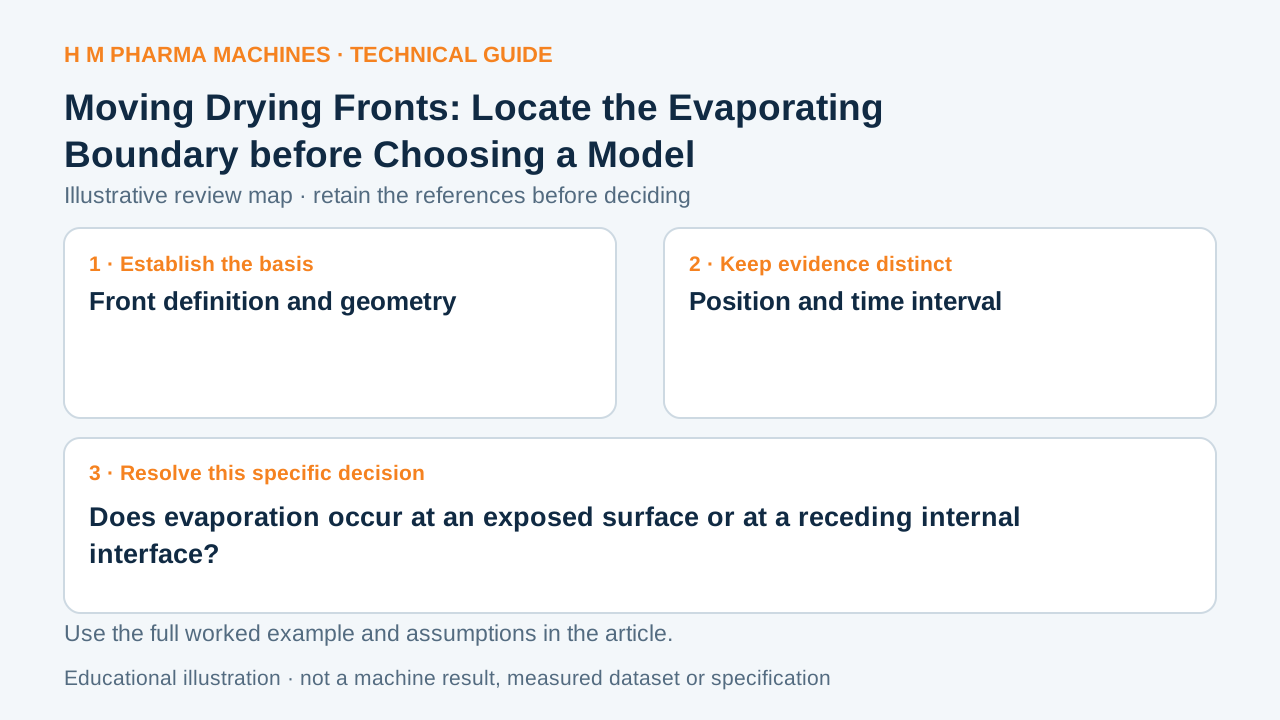
Track the internal evaporation boundary when a receding-front model is proposed; a dry outer surface does not locate the remaining wet region.
Define the Material or Thermodynamic Model
The Torabi–Mehrafarin drying model treats the evaporation boundary as a moving interface between wet and dry regions. In its falling-rate description, the interface recedes inside a porous medium. Front position is a spatial model variable distinct from a total water-loss curve.
Review a Hypothetical Comparison
Imagine a 5 mm slab with an assigned front 1.0 mm below the exposed face at time A and 1.5 mm at time B. The modelled dry-layer thickness increases by 0.5 mm while wet material remains deeper inside. An observation that the face looks dry at both times cannot distinguish those two interface positions.
Keep the Evidence with the Decision
Record the assumed geometry, front definition and independent observation used to estimate position. Check whether a sharp interface is defensible or whether the material instead has a broad moisture profile.
The fictional positions are not measurements and give no front velocity without a time interval. A receding-interface model is one representation of porous drying, not a universal mechanism for every solid or solvent system.
Does evaporation occur at an exposed surface or at a receding internal interface?
This blank worksheet is for your own project. It contains no H M machine trial result.
| Review field | Reference or result | Responsible person |
|---|---|---|
| Front definition and geometry | To complete | To complete |
| Position and time interval | To complete | To complete |
| Spatial observation supporting the front | To complete | To complete |
| Sharp-boundary versus distributed-profile model | To complete | To complete |
Customer Questions
How far does the assigned front advance?
0.5 mm inward.
Is the slab fully dry at B?
Not on the stated model.
Can surface appearance locate the front?
The example supplies no such mapping.
Primary References
These references support the technical principles discussed in this guide. The worked examples and review questions are educational.
Discuss Your Machine Requirement
Share your product, container, required output and the evidence needed for your technical review.
Request a Technical Review