
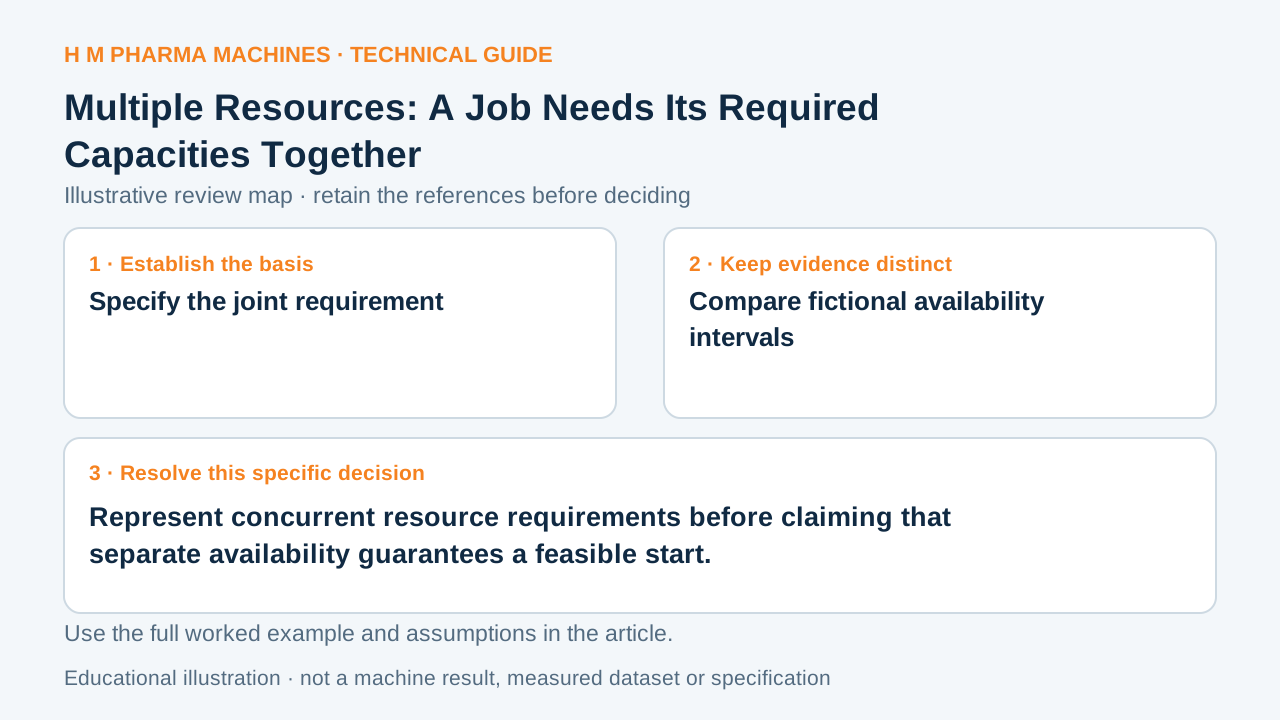
Resources available at separate times do not necessarily permit one joint task. Define whether the job acquires a complete set together.
Specify the joint requirement
A resource-acquisition model can wait until an entire required set is available and then seize its units together. This differs from acquiring units one by one while holding earlier acquisitions. A task requiring both a tool and an operator needs a defined policy for those simultaneous requirements. Primary reference: AnyLogic Seize: whole-set and sequential resource acquisition.
For an original resource sheet, distinguish one required set from alternative acceptable sets. Replacing a missing tool with another operator is not allowed unless the model explicitly defines that alternative. State how many units from each pool the same job must hold throughout the modeled task.
Compare fictional availability intervals
Suppose a hypothetical job needs one tool and one operator for a continuous 2-minute task. The tool is available from minute 0 to 2, while the operator is available from 3 to 5. Each has two free minutes, but there is no overlapping interval permitting that joint task.
If the tool also becomes available from 3 to 5, the complete set can serve the job from 3 to 5 under a whole-set acquisition rule. Separate total free-time figures would have missed the first scenario’s incompatibility. This example assumes no travel, preparation or interruption.
Review a joint-start trial
Prepare a timeline showing each required unit’s availability and the intersection used by the task. At the modeled start, check that every requirement is granted, then retain all required releases. If sequential acquisition is chosen instead, explicitly record any partial holds while waiting for the rest.
Actual task requirements and acceptable alternatives need their own operational evidence. These fictional intervals do not establish machine staffing or tooling sufficiency. The reader decision is whether independently free resources have been mistaken for a concurrently available complete set.
Customer Questions
Are separately available resources enough for a joint task?
No. The required units must overlap for the defined task interval.
Can the first fictional scenario start the task?
No. Tool and operator availability do not overlap.
Is whole-set acquisition the same as taking units one by one?
No. Partial holding changes the resource-state logic.
Primary References
These references support the technical principles discussed in this guide. The worked examples and review questions are educational.
Discuss Your Machine Requirement
Share your product, container, required output and the evidence needed for your technical review.
Request a Technical Review