
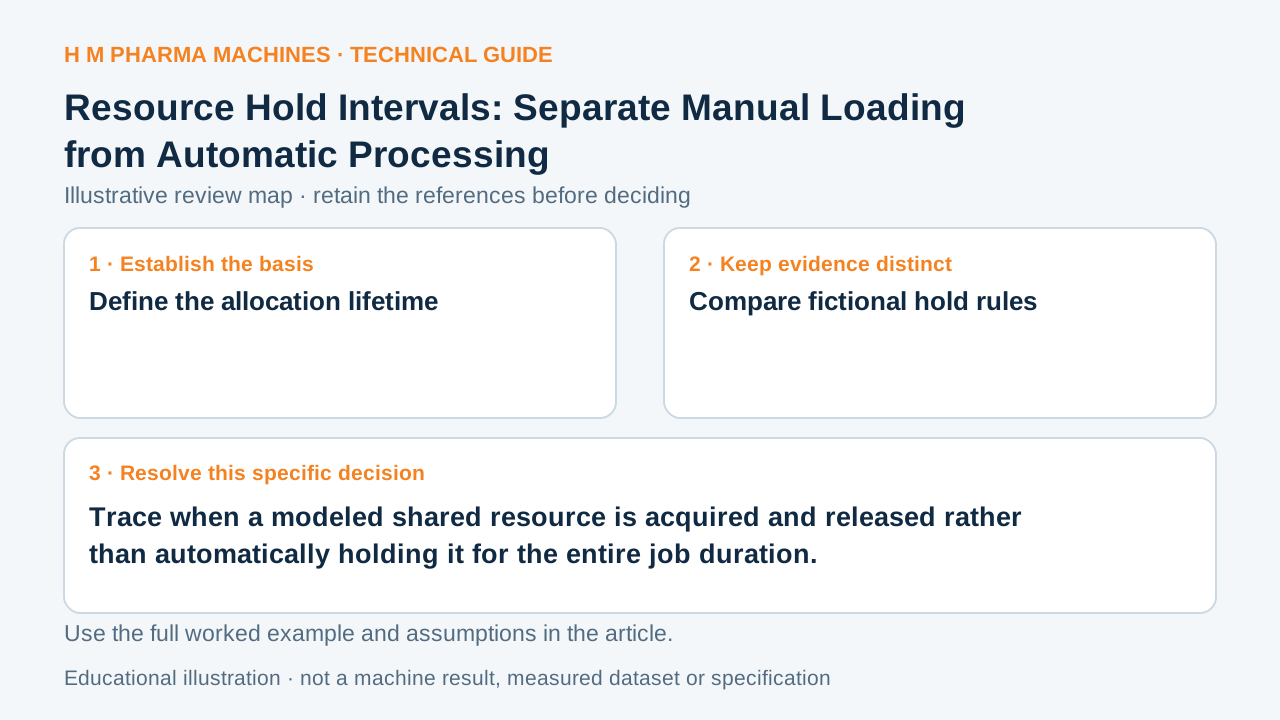
A resource may be held for only part of a job, or throughout its duration. Make that allocation rule explicit instead of inferring it from the job’s overall time.
Define the allocation lifetime
A shared-resource request occupies a unit until the model releases it. The resource can remain allocated during a delay even when the model describes that delay as automatic processing. Its hold lifetime is therefore a separate definition from the duration of the complete job. Primary reference: SimPy shared resource primitives: requests, capacity and release.
For an original resource-state worksheet, mark acquisition and release events around each task. State whether automatic processing releases the modeled operator or retains that unit. Neither rule follows solely from the word automatic; the task requirements determine which model is intended.
Compare fictional hold rules
Suppose job A begins loading at minute 0, needs 2 minutes of modeled operator occupation, then performs 5 minutes of automatic processing. Under a release-after-loading rule, the operator is free at minute 2 while A’s processing continues until minute 7. Another eligible loading request can acquire that unit at minute 2.
Under a retain-through-processing rule, the same unit stays allocated to A until minute 7, so another loading request cannot acquire it before then. The job durations are unchanged in this comparison; only the resource allocation lifetime differs. Any unloading requirement would need its own request and event.
Review the held-state timeline
Prepare a trial ledger of resource owner, acquisition, automatic-processing interval and release. Check ownership immediately before and after the minute-2 event. A display showing an operator beside the machine is not the governing allocation rule; the request-and-release state history is.
Then justify the chosen hold rule using the intended operation. The example neither permits a real person to leave equipment unattended nor establishes staffing capacity or an HM procedure. Its reader decision is whether the simulation has intentionally retained or released a shared unit during another task’s automatic interval.
Customer Questions
Does calling processing automatic release the resource?
No. Release depends on the model’s explicit allocation rule.
When is the unit free under release-after-loading?
Minute 2 in the stated fictional timeline.
Are unloading requirements already represented?
No. They need their own defined request and release events.
Primary References
These references support the technical principles discussed in this guide. The worked examples and review questions are educational.
Discuss Your Machine Requirement
Share your product, container, required output and the evidence needed for your technical review.
Request a Technical Review