
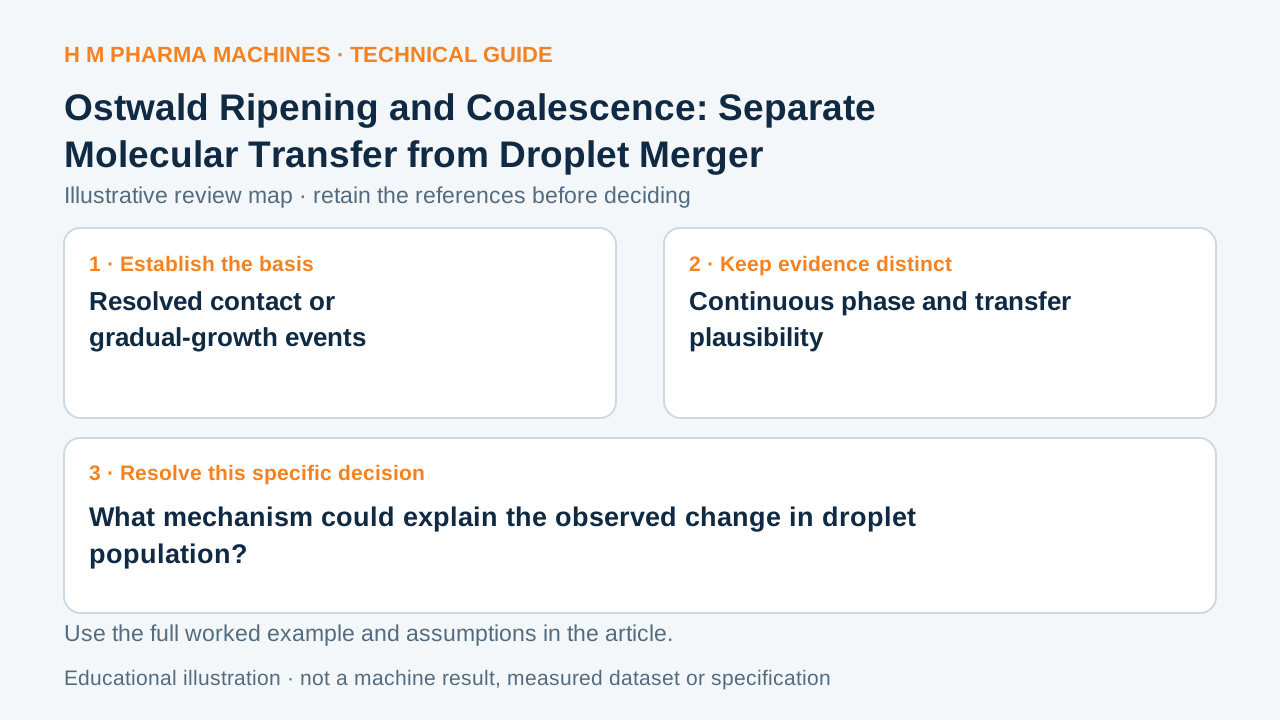
Droplets can become larger by molecular transfer or by merging; a size trend alone does not identify the route.
Define the Interface or Transport Basis
Cates' primary emulsion lectures, sections 3.4–3.5 distinguish coalescence from Ostwald ripening. In the latter, material diffuses through the continuous phase between droplets. Coalescence instead joins droplets when the separating boundary fails. Both can coarsen a population while conserving dispersed material in a closed idealized sample.
Review a Hypothetical Comparison
Consider a hypothetical time-resolved view. Two initially separate droplets with volumes 4 and 6 arbitrary units touch and become one of volume 10: a resolved merger supports coalescence. Another record shows a small droplet gradually shrinking while a distant larger droplet grows, without a contact event. That second pattern motivates a molecular-transfer investigation, but the observation must also exclude transport out of view. The two records require different evidence even if their average final size happens to match.
Keep the Evidence with the Decision
Keep event-resolved images or another method capable of distinguishing the proposed route, together with the size distribution. Record the continuous phase and whether dispersed material can dissolve in it. Track material entering or leaving the observation window before interpreting disappearance as dissolution. Ask whether the measurement resolution could hide short contact events.
These invented sequences illustrate evidence selection. They do not supply a ripening rate, prove one mechanism from two snapshots or establish a product's storage lifetime.
What mechanism could explain the observed change in droplet population?
This blank worksheet is for your own project. It contains no H M machine trial result.
| Review field | Reference or result | Responsible person |
|---|---|---|
| Resolved contact or gradual-growth events | To complete | To complete |
| Continuous phase and transfer plausibility | To complete | To complete |
| Population distribution over time | To complete | To complete |
| Observation-window material balance | To complete | To complete |
Customer Questions
Does larger average size prove coalescence?
No. Molecular transfer and population sampling changes can also affect the average.
Does preventing contact automatically stop ripening?
No. Material can still transfer through the continuous phase when that route is possible.
Why record the observation window?
A droplet moving out of view should not be mistaken for one that dissolved.
Primary References
These references support the technical principles discussed in this guide. The worked examples and review questions are educational.
Discuss Your Machine Requirement
Share your product, container, required output and the evidence needed for your technical review.
Request a Technical Review