
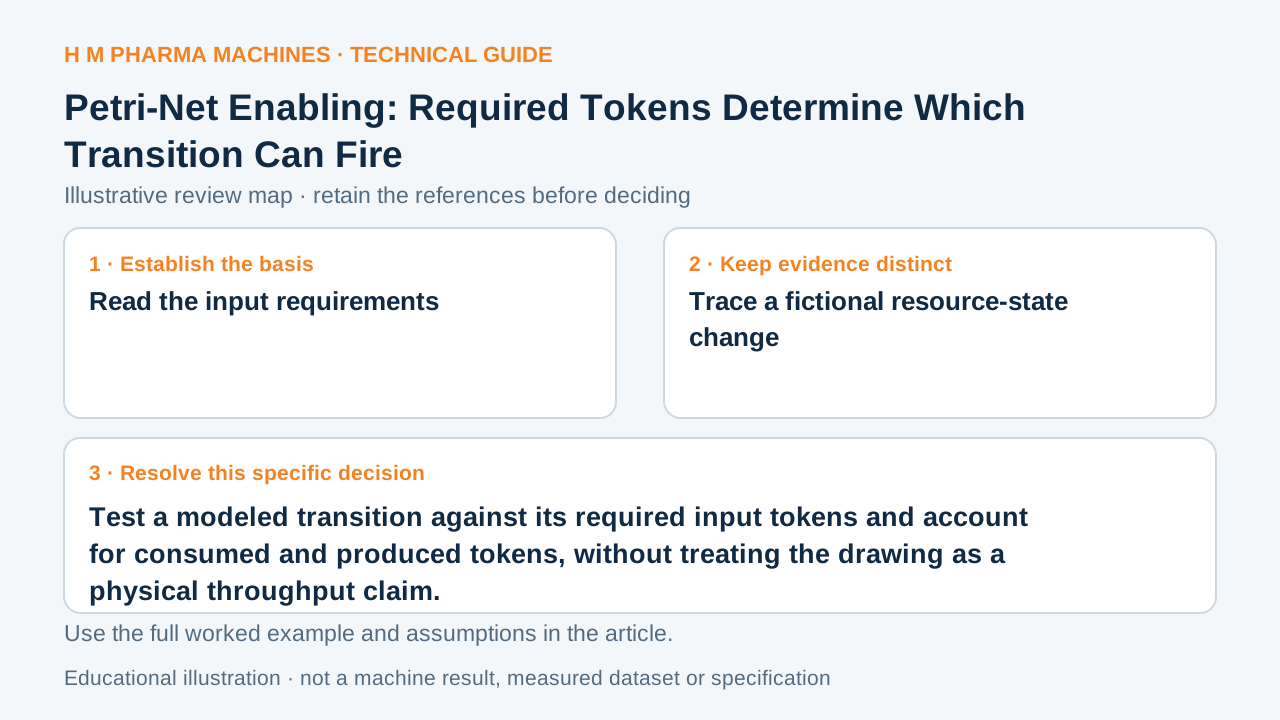
A Petri-net drawing represents state and permitted transitions. Check its token requirements before treating a pictured action as enabled.
Read the input requirements
In an ordinary unit-weight Petri net, a transition is enabled when each input place contains at least one token. Firing removes one token from every input place and produces one in every output place. This formal rule describes a marking change; the graph alone supplies no physical processing duration. Primary reference: Van der Aalst: Petri-net enabling and firing definitions.
For an original worksheet, name each place and state what its tokens represent. Do not use a job token and a free-resource token interchangeably merely because both are drawn as dots. Also keep this unit-weight example separate from extensions with arc multiplicities, timing or extra enabling rules.
Trace a fictional resource-state change
Suppose transition Start has input places ReadyJob and FreeTool, and output places ActiveJob and HeldTool. With one token in each input and none in the outputs, Start is enabled. After one firing the input counts are zero and the two output counts are one each.
If ReadyJob has a token but FreeTool has none, Start is not enabled. An original Finish transition consuming ActiveJob and HeldTool and producing DoneJob and FreeTool can return the tool token. In this defined cycle, FreeTool plus HeldTool stays equal to one; that conservation follows the specified arcs.
Review the model without inventing timing
Prepare a before-and-after marking table for each trial firing and verify every consumed and produced token. A transition being enabled means it may fire under the formal rule; it does not show when a real action starts. If competing transitions share a token, record the choice logic separately.
This small model is not a machine controller, a safety interlock or proof of throughput. It is also not a deadlock analysis. Its reader decision is whether the current marking permits one stated transition and whether the resulting resource-token accounting follows the defined net.
Customer Questions
Can Start fire with no FreeTool token?
No. That input requirement is missing in the stated net.
Does an enabled transition establish a processing time?
No. This untimed net specifies permitted state changes only.
Why does FreeTool plus HeldTool stay one?
The specified Start and Finish arcs move that one modeled resource token between the two places.
Primary References
These references support the technical principles discussed in this guide. The worked examples and review questions are educational.
Discuss Your Machine Requirement
Share your product, container, required output and the evidence needed for your technical review.
Request a Technical Review