
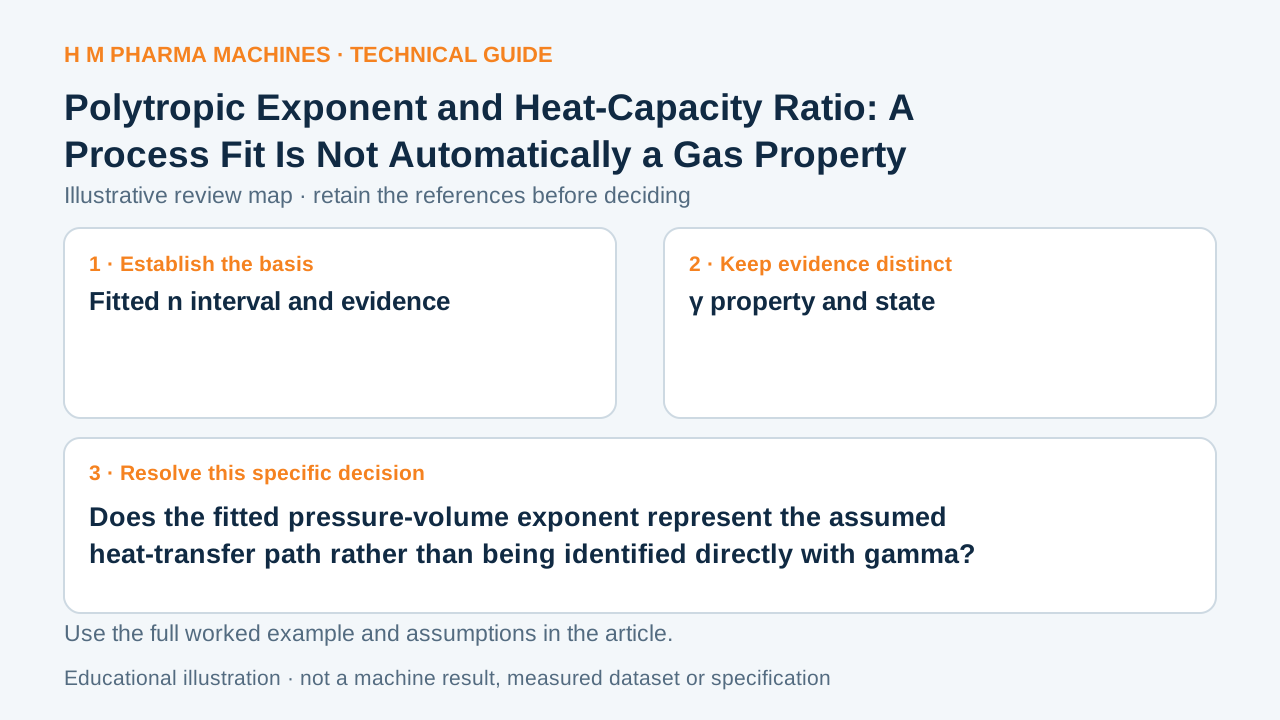
A fitted pressure-volume exponent describes a process relation; do not automatically equate it with the gas heat-capacity ratio.
Define the Material or Thermodynamic Model
NPTEL’s process discussion distinguishes PV^n = constant with n = 1 for ideal isothermal behaviour from the frictionless adiabatic case n = γ. For a fixed amount of ideal gas on the stated polytropic path, combining that relation with PV ∝ T gives T2/T1 = (P2/P1)^((n − 1)/n).
Review a Hypothetical Comparison
Assign two fictional endpoints for a fixed amount of ideal gas: absolute pressure ratio P2/P1 = 2 and volume ratio V1/V2 = 1.8. The endpoint exponent is ln(2)/ln(1.8) = 1.17925. Substituting a separately assigned γ = 1.40 would instead predict a pressure ratio 1.8^1.40 = 2.27710 for that volume ratio. The endpoint temperature ratio is 2/1.8 = 1.11111. These two records do not prove that one exponent describes every intermediate state.
Keep the Evidence with the Decision
Document the interval over which the exponent was fitted and the thermal model used to interpret it. Keep the material property γ beside its state and keep the process parameter n beside its fit data.
The two numbers are invented. A single exponent need not describe an entire real process, and this ideal-gas identity supplies no compressor efficiency or heat-removal rate.
Does the fitted pressure-volume exponent represent the assumed heat-transfer path rather than being identified directly with gamma?
This blank worksheet is for your own project. It contains no H M machine trial result.
| Review field | Reference or result | Responsible person |
|---|---|---|
| Fitted n interval and evidence | To complete | To complete |
| γ property and state | To complete | To complete |
| Pressure-volume path assumption | To complete | To complete |
| Temperature relation and fit limitations | To complete | To complete |
Customer Questions
What exponent fits the assigned endpoints?
1.17925.
What pressure ratio follows from the assigned γ instead?
2.27710 for the stated volume ratio.
Do two endpoints prove a constant-exponent path?
No; the intermediate path is not supplied.
Primary References
These references support the technical principles discussed in this guide. The worked examples and review questions are educational.
Discuss Your Machine Requirement
Share your product, container, required output and the evidence needed for your technical review.
Request a Technical Review