
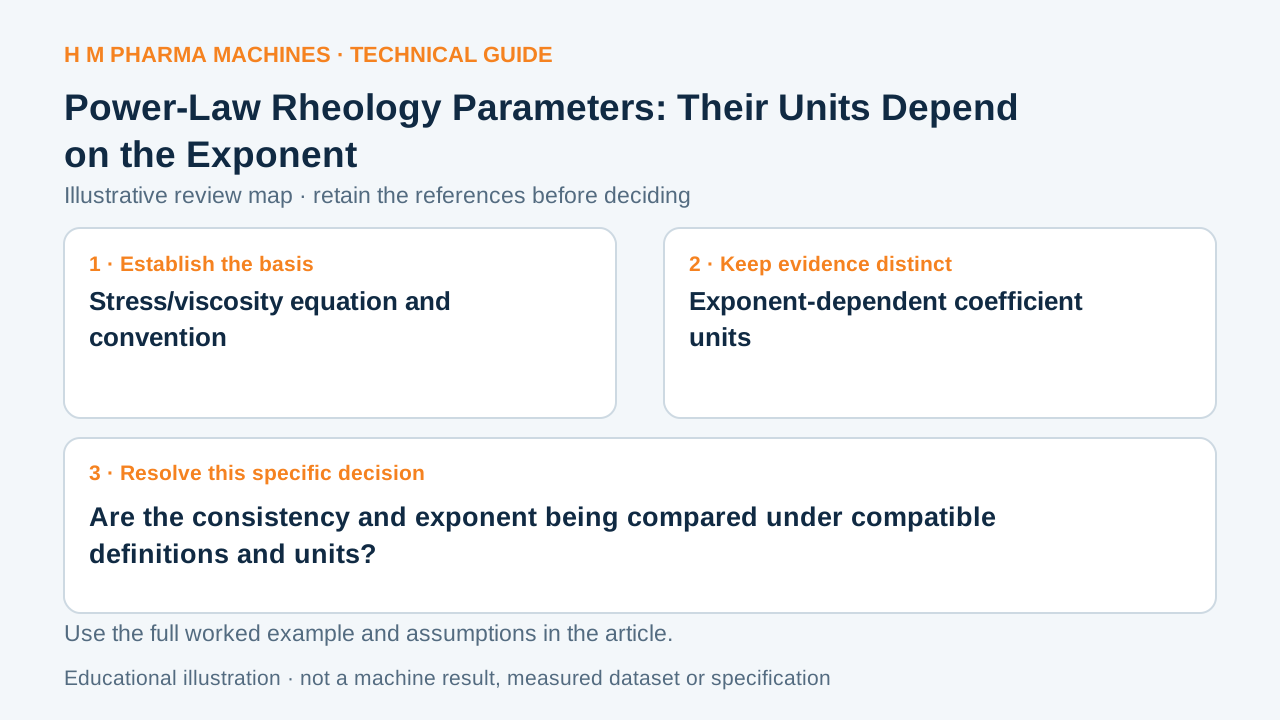
Keep the exponent-dependent units of the power-law consistency parameter before comparing two rheology fits with the same numerical coefficient.
Identify the Deformation and Model
Altair documents the consistency parameter of its power-law rheology model in Pa·sⁿ, where n is the model exponent. The exact equation and parameter convention must accompany its numbers. Primary reference: power-law parameter definitions.
Review a Hypothetical Comparison
Use the explicitly chosen fictional stress equation τ = Kγ̇ⁿ. With K = 2 Pa·s⁰·⁵, n = 0.5 and rate 4 per second, predicted stress is 4 Pa. With K = 2 Pa·s and n = 1 at the same rate, predicted stress is 8 Pa. The two numerical “2” coefficients have different dimensions and do not assert identical viscosity.
Keep the Evidence with the Decision
Retain the fitted stress or viscosity equation, dimensional units, rate units and supported rate interval. Convert the model into predicted stress or apparent viscosity at a common stated rate when a comparison is needed. Check whether the software uses a reference-rate normalization or truncation that changes the parameter meaning. Keep coefficient changes distinct from a simple viscosity-unit conversion.
A power law fitted over one interval does not supply every low- or high-rate limit. The invented coefficients establish no formulation ranking across unmeasured rates or HM pumping requirement. The useful output is a model-definition sheet that prevents similar-looking coefficients from being compared as if they represented the same physical quantity.
Are the consistency and exponent being compared under compatible definitions and units?
This blank worksheet is for your own project. It contains no H M machine trial result.
| Review field | Reference or result | Responsible person |
|---|---|---|
| Stress/viscosity equation and convention | To complete | To complete |
| Exponent-dependent coefficient units | To complete | To complete |
| Rate units and fitted interval | To complete | To complete |
| Common-rate prediction and normalization | To complete | To complete |
Customer Questions
What stress follows from the first fictional fit?
4 Pa at rate 4 per second.
Are both numerical K values the same viscosity?
No. Their dimensional meanings differ.
Can a coefficient be read without its equation?
No. Preserve the model convention.
Primary References
These references support the technical principles discussed in this guide. The worked examples and review questions are educational.
Discuss Your Machine Requirement
Share your product, container, required output and the evidence needed for your technical review.
Request a Technical Review