
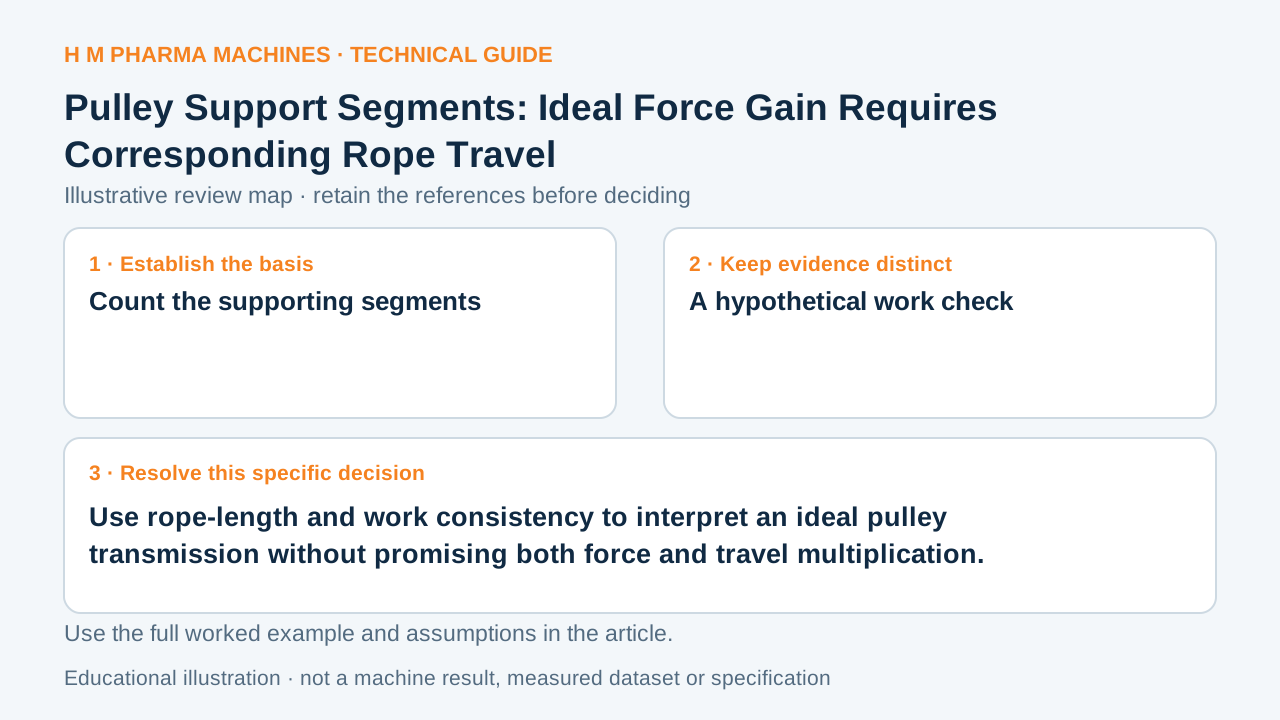
Check both force and rope travel when describing an ideal pulley arrangement.
Count the supporting segments
For the stated ideal pulley arrangement, equal-tension rope segments supporting a load add their forces, while the effort travels a correspondingly longer distance. Primary reference: pulley mechanical advantage.
Count segments that actually support the moving assembly rather than every visible pulley. A fixed pulley may redirect a rope without adding support segments. The geometry, movement directions and neglected losses must remain explicit.
A hypothetical work check
Assume a fictional arrangement has four parallel supporting segments and an ideal 400 N load. Each segment has 100 N tension. Raising the load by 0.2 m shortens the four supporting segments by a combined 0.8 m, so the effort end travels 0.8 m in the stated arrangement.
Output work is 400×0.2 = 80 J and input work is 100×0.8 = 80 J. Claiming both fourfold force gain and unchanged effort travel would contradict this ideal work balance. The example is a geometry exercise, not lifting-system sizing or approval.
Keep the rope-length model
Sketch fixed points, moving pulleys and the path of the continuous rope. Write which segments change length as the output moves. If the geometry includes angled segments, derive the actual displacement relationship rather than assuming a simple integer gain.
An actual mechanism also needs its component, loading and loss assessment. This guide does not select ropes, support ratings or a lifting procedure. Its useful result is a consistent statement of force and travel in the proposed ideal model, without pretending mechanical advantage creates extra work.
Customer Questions
Does every pulley add force gain?
Count the actual supporting rope segments.
Is effort travel unchanged in the example?
It is four times the load travel.
Does equal ideal work prove a real lifting rating?
The actual arrangement requires its own assessment.
Primary References
These references support the technical principles discussed in this guide. The worked examples and review questions are educational.
Discuss Your Machine Requirement
Share your product, container, required output and the evidence needed for your technical review.
Request a Technical Review