
A radiative heat-loss estimate needs absolute temperatures. Raising a Celsius number to the fourth power changes the model incorrectly.
Define the Thermal Model
For a gray surface facing large isothermal surroundings, the simple net-radiation model is P = εσA(T_s⁴ − T_sur⁴), with temperatures in kelvin. OpenStax’s radiation discussion states the fourth-power dependence. Geometry and emissivity remain explicit assumptions rather than being hidden inside a convection coefficient.
Compare a Hypothetical Case
Take a hypothetical area of 1 m², ε = 0.8, T_s = 350 K and T_sur = 300 K. Using σ ≈ 5.67 × 10⁻⁸ W/(m²K⁴) gives approximately 313 W net radiation. Entering the Celsius equivalents directly into the fourth powers would calculate a different quantity, even though the temperature difference remains 50 K.
Complete the Engineering Review
Record the radiating surface condition, emissivity source and surrounding temperatures. State which surfaces the model assumes it sees. Keep convection as a separate heat path when both occur. A surface looking reflective to the eye does not by itself provide a defensible numerical thermal emissivity.
Use a storage-tank enquiry to discuss actual surface and installation details. The example is a heat-loss model, not an infrared thermometer correction or an HM loss rating. Nearby hot surfaces and restricted view geometry may need a more detailed radiation calculation.
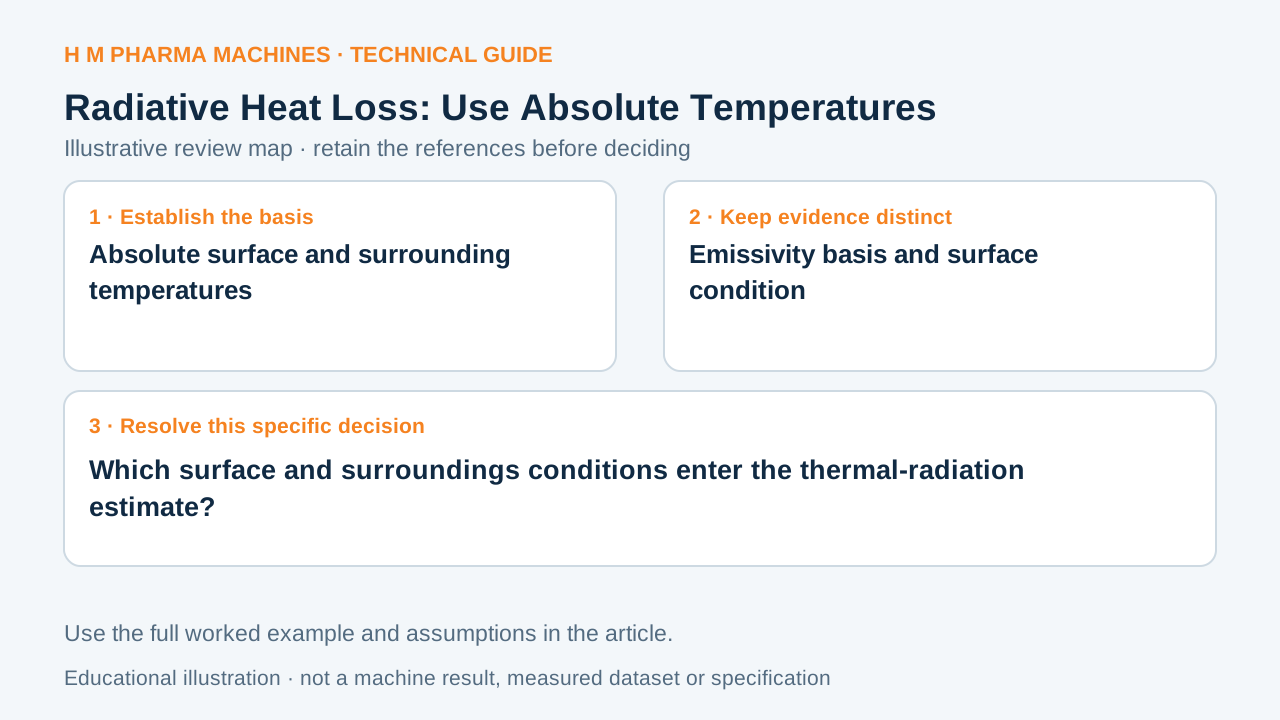
Which surface and surroundings conditions enter the thermal-radiation estimate?
This blank worksheet is for your own project. It contains no H M machine trial result.
| Review field | Reference or result | Responsible person |
|---|---|---|
| Absolute surface and surrounding temperatures | To complete | To complete |
| Emissivity basis and surface condition | To complete | To complete |
| Radiating area and view assumptions | To complete | To complete |
| Separate convection contribution | To complete | To complete |
Customer Questions
Can Celsius differences be used in T⁴?
Convert each absolute temperature to kelvin.
Is radiation identical to convection?
They are separate heat-transfer mechanisms.
Does this fix an infrared reading?
Instrument interpretation needs its own review.
Related Equipment References
Review the actual offered equipment and application separately from this educational example.
Primary References
These references support the technical principles discussed in this guide. The worked examples and review questions are educational.
Discuss Your Machine Requirement
Share your product, container, required output and the evidence needed for your technical review.
Request a Technical Review