
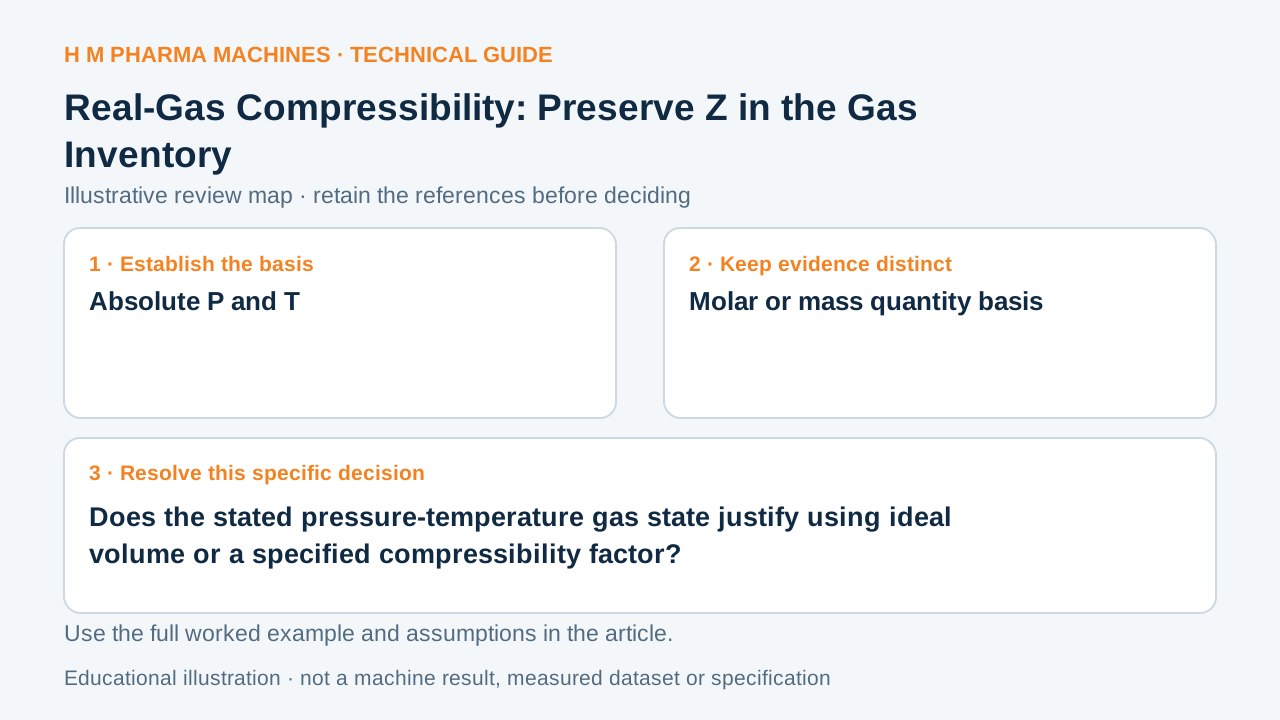
Keep the supplied real-gas factor beside pressure, temperature and quantity basis when estimating gas inventory.
Define the Material or Thermodynamic Model
NASA’s thermodynamic equations retain compressibility factor Z in the density relation. In molar form, the same inventory convention is PV = nZRT. Choosing Z = 1 is an ideal-gas modelling decision, not a correction that can be omitted without checking the state.
Review a Hypothetical Comparison
Assign absolute pressure 200 kPa, volume 0.010 m³, temperature 300 K, molar R = 8.314 J/(mol·K) and Z = 0.92. The ideal calculation gives 0.8019 mol; retaining the assigned Z gives 0.8716 mol. The latter is 8.70% larger. This compares two accounts for the same P, V and T, not two gases supplied at different conditions.
Keep the Evidence with the Decision
Record where Z came from, the gas composition and applicable state range. Keep molar and mass-specific gas constants distinct. A property model supporting another pressure or mixture cannot silently be transferred to the present inventory.
Z = 0.92 is fictional and not a property of a named gas. The calculation is a single-phase educational account; phase changes and changing composition require their appropriate property model.
Does the stated pressure-temperature gas state justify using ideal volume or a specified compressibility factor?
This blank worksheet is for your own project. It contains no H M machine trial result.
| Review field | Reference or result | Responsible person |
|---|---|---|
| Absolute P and T | To complete | To complete |
| Molar or mass quantity basis | To complete | To complete |
| Z source and state range | To complete | To complete |
| Composition and phase-model validity | To complete | To complete |
Customer Questions
What inventory uses the assigned Z?
0.8716 mol.
How large is the ideal result?
0.8019 mol.
Is 0.92 a measured gas property here?
No; it is explicitly assigned.
Primary References
These references support the technical principles discussed in this guide. The worked examples and review questions are educational.
Discuss Your Machine Requirement
Share your product, container, required output and the evidence needed for your technical review.
Request a Technical Review