
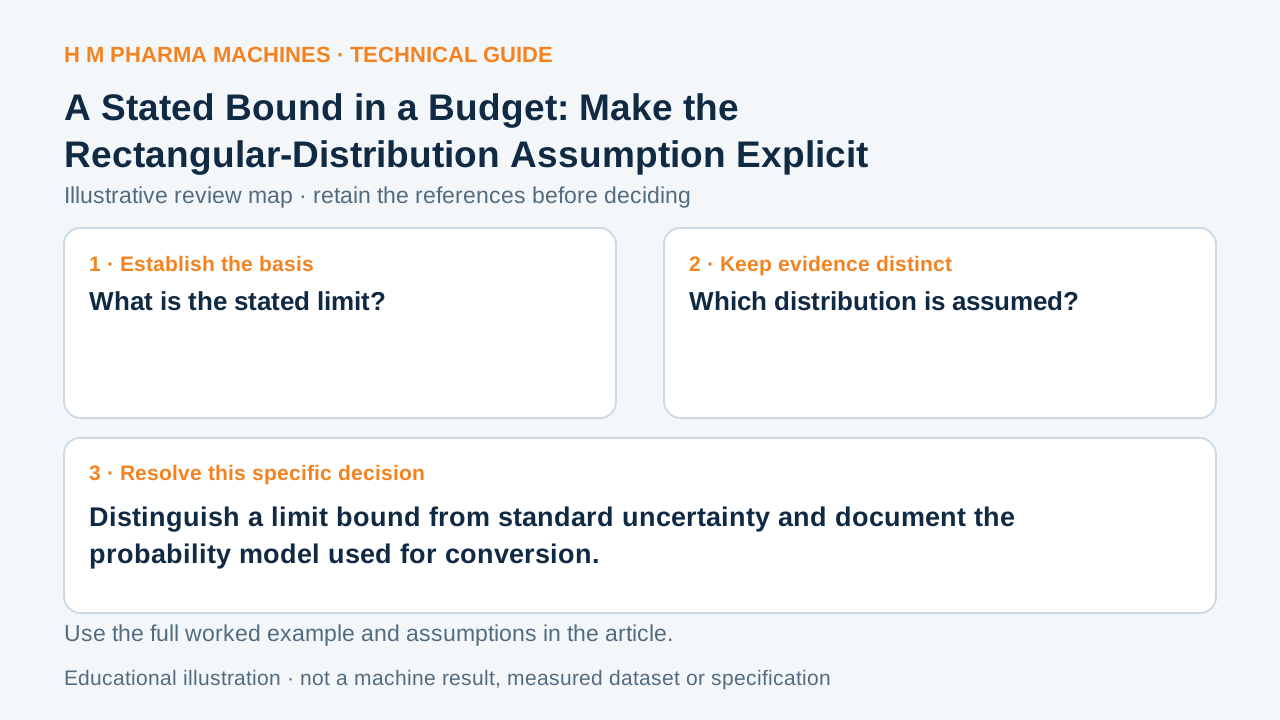
A ± limit is not automatically one standard deviation. State the distribution assumption before converting a bounded contribution.
A bound needs an interpretation
A Type B evaluation can use available information and an assumed probability distribution. For a symmetric rectangular distribution between −a and +a, standard uncertainty is a divided by the square root of three. The conversion depends on that model, not solely on the printed ± symbol.
An invented bounded influence
Assume, only for illustration, an influence uniformly distributed within ±0.30 g. Its standard uncertainty under that model is about 0.1732 g. The full interval width is 0.60 g, but using that width as the standard uncertainty would describe a different quantity.
A certificate stating expanded uncertainty is not a rectangular bound merely because it uses ± notation. Read the statement first. If the available evidence does not justify the assumed distribution, refer the component to the measurement reviewer.
Document the model choice
Retain the limit source, half-width, distribution assumption, divisor and resulting standard value. Explain why the bound applies to the actual measurement conditions. Keep the invented example separate from the real instrument specification and do not assume that all influences are independent.
Primary references: NIST measurement handbook.
Measurement review worksheet
This blank worksheet is for your own project. It contains no H M machine trial result.
| Question | Evidence to retain |
|---|---|
| What is the stated limit? | Source and half-width a |
| Which distribution is assumed? | Evidence for rectangular or other model |
| How was it converted? | Divisor and standard uncertainty |
Customer Questions
Is every ± value a uniform bound?
No. The source statement determines its interpretation.
Is a the full width?
No. In this example a is the half-width.
Does the example supply an HM uncertainty value?
No. It illustrates one explicitly assumed mathematical model.
Primary References
These references support the technical principles discussed in this guide. The worked examples and review questions are educational.
Discuss Your Machine Requirement
Share your product, container, required output and the evidence needed for your technical review.
Request a Technical Review