
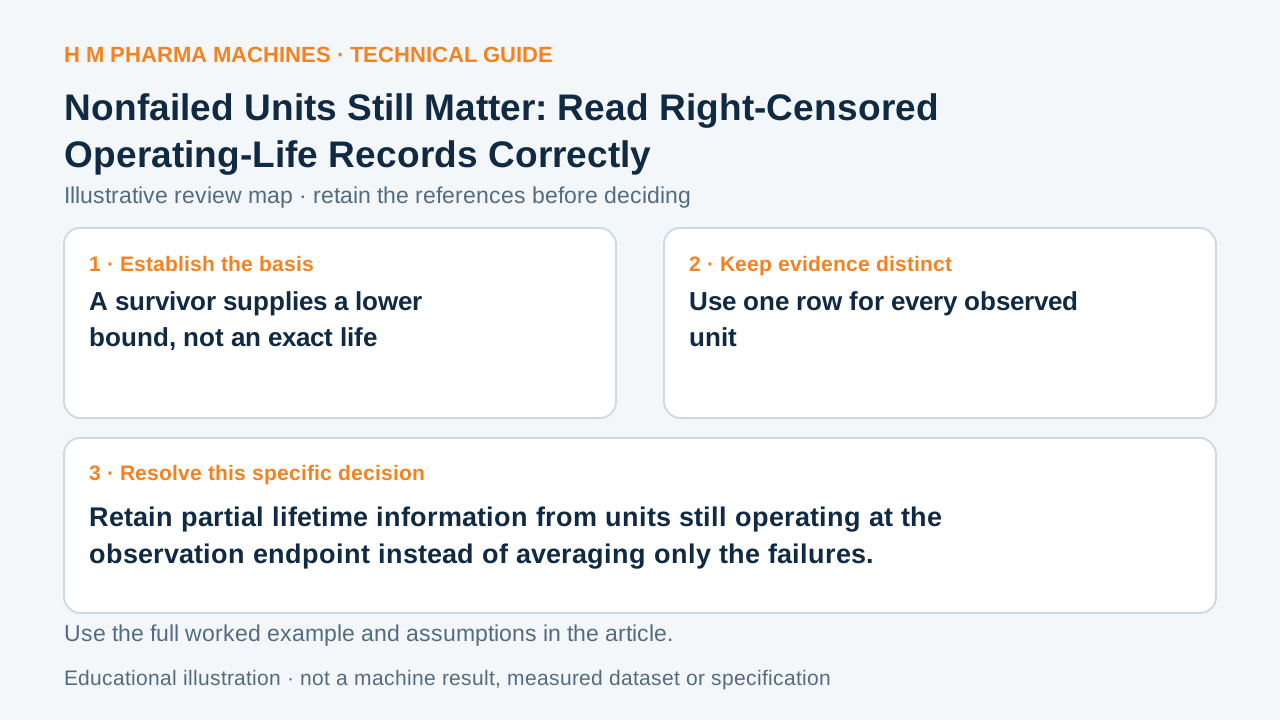
Retain partial lifetime information from units still operating at the observation endpoint instead of averaging only the failures.
A survivor supplies a lower bound, not an exact life
NIST describes right-censoring when an observation ends before a unit's failure time is known. A unit still operating after 100 hours has not demonstrated an exact 100-hour lifetime; it has supplied information that its observed life exceeds that endpoint under the defined test. Deleting such units discards evidence. Assigning them a fabricated failure at the endpoint also changes the evidence. Keep failure status separate from exposure time.
NIST: censoring supports the technical principle above.
Use one row for every observed unit
Record unit identity, start of observation, exposure basis, endpoint, event status and the reason observation ended. Distinguish an actual failure from a planned test stop or removal for another reason. Preserve differing start times and operating exposure where relevant. Calendar age and active operating hours are not automatically interchangeable.
A subsequent reliability model must account for the censoring scheme and its assumptions. The worksheet should make the raw evidence available without prematurely choosing a distribution. If observation ended for reasons related to deteriorating condition, record that fact rather than pretending every censoring event is unrelated to failure behavior.
Hypothetical four-unit worksheet
Imagine a fictional observation with two units failing at 20 and 40 operating hours, and two still operating when the test ends at 100 hours each. Total recorded exposure is 20 + 40 + 100 + 100 = 260 unit-hours. The average of the two failure times is 30 hours, but that average alone ignores the two survivors. Conversely, entering four failures at 20, 40, 100 and 100 hours fabricates events that were not observed. Make four rows with times and event flags: failure, failure, right-censored, right-censored. These teaching records are not HM test results and establish no actual lifetime distribution or guarantee.
Make the report preserve uncertainty honestly
A useful reliability report states the number of units, failure count, observation scheme, exposure basis and analysis method. It should show which observations are censored and explain what the model can support. Follow-up observation may add information, but the original endpoint remains part of the historical record. For a machinery project, ask what evidence underlies a lifetime claim rather than requiring every unit to have failed. This guide teaches how incomplete lifetimes remain useful data; it supplies no component life target, replacement interval or statistical certification of a proposed machine.
Customer Questions
Does a unit surviving 100 hours have a 100-hour failure life?
No. Its failure time remains unknown beyond the observed endpoint.
Can I average only failed units to estimate all unit lives?
That discards survivor information and generally does not answer the complete lifetime question.
What should a raw record contain?
Exposure time, event status, observation endpoint and why the observation ended, for every unit.
Related Equipment References
Review the actual offered equipment and application separately from this educational example.
Primary References
These references support the technical principles discussed in this guide. The worked examples and review questions are educational.
Discuss Your Machine Requirement
Share your product, container, required output and the evidence needed for your technical review.
Request a Technical Review