
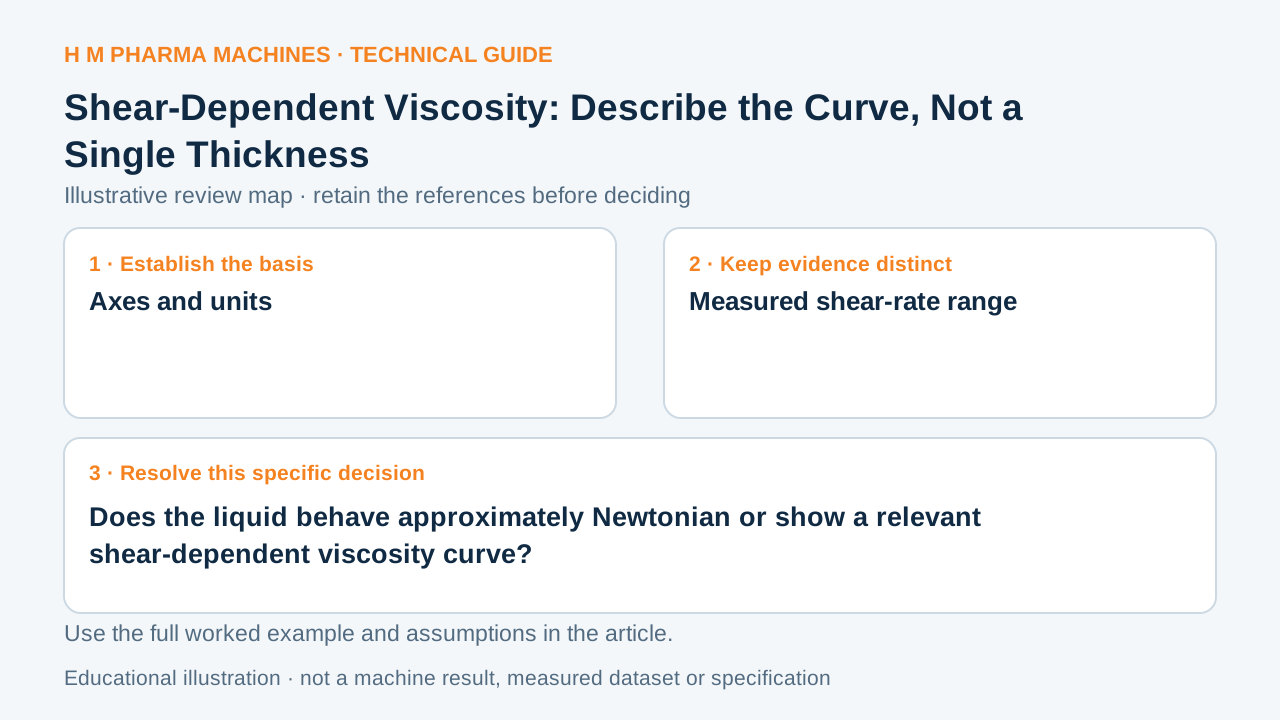
A product described as thick can respond differently under different shear conditions. A curve can explain the response that one value leaves hidden.
Name the Relationship
Anton Paar distinguishes ideally viscous, shear-thinning and shear-thickening flow behaviours. For a Newtonian liquid at fixed conditions, viscosity is independent of shear rate. In shear-thinning behaviour it decreases with increasing shear rate; in shear-thickening behaviour it increases.
A curve should therefore retain the shear-rate axis, viscosity axis and relevant conditions. Descriptions such as thick at rest and thin in motion can motivate a test question, but they should not substitute for a defined measurement. Primary rheology reference.
Illustrative Curve Comparison
Hypothetical liquid A is reported at 0.8 Pa·s over the tested range. Liquid B is 0.8 Pa·s at 1 s⁻¹ and 0.2 Pa·s at 100 s⁻¹. Their equality at the first point does not make their complete measured responses equivalent.
These invented values are not HM formulation or filling results. The second response could matter to a processing discussion, but it cannot directly predict nozzle shear rate, pump output or dose accuracy. The engineer must relate actual conditions to the product and equipment.
Preserve the Curve Range
Ask the formulation owner which rate range is measured and where an extrapolation begins. Keep temperature, method and sample condition linked to the curve, while focusing the review on its shape. Do not label an unmeasured high-rate region as confirmed merely because the low-rate points look smooth.
Complete the worksheet with the response classification, measured range and intended process question. This adds a bounded material description to a filler enquiry. It complements a viscosity-method record without turning a laboratory curve into machinery compatibility approval. HM application context: Servo Piston Liquid Filling Machine.
Shear-Dependent Viscosity: Describe the Curve, Not a Single Thickness — blank interpretation record
This blank worksheet is for your own project. It contains no H M machine trial result.
| Comparison | Evidence/reference | Reviewer |
|---|---|---|
| Axes and units | To complete | To complete |
| Measured shear-rate range | To complete | To complete |
| Curve classification and conditions | To complete | To complete |
| Process relevance/extrapolation boundary | To complete | To complete |
Customer Questions
Can equal single-point values hide different responses?
Yes. Their curves can differ elsewhere in the measured range.
Does shear thinning establish filler output?
No. Actual equipment and product-path performance need their own assessment.
Can a curve be extrapolated indefinitely?
Keep extrapolation explicit and obtain the responsible reviewer’s basis.
Related Equipment References
Review the actual offered equipment and application separately from this educational example.
Primary References
These references support the technical principles discussed in this guide. The worked examples and review questions are educational.
Discuss Your Machine Requirement
Share your product, container, required output and the evidence needed for your technical review.
Request a Technical Review