
Look for particle motion relative to the mixture across a shear gradient, rather than assigning every suspension redistribution to gravitational settling.
Identify the Deformation and Model
The primary paper studies nearly unconfined, neutrally buoyant pressure-driven Stokes suspensions. In that setting, migration from high-shear wall regions toward lower-shear central regions is modeled through particle interactions and phase stresses. This mechanism is separate from a density-difference settling force. Primary reference: shear-driven particle transport.
Review a Hypothetical Comparison
For a hypothetical local flux record, define positive transverse direction from the center toward the wall. Assign particle volume fraction 0.20 and particle velocity relative to the mixture −2 micrometres/s. Relative solid-volume flux is fraction times relative velocity, −0.4 micrometres/s, or −4 × 10⁻⁷ m/s. Its negative sign identifies motion toward the center on this declared axis; it does not supply an independently predicted migration speed.
Keep the Evidence with the Decision
Place this flux beside the measured or modeled shear-gradient direction and the phase-velocity definitions. Check density matching, particle interactions, confinement and whether Brownian transport competes. Compare flowing and resting observations without assuming that stopping flow merely preserves the same driving mechanism. Retain the stress closure when a model, rather than measured phase motion, supplies the flux.
A concentration photograph alone cannot establish that relative flux or its driving cause. The paper reports limitations of simplified flux models in other geometries, so centerward transport is not a universal rule. The invented values specify no HM material or performance. The worksheet identifies what shear, phase-motion and model evidence would support a migration interpretation beyond an ordinary settling account.
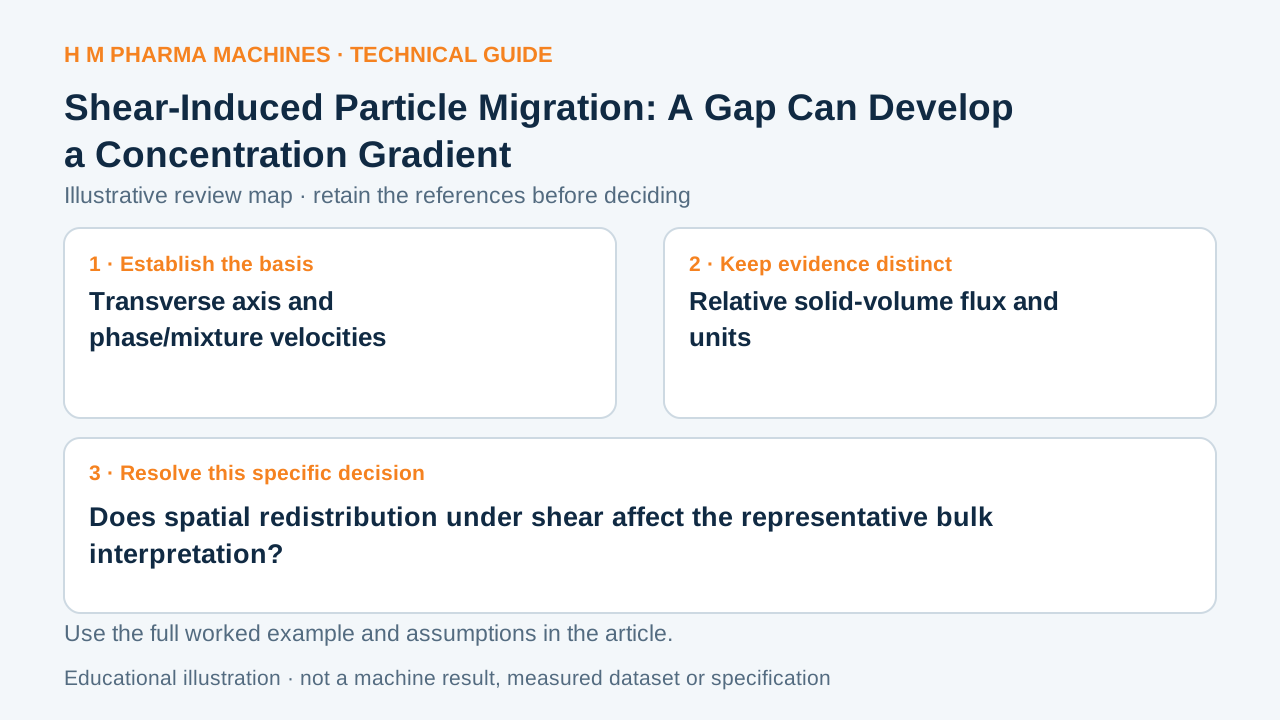
Does spatial redistribution under shear affect the representative bulk interpretation?
This blank worksheet is for your own project. It contains no H M machine trial result.
| Review field | Reference or result | Responsible person |
|---|---|---|
| Transverse axis and phase/mixture velocities | To complete | To complete |
| Relative solid-volume flux and units | To complete | To complete |
| Shear-gradient and particle/stress model | To complete | To complete |
| Density matching, Brownian transport and confinement | To complete | To complete |
Customer Questions
What relative flux follows from the assigned fields?
−0.4 micrometres/s on the declared solid-volume-flux basis.
Does a concentration image measure that flux?
No. Phase-motion evidence or an applicable model is required.
Must all suspension geometries show centerward migration?
No. The stated flow and closure assumptions matter.
Primary References
These references support the technical principles discussed in this guide. The worked examples and review questions are educational.
Discuss Your Machine Requirement
Share your product, container, required output and the evidence needed for your technical review.
Request a Technical Review