
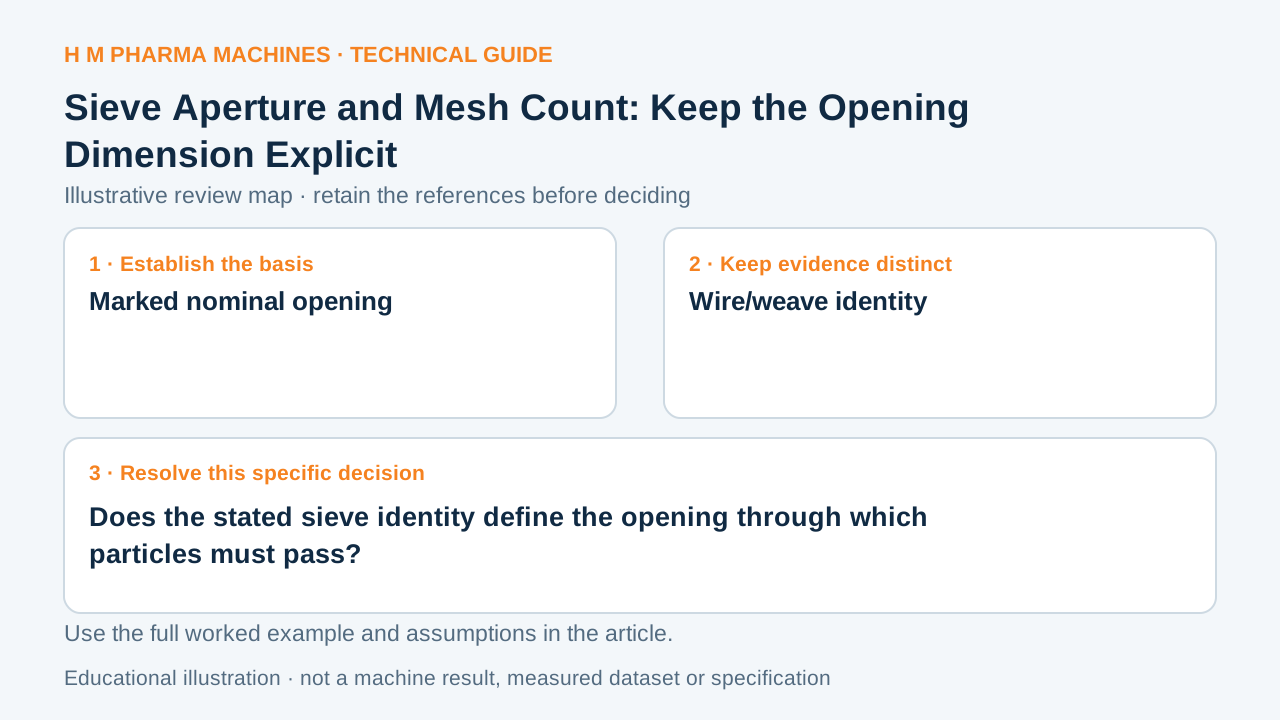
Specify the sieve opening dimension and construction record; a mesh-count label alone does not supply every geometric quantity.
Identify the Material Response
RETSCH distinguishes the nominal opening width from the woven-wire diameter in its test-sieve information. Retain the marked opening and applicable sieve identity instead of treating an informal mesh number as a complete dimensional specification. Primary reference: test-sieve opening and wire geometry.
Review a Hypothetical Comparison
For an invented ideal square weave with 50 equal pitches per inch, pitch is 25.4/50=0.508 mm. A 0.200 mm wire leaves a 0.308 mm opening; a 0.250 mm wire leaves 0.258 mm. The same ideal count gives different openings when the wire changes. These are geometric teaching values, not a standard sieve conversion table.
Keep the Evidence with the Decision
Record whether the supplier states aperture, nominal mesh count or another designation. Keep the weave and dimensional references with the actual sieve record. Do not infer an allowable manufacturing tolerance from the simple pitch calculation, or substitute a generic conversion chart for the identified sieve specification.
Use the marked opening and accepted dimensional evidence when comparing retained fractions. A nominal opening also does not turn every elongated particle into a sphere or prove that orientation has no effect on passage. This article clarifies the opening identity; it does not define a new particle-size test or machinery outlet dimension.
Does the stated sieve identity define the opening through which particles must pass?
This blank worksheet is for your own project. It contains no H M machine trial result.
| Review field | Reference or result | Responsible person |
|---|---|---|
| Marked nominal opening | To complete | To complete |
| Wire/weave identity | To complete | To complete |
| Sieve reference and dimensional evidence | To complete | To complete |
| Reporting units and designation | To complete | To complete |
Customer Questions
Does count alone fix opening width in the ideal example?
No. Wire diameter changes the remaining opening.
Is 0.308 mm an approved 50 mesh conversion?
No. It follows only from the invented geometry.
Does aperture describe every particle dimension?
No. Particle shape and orientation remain separate questions.
Primary References
These references support the technical principles discussed in this guide. The worked examples and review questions are educational.
Discuss Your Machine Requirement
Share your product, container, required output and the evidence needed for your technical review.
Request a Technical Review