
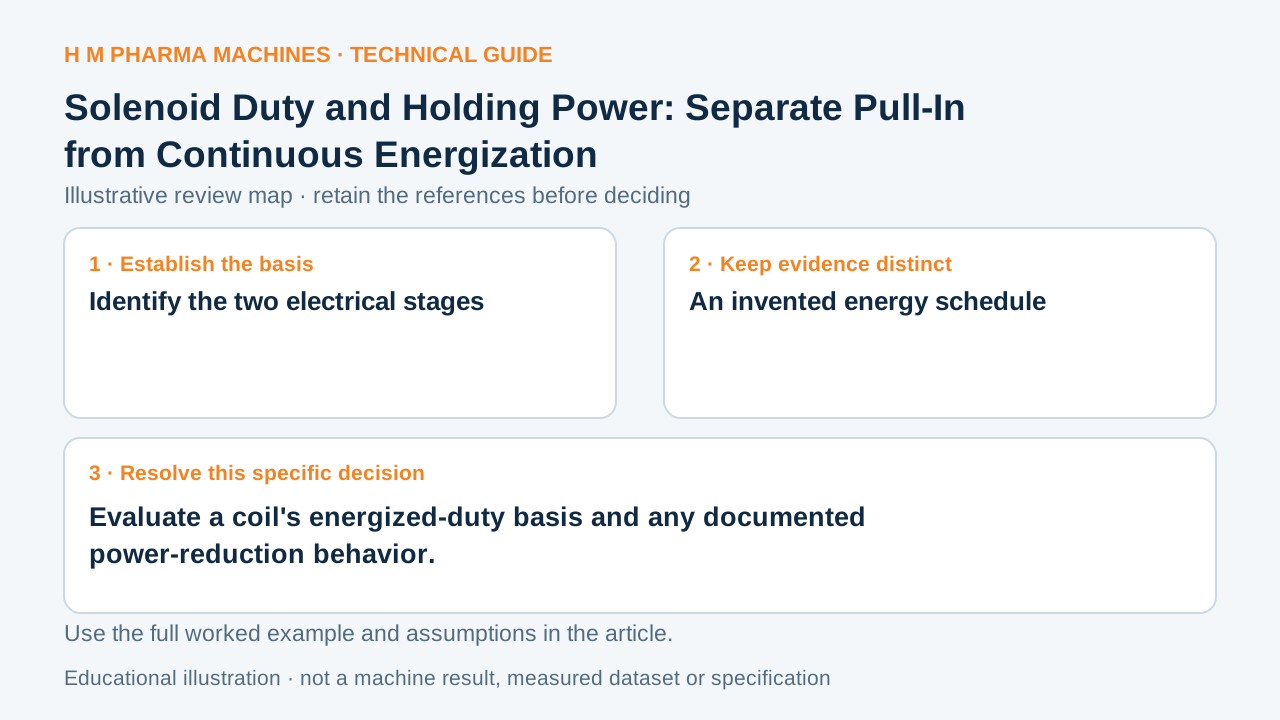
A coil can have different power conditions during activation and a sustained hold.
Identify the two electrical stages
Bürkert's Kick-and-Drop explanation distinguishes activation power from a reduced holding condition in its identified technology. Preserve the actual coil variant and stage definitions. Primary reference: Bürkert activation/holding architecture.
A demand record should say whether it represents pull-in, holding or another stated condition. It should also retain the coil's permitted energized-duty basis. A low holding figure cannot silently describe the supply requirement at activation or certify an unidentified coil for continuous use.
An invented energy schedule
Assume fictional documentation specifies 10 W for 0.2 seconds followed by 2 W for 9.8 seconds in a 10-second energized interval. The simplified stage energy is 10×0.2 +2×9.8 =21.6 J. Treating all 10 seconds as 2 W would give 20 J; treating it all as 10 W would give 100 J. These teaching inputs are not Bürkert data or HM measurements.
Record stage power, duration, duty eligibility and any separate repeat-rate conditions. The average for this defined example is 2.16 W, but an average does not remove the activation requirement. It supplies no actual temperature-rise prediction.
Request applicable coil evidence
Ask which voltage, frequency and ambient conditions the actual coil statement covers, and how any power-reduction option is identified. Keep the valve and coil identities linked so the quoted behavior belongs to the offered combination.
A replacement with the same connector can leave stage demand or duty conditions different. Compare those records before accepting equivalence. This guide provides a conditional schedule rather than a circuit design, universal switching delay or verified energy-saving percentage for the machinery. Manufacturer limits and the actual operating cycle remain necessary comparison inputs.
Customer Questions
Does holding power describe every activation demand?
No. Preserve the pull-in stage separately.
Does low power prove continuous-duty eligibility?
No. Read the actual coil's duty conditions.
Does the 2.16 W average remove the peak requirement?
No. It describes only the defined energy interval.
Primary References
These references support the technical principles discussed in this guide. The worked examples and review questions are educational.
Discuss Your Machine Requirement
Share your product, container, required output and the evidence needed for your technical review.
Request a Technical Review