
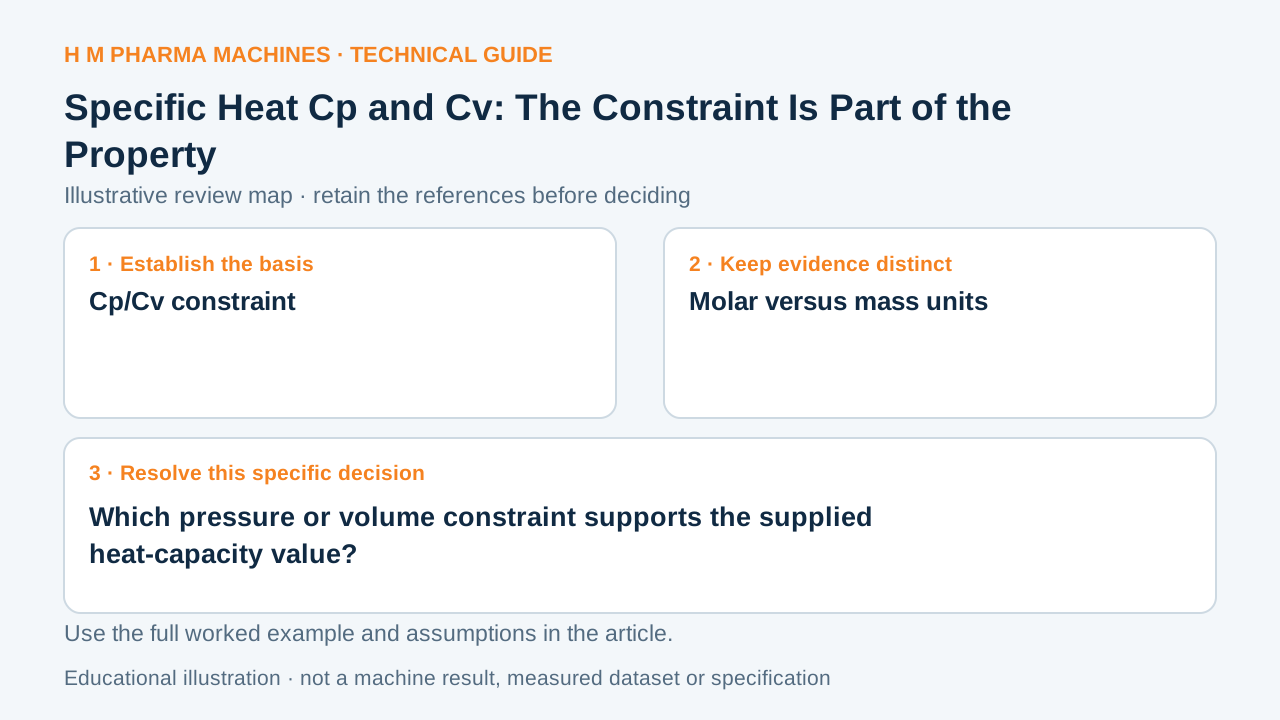
Keep constant-pressure and constant-volume constraints with a heat-capacity value before calculating heat for a gas.
Define the Material or Thermodynamic Model
NASA’s heat-capacity derivation distinguishes Cp and Cv and obtains Cp − Cv = R for the stated ideal-gas model. Equal temperature rises can require different heat inputs because the pressure-constrained path includes expansion work.
Review a Hypothetical Comparison
Assign molar Cv = 20.786 J/(mol·K), R = 8.314 and therefore Cp = 29.100. Heating 2 mol through 10 K at fixed volume requires 415.72 J in the simple model. At fixed pressure it requires 582.00 J. The 166.28 J difference matches nRΔT expansion work; it is not an unexplained loss.
Keep the Evidence with the Decision
State whether heat capacity is molar or mass-specific, its temperature range and the constraint under which heat is being related to temperature. Keep the work boundary explicit rather than using a Cp value in every energy term.
These are assigned constants and ideal closed-system paths with only pressure-volume work. Actual temperature-dependent properties require integration; the arithmetic does not identify a real gas or an equipment heater size.
Which pressure or volume constraint supports the supplied heat-capacity value?
This blank worksheet is for your own project. It contains no H M machine trial result.
| Review field | Reference or result | Responsible person |
|---|---|---|
| Cp/Cv constraint | To complete | To complete |
| Molar versus mass units | To complete | To complete |
| Property range or integration | To complete | To complete |
| Pressure-volume work boundary | To complete | To complete |
Customer Questions
What fixed-volume heat is assigned?
415.72 J.
What fixed-pressure heat follows?
582.00 J.
Where does the difference go in this model?
Into the assigned 166.28 J expansion-work term.
Primary References
These references support the technical principles discussed in this guide. The worked examples and review questions are educational.
Discuss Your Machine Requirement
Share your product, container, required output and the evidence needed for your technical review.
Request a Technical Review